



 Chat with AI
Exam 6: Government Actions in Markets

Exam 1: What Is Economics483 Questions
Exam 2: The Economic Problem440 Questions
Exam 3: Demand and Supply515 Questions
Exam 4: Elasticity530 Questions
Exam 5: Efficiency and Equity450 Questions
Exam 6: Government Actions in Markets412 Questions
Exam 7: Global Markets in Action205 Questions
Exam 8: Utility and Demand366 Questions
Exam 10: Organizing Production385 Questions
Exam 11: Output and Costs493 Questions
Exam 12: Perfect Competition487 Questions
Exam 13: Monopoly599 Questions
Exam 14: Monopolistic Competition318 Questions
Exam 15: Oligopoly276 Questions
Exam 16: Public Choices, Public Goods, and Healthcare205 Questions
Exam 17: Externalities437 Questions
Exam 18: Markets for Factors of Production382 Questions
Exam 19: Economic Inequality351 Questions
Exam 20: Uncertainty and Information233 Questions
Select questions type


Two small California cities, Richmond and El Monte, are planning to impose a penny per ounce tax on sugary drinks. They are being opposed by the soda industry that is vehemently against this new legislation. (Source: Reuters, September 6, 2012)
-Assuming the market of soda has a regular downward sloping demand curve and upward sloping supply curve, the tax will ________ the price paid by buyers and ________ the price received by sellers.
(Multiple Choice)
4.9/5  (70)
(70) 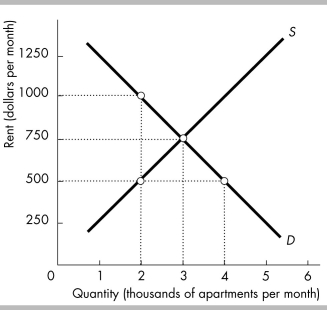 -The above figure shows the apartment rental market in Bigtown. If the Bigtown Housing Authority imposes a rent ceiling of $500 per month, the rent ceiling will help
 (Multiple Choice)
4.9/5 (76)
(76) Making the buying and selling of a good illegal shifts the demand curve ________ and shifts the supply curve ________.
(Multiple Choice)
4.8/5 (60)
(60) Which of the following leads to the suppliers paying all of a tax?
(Multiple Choice)
4.8/5 (92)
(92) 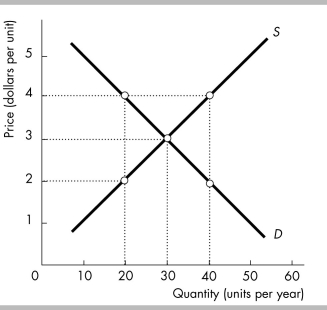 -In the above figure, a price ceiling of $4 would
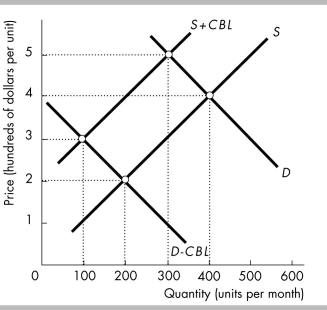 -In the above figure, CBL is the cost of breaking the law. If it is illegal to sell, but not illegal to buy, then the price per unit will be
 (Multiple Choice)
4.7/5 (76)
(76) 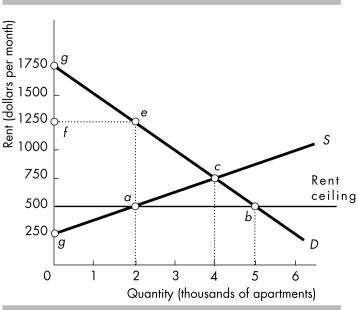 -The above figure shows the demand and supply curves for housing. What would be the effects of a rent ceiling equal to $500 per month?
 (Multiple Choice)
4.8/5 (75)
(75) 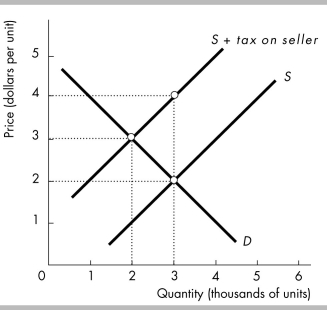 -In the above figure, the amount of the tax per unit imposed on the sellers is
 (Multiple Choice)
4.7/5 (74)
(74) 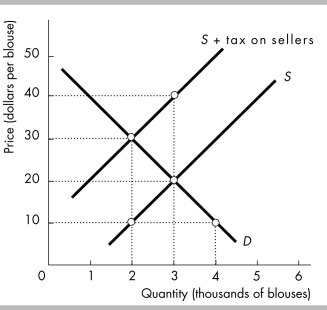 -The above figure shows the market for blouses. The government decides to impose the sales tax on sellers, as shown in the figure. What is the deadweight loss?
 (Multiple Choice)
5.0/5 (84)
(84) In some recent past years, prices of basic food commodities such as corn, rice, and wheat have increased sharply. Chinese authorities were concerned that escalating prices would cause inflation and be followed by civil unrest.
-If the Chinese government sets a price ceiling below the equilibrium price, the result will be I. an increase in the quantity demanded.
II) a decrease in the quantity supplied.
III) a shortage.
(Multiple Choice)
5.0/5 (83)
(83) 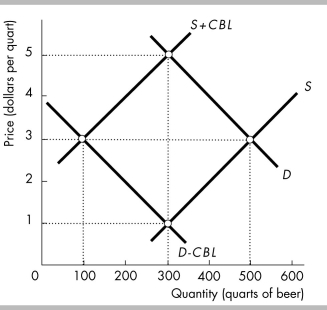 -Using the above figure, CBL is the cost of breaking the law. What is the equilibrium price and quantity if beer is legal?
 (Multiple Choice)
4.7/5 (80)
(80) An upper limit to the quantity of a good that may be produced in a specific period is called
(Multiple Choice)
4.8/5 (70)
(70) The sellers pay the entire sales tax levied on a good when demand is perfectly ________ or supply is perfectly ________.
(Multiple Choice)
5.0/5 (77)
(77) 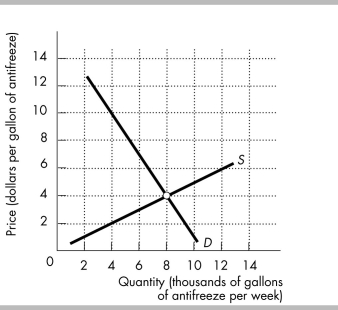 -The figure above illustrates the market for antifreeze. Suppose the government decides to implement an $8 sales tax on the sellers for every gallon of antifreeze sold.
a) In the figure, illustrate the effect the tax has on the market for antifreeze.
b) What is the equilibrium price of a gallon of antifreeze before the tax? What is the price paid by buyers after the tax?
c) What is the equilibrium quantity of antifreeze before the tax? What is the equilibrium quantity after the tax?
d) What is the revenue collected by the government from this tax?
e) Do buyers or sellers bear the largest incidence of the tax?
f) Illustrate the deadweight loss created by the tax.
-The figure above illustrates the market for antifreeze. Suppose the government decides to implement an $8 sales tax on the sellers for every gallon of antifreeze sold.
a) In the figure, illustrate the effect the tax has on the market for antifreeze.
b) What is the equilibrium price of a gallon of antifreeze before the tax? What is the price paid by buyers after the tax?
c) What is the equilibrium quantity of antifreeze before the tax? What is the equilibrium quantity after the tax?
d) What is the revenue collected by the government from this tax?
e) Do buyers or sellers bear the largest incidence of the tax?
f) Illustrate the deadweight loss created by the tax. (Essay)
4.9/5 (58)
(58) The government of Healthyland imposes a tax on sellers of salt. The tax is $0.10 per pound. With no tax, the price of salt is $0.40 per pound. The demand for salt is perfectly inelastic and the elasticity of supply is 1.5. How is the salt tax burden shared between buyers and sellers in Healthyland?
(Multiple Choice)
4.8/5 (88)
(88) 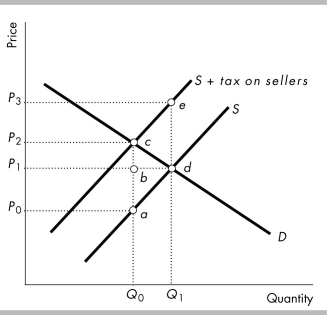 -To help pay for the cost of sport related injuries, the government imposes a tax on sellers of all sports equipment. Referring to the above figure, how much tax per unit has the government imposed?
 (Multiple Choice)
4.8/5 (69)
(69) 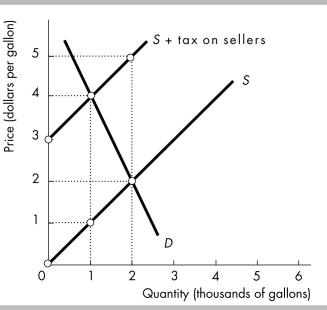 -The above figure shows the market for anti-freeze. The government imposes the sales tax shown in the figure on sellers. What is the deadweight loss from this tax?
 (Multiple Choice)
4.9/5 (83)
(83) 
Filters
- Essay(0)
- Multiple Choice(0)
- Short Answer(0)
- True False(0)
- Matching(0)