



 Chat with AI
Exam 11: Expenditure Multipliers

Exam 1: What Is Economics483 Questions
Exam 2: The Economic Problem443 Questions
Exam 3: Demand and Supply515 Questions
Exam 4: Measuring Gdp and Economic Growth395 Questions
Exam 5: Monitoring Jobs and Inflation409 Questions
Exam 6: Economic Growth352 Questions
Exam 7: Finance, Saving, and Investment227 Questions
Exam 8: Money, the Price Level, and Inflation578 Questions
Exam 9: The Exchange Rate and the Balance of Payments489 Questions
Exam 10: Aggregate Supply and Aggregate Demand426 Questions
Exam 11: Expenditure Multipliers469 Questions
Exam 12: The Business Cycle, Inflation, and Deflation409 Questions
Exam 13: Fiscal Policy263 Questions
Exam 14: Monetary Policy229 Questions
Exam 15: International Trade Policy208 Questions
Select questions type


If there are no income taxes or imports, the multiplier equals 1/(1 - marginal propensity to consume).
(True/False)
4.8/5  (79)
(79) 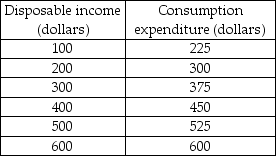 -Using the data in above table, the marginal propensity to consume is
 (Multiple Choice)
4.9/5 (82)
(82) "Few if any economists anticipated the extent of the inventory adjustment... Production cutbacks have been much greater than expected. Those cuts have weakened the industrial sector considerably." As a result of these changes, the U.S. government lowered its estimate of fourth-quarter growth in real GDP. www.businessweek.com 3/12/2007
The article suggests that
(Multiple Choice)
4.8/5 (71)
(71) Discuss how the marginal propensity to consume, imports, and income tax rates influence the multiplier.
(Essay)
4.8/5 (74)
(74) 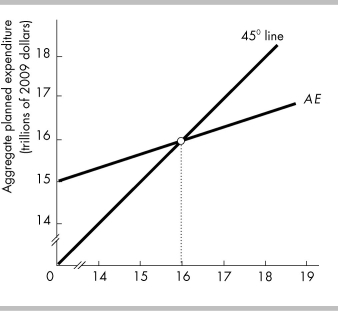 -If aggregate planned expenditure is less than real GDP, then in the short run
 (Multiple Choice)
4.9/5 (73)
(73) 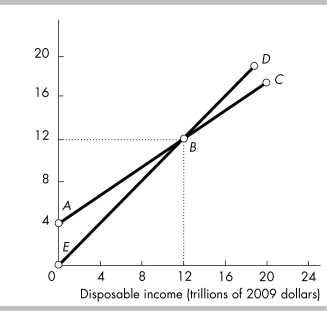 -In the above figure, when disposable income is $12 trillion , induced consumption equals
 (Multiple Choice)
4.8/5 (83)
(83) In the aggregate expenditure model, when real GDP is greater than aggregate planned expenditure
(Multiple Choice)
4.8/5 (92)
(92) 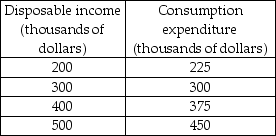 -According to the data in the above table, what is the marginal propensity to save?
 (Multiple Choice)
4.8/5 (90)
(90) Suppose disposable income increases from $5 trillion to $6 trillion. As a result, consumption expenditure increases from $4 trillion to ________. This result means the MPC equals ________.
(Multiple Choice)
4.8/5 (83)
(83) When autonomous expenditure increases, equilibrium aggregate expenditure
(Multiple Choice)
4.9/5 (78)
(78) The components of aggregate expenditure include
I. imports.
II. consumption.
III. government transfer payments.
(Multiple Choice)
4.8/5 (66)
(66)
-According to the data in the above table, what is the marginal propensity to consume?
-According to the data in the above table, what is the marginal propensity to consume? (Multiple Choice)
4.9/5 (79)
(79) An increase in ________ shifts the AE curve ________ and an increase in ________ shifts the aggregate demand curve ________.
(Multiple Choice)
4.9/5 (84)
(84) 
Filters
- Essay(0)
- Multiple Choice(0)
- Short Answer(0)
- True False(0)
- Matching(0)