



 Chat with AI
Exam 11: Expenditure Multipliers

Exam 1: What Is Economics483 Questions
Exam 2: The Economic Problem443 Questions
Exam 3: Demand and Supply515 Questions
Exam 4: Measuring Gdp and Economic Growth395 Questions
Exam 5: Monitoring Jobs and Inflation409 Questions
Exam 6: Economic Growth352 Questions
Exam 7: Finance, Saving, and Investment227 Questions
Exam 8: Money, the Price Level, and Inflation578 Questions
Exam 9: The Exchange Rate and the Balance of Payments489 Questions
Exam 10: Aggregate Supply and Aggregate Demand426 Questions
Exam 11: Expenditure Multipliers469 Questions
Exam 12: The Business Cycle, Inflation, and Deflation409 Questions
Exam 13: Fiscal Policy263 Questions
Exam 14: Monetary Policy229 Questions
Exam 15: International Trade Policy208 Questions
Select questions type


Suppose the economy has no income taxes or imports. How is the size of the expenditure multiplier related to the marginal propensity to consume? What is the multiplier if the MPC equals 0.25? If the MPC equals 0.50? If the MPC equals 0.90?
(Essay)
4.7/5  (80)
(80) The sum of the components of aggregate expenditure that vary with real GDP equal
(Multiple Choice)
4.8/5 (90)
(90) Between 2012 and 2013 the government reports that investment decreased by $400 billion. The government also estimates that the marginal propensity to save is 0.20. If the entire decrease in investment is autonomous, then real GDP
(Multiple Choice)
4.7/5 (74)
(74) 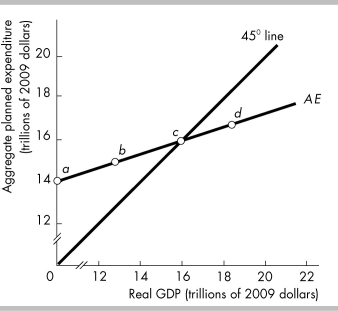 -In the above figure, equilibrium real GDP is equal to
Read the two statements below and indicate if they are true or false.
I. Autonomous expenditures change when GDP changes.
II. Aggregate planned expenditure is the sum of planned consumption expenditure, investment,
Government expenditure, and net exports.
(Multiple Choice)
4.9/5 (76)
(76) The positive relationship between consumption expenditure and disposable income is shown by a movement along the consumption function.
(True/False)
4.9/5 (80)
(80) 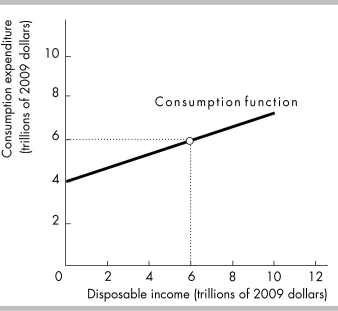 -The figure above illustrates an economy's consumption function. What is the marginal propensity to save in this economy?
 (Multiple Choice)
4.8/5 (86)
(86) 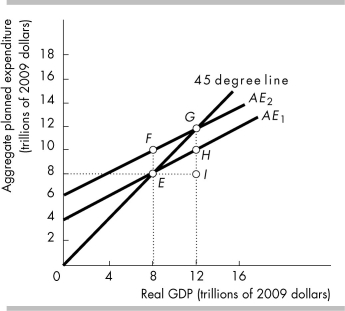 -In the above figure, the increase in autonomous expenditure moves the economy from point E to
 (Multiple Choice)
4.8/5 (82)
(82) 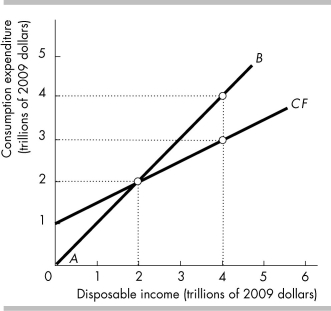 -In the above figure, consumption and disposable income are equal at
 (Multiple Choice)
4.9/5 (72)
(72) 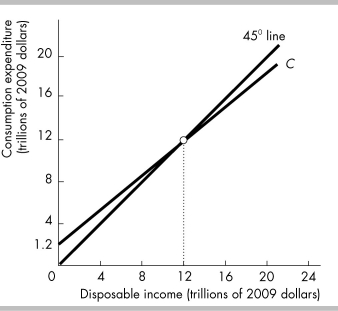 -In the above figure, a change in autonomous consumption to $4 trillion with no change to the MPC would cause the consumption function to
 (Multiple Choice)
4.8/5 (72)
(72) With consumption expenditure on the vertical axis and disposable income on the horizontal axis, the consumption function intersects the 45-degree line at $8 trillion. This result indicates that
(Multiple Choice)
4.9/5 (82)
(82) Components of aggregate expenditure include saving, consumption expenditure, investment and government expenditure.
(True/False)
4.9/5 (75)
(75) In the short run with fixed prices, an increase in investment of $100 billion
(Multiple Choice)
4.9/5 (77)
(77) What is the relationship between the slope of the aggregate expenditure curve and the multiplier?
(Essay)
4.9/5 (81)
(81) The multiplier is greater than 1 because the change in autonomous expenditure leads to
(Multiple Choice)
4.8/5 (88)
(88) What is the difference between induced and autonomous expenditure? Which components of aggregate expenditure fall under which category?
(Essay)
4.9/5 (65)
(65) 
Filters
- Essay(0)
- Multiple Choice(0)
- Short Answer(0)
- True False(0)
- Matching(0)