



 Chat with AI
Exam 15: International Trade Policy

Exam 1: What Is Economics483 Questions
Exam 2: The Economic Problem443 Questions
Exam 3: Demand and Supply515 Questions
Exam 4: Measuring Gdp and Economic Growth395 Questions
Exam 5: Monitoring Jobs and Inflation409 Questions
Exam 6: Economic Growth352 Questions
Exam 7: Finance, Saving, and Investment227 Questions
Exam 8: Money, the Price Level, and Inflation578 Questions
Exam 9: The Exchange Rate and the Balance of Payments489 Questions
Exam 10: Aggregate Supply and Aggregate Demand426 Questions
Exam 11: Expenditure Multipliers469 Questions
Exam 12: The Business Cycle, Inflation, and Deflation409 Questions
Exam 13: Fiscal Policy263 Questions
Exam 14: Monetary Policy229 Questions
Exam 15: International Trade Policy208 Questions
Select questions type


The U.S.-Colombia Trade Promotion Agreement was signed on November 22, 2006, in Washington, D.C. This comprehensive trade agreement eliminated tariffs and other barriers to goods and services. Currently, no U.S. agricultural exports enjoy tariff-free access to the Colombian market. If the United States has a comparative advantage in agricultural, which of the following is TRUE?

Free
(Multiple Choice)
4.8/5  (73)
(73) Correct Answer: Verified
A
Explain the effects of a quota.
Free
(Essay)
4.8/5 (77)
(77) Correct Answer:Verified
VerifiedA quota is a quantitative restriction on the maximum amount of a good that can be imported. Because quotas limit the supply of the good, they raise the prices of imported goods and decrease the quantities imported. Unlike a tariff, however, the government gets no revenue from a quota; the revenue from the higher price goes to importers.
In 2006, the European Union (EU) threatened to ban imports of long-grain rice because traces of genetically modified rice were found mixed in to commercial supplies. Instead of a ban, suppose the EU placed a tariff on the import of long-grain rice. Which of the following would be an outcome of this tariff?
(Multiple Choice)
4.7/5 (70)
(70) In 2013 the U.S. government removed its tariff on imported ethanol. Removing the tariff benefited ________ of ethanol, each of whom gained a ________.
(Multiple Choice)
4.9/5 (91)
(91) In developing countries, there is more reliance on ________ as opposed to ________ for government revenue.
(Multiple Choice)
4.9/5 (83)
(83) Which of the following statements concerning tariffs is NOT true?
(Multiple Choice)
4.8/5 (78)
(78) Japan was accused of dumping in the steel industry within the United States when it
(Multiple Choice)
4.8/5 (80)
(80) 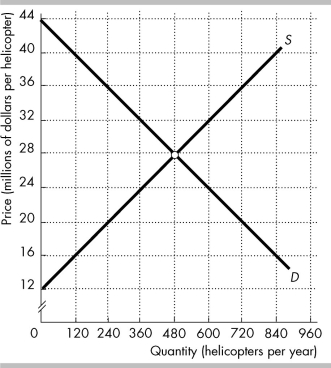 The figure shows the market for helicopters in the United States, where D is the domestic demand curve and S is the domestic supply curve. The United States trades helicopters with the rest of the world at a price of $36 million per helicopter.
-In the figure above, with international trade ________ helicopters per year are produced in the United States.
The figure shows the market for helicopters in the United States, where D is the domestic demand curve and S is the domestic supply curve. The United States trades helicopters with the rest of the world at a price of $36 million per helicopter.
-In the figure above, with international trade ________ helicopters per year are produced in the United States. (Multiple Choice)
4.9/5 (78)
(78) Suppose that elimination of tariffs on agricultural products means that 1,000 farm workers lose jobs that pay an average of $20,000 per year. At the same time, because of the importation of relatively cheaper foreign vegetables, 150 million consumers save $2 per year on their grocery bills.
a) What is the total income lost by farm workers because of the free trade?
b) What is the total dollar amount saved by all consumers combined?
c) Which is greater, the lost income or the consumer savings? Do the benefits of free trade out-weigh the costs in this simple example?
d) Which group is most likely to become politically involved over the issue of removing the tariffs, the farm workers or the consumers? Why?
(Essay)
4.7/5 (81)
(81) Between August 2007 and July 2008, Brazil exported more than 3.5 billion pounds of coffee to the rest of the world. Because of this, we know definitively that
(Multiple Choice)
4.8/5 (74)
(74) Suppose the country of Atlantica imposes a tariff on foreign-produced cars. As a result of the tariff
(Multiple Choice)
4.8/5 (67)
(67) 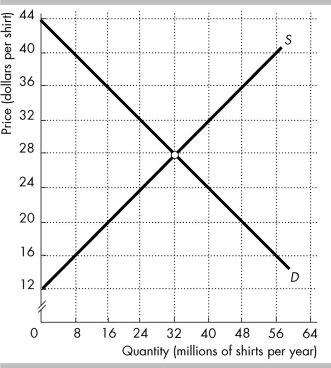 The figure shows the market for shirts in the United States, where D is the domestic demand curve and S is the domestic supply curve. The world price is $20 per shirt. The United States imposes a tariff on imported shirts of $4 per shirt.
-In the figure above, the U.S. government's revenue from the tariff is
The figure shows the market for shirts in the United States, where D is the domestic demand curve and S is the domestic supply curve. The world price is $20 per shirt. The United States imposes a tariff on imported shirts of $4 per shirt.
-In the figure above, the U.S. government's revenue from the tariff is (Multiple Choice)
4.8/5 (98)
(98) In 2006, the European Union (EU) threatened to ban imports of long-grain rice because traces of genetically modified rice were found mixed in to commercial supplies. Instead of a complete ban, suppose the EU placed a tariff on the import of long-grain rice. Which of the following would be an outcome of this tariff?
(Multiple Choice)
4.9/5 (81)
(81) Which of the following best describes the history of tariffs in the United States over the past 70 years?
(Multiple Choice)
5.0/5 (89)
(89) The figure shows the market for shirts in the United States, where D is the domestic demand curve and S is the domestic supply curve. The world price is $20 per shirt. The United States imposes a tariff on imported shirts of $4 per shirt.
-In the figure above, the tariff ________ the domestic production of shirts in the United States by ________ per year.
The figure shows the market for shirts in the United States, where D is the domestic demand curve and S is the domestic supply curve. The world price is $20 per shirt. The United States imposes a tariff on imported shirts of $4 per shirt.
-In the figure above, the tariff ________ the domestic production of shirts in the United States by ________ per year. (Multiple Choice)
4.9/5 (81)
(81) 
Filters
- Essay(0)
- Multiple Choice(0)
- Short Answer(0)
- True False(0)
- Matching(0)