



 Chat with AI
Exam 15: International Trade Policy

Exam 1: What Is Economics483 Questions
Exam 2: The Economic Problem443 Questions
Exam 3: Demand and Supply515 Questions
Exam 4: Measuring Gdp and Economic Growth395 Questions
Exam 5: Monitoring Jobs and Inflation409 Questions
Exam 6: Economic Growth352 Questions
Exam 7: Finance, Saving, and Investment227 Questions
Exam 8: Money, the Price Level, and Inflation578 Questions
Exam 9: The Exchange Rate and the Balance of Payments489 Questions
Exam 10: Aggregate Supply and Aggregate Demand426 Questions
Exam 11: Expenditure Multipliers469 Questions
Exam 12: The Business Cycle, Inflation, and Deflation409 Questions
Exam 13: Fiscal Policy263 Questions
Exam 14: Monetary Policy229 Questions
Exam 15: International Trade Policy208 Questions
Select questions type


If the United States imposes a tariff on imported cars, the
(Multiple Choice)
4.8/5  (68)
(68) Compared to the situation before international trade, after the United States imports a good, then production in the United States ________ and consumption in the United States ________.
(Multiple Choice)
4.9/5 (74)
(74) Some people assert that protection from foreign competition prevents rich countries from exploiting developing countries. What is this argument in more detail and what is its flaw?
(Essay)
4.7/5 (74)
(74) In 2006, European Union tariff on imported bananas from Latin America was €176 a ton. Suppose 2.5 million tons of bananas were imported in 2006 but then the tariff decreased to €152 a ton in 2007 and as a result, 3 million tons were imported in 2007. What is the change in tariff revenue between 2006 and 2007?
(Multiple Choice)
4.9/5 (88)
(88) Define comparative advantage and discuss its role in international trade.
(Essay)
4.9/5 (80)
(80) 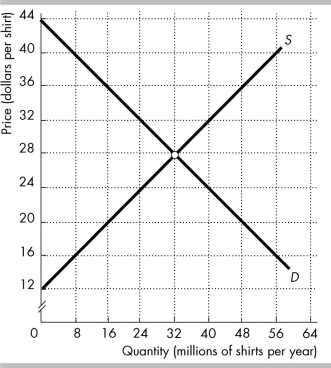 The figure shows the market for shirts in the United States, where D is the domestic demand curve and S is the domestic supply curve. The world price is $20 per shirt.
-In the figure above, with international trade Americans buy ________ million shirts per year.
The figure shows the market for shirts in the United States, where D is the domestic demand curve and S is the domestic supply curve. The world price is $20 per shirt.
-In the figure above, with international trade Americans buy ________ million shirts per year. (Multiple Choice)
4.7/5 (80)
(80) Some observers opposing free trade argue that when we buy shoes from Brazil or shirts from Taiwan, U.S. workers lose their jobs. The fact of the matter is that
(Multiple Choice)
4.8/5 (71)
(71) The United States decides to follow its comparative advantage and specialize in the production of airplanes. Which of the following will occur?
(Multiple Choice)
4.9/5 (71)
(71) Belize, a country in Central America, has a small coffee industry. Suppose Belize does not have free trade but it has comparative advantage in coffee production. If Belize allowed international trade, what would be the gains from trade?
(Multiple Choice)
4.8/5 (72)
(72) During 2010, as oil and gas prices continued to increase, a growing number of Americans called for the United States to become less reliant on Middle-Eastern oil. Would it make sense for the United States to try to become totally self-reliant in the production of oil? Why or why not?
(Essay)
4.8/5 (73)
(73) The U.S. government imposes an import quota on sugar. This import quota helps ________ and harms ________.
(Multiple Choice)
4.8/5 (66)
(66) In poorer countries, free trade ________ the demand for labor in these countries and ________ the wages paid in these countries.
(Multiple Choice)
4.9/5 (79)
(79) Suppose that the country of Pacifica imposes a quota on bananas. The reason that the government imposed this trade restriction could be
(Multiple Choice)
4.8/5 (75)
(75) Increasing a tariff will ________ the domestic quantity consumed of the good, while ________ the domestic production of the good.
(Multiple Choice)
4.9/5 (82)
(82) The European Union imports bananas from Latin America as well as imports from Europe's former colonies in the African, Caribbean and Pacific (ACP) group. In 2006 the tariff on bananas from Latin America was higher than on ACP bananas. Which of the following statements is NOT true?
(Multiple Choice)
4.9/5 (77)
(77) 
Filters
- Essay(0)
- Multiple Choice(0)
- Short Answer(0)
- True False(0)
- Matching(0)