



 Chat with AI
Exam 11: Expenditure Multipliers

Exam 1: What Is Economics483 Questions
Exam 2: The Economic Problem443 Questions
Exam 3: Demand and Supply515 Questions
Exam 4: Measuring Gdp and Economic Growth395 Questions
Exam 5: Monitoring Jobs and Inflation409 Questions
Exam 6: Economic Growth352 Questions
Exam 7: Finance, Saving, and Investment227 Questions
Exam 8: Money, the Price Level, and Inflation578 Questions
Exam 9: The Exchange Rate and the Balance of Payments489 Questions
Exam 10: Aggregate Supply and Aggregate Demand426 Questions
Exam 11: Expenditure Multipliers469 Questions
Exam 12: The Business Cycle, Inflation, and Deflation409 Questions
Exam 13: Fiscal Policy263 Questions
Exam 14: Monetary Policy229 Questions
Exam 15: International Trade Policy208 Questions
Select questions type


In the very short run, the components of aggregate planned expenditure that depend on the level of real GDP are
(Multiple Choice)
4.8/5  (72)
(72) In the third quarter of 2008, investment in the U.S. totaled $1.4 trillion and in 2007, investment was $1.3 trillion. The change in investment
(Multiple Choice)
4.8/5 (92)
(92) "The global financial crisis has had a considerable impact on China's export growth, which will continue to show weakness with recession in the U.S. and Europe," said a report by JP Morgan & Co. www.money.cnn.com, 11/11/2008
If Chinese exports continue to decline, the AE curve will shift ________, the price level will ________ in the long run and real GDP will ________ in the long run.
(Multiple Choice)
4.9/5 (92)
(92) Because of changes in the ________, the long-run effect of a $10 increase in investment on real GDP equals ________.
(Multiple Choice)
4.8/5 (85)
(85) A movement along the consumption function is the result of changes in
(Multiple Choice)
4.7/5 (87)
(87) The sum of the components of aggregate expenditure that are not influenced by real GDP is called
(Multiple Choice)
4.9/5 (79)
(79) 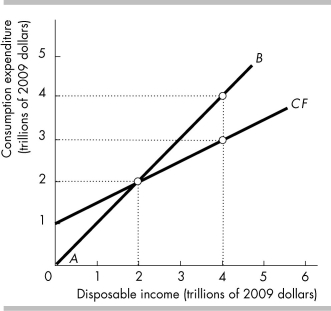 -In the above figure, at a disposable income level of $2 trillion, saving equals
 (Multiple Choice)
4.9/5 (84)
(84) A change in which of the following changes the slope of the aggregate expenditure curve?
(Multiple Choice)
4.9/5 (91)
(91) Mauritius, an island off the coast of Africa, competes with other countries producing goods with low-skilled labor. In 2006, it was reported that its "... factories have been exposed to ... competition from China, India and other Asian mass producers." As a result, "the main export industry has seen a 30 per cent reduction in volume ..." www.ft.com, 3/13/2006
The story describes
(Multiple Choice)
4.9/5 (86)
(86) In an article regarding Bangladesh's economy, the author suggests that the government ..."[g]ive double tax breaks on investment dollars. Give a tax break to R&D [research and development]. Give a tax break on donations to educational institutions." www.groundreport.com, March 24, 2008
The increase in investment is considered ________ and will generate a larger increase in ________.
(Multiple Choice)
4.9/5 (92)
(92) Suppose the equilibrium level of expenditure is $18 trillion. If real GDP is $17 trillion, then inventories are ________ their target levels and real GDP will ________.
(Multiple Choice)
4.7/5 (96)
(96) The relationship between net exports and GDP makes the slope of the aggregate expenditure curve
(Multiple Choice)
4.9/5 (81)
(81) If the change in autonomous investment equals $1 trillion and the change in real GDP equals $4 trillion, the multiplier equals 1/4.
(True/False)
4.8/5 (82)
(82) In an article regarding Bangladesh's economy, the author suggests that the government ..."[g]ive double tax breaks on investment dollars. Give a tax break to R&D [research and development]. Give a tax break on donations to educational institutions." www.groundreport.com, March 24, 2008
Suppose the multiplier in Bangladesh is 2. As a result of enacting the proposed policies, which of the following describe possible outcomes in the short run?
I. an $20 billion increase in investment will increase aggregate expenditure by $40 billion.
II. the AE curve will shift upward.
III. there will be an unplanned increase in inventories.
(Multiple Choice)
4.8/5 (85)
(85) The slope of the aggregate expenditure curve equals the change in
(Multiple Choice)
4.9/5 (77)
(77) 
Filters
- Essay(0)
- Multiple Choice(0)
- Short Answer(0)
- True False(0)
- Matching(0)