



 Chat with AI
Exam 15: The Shortcomings of Free Markets

Exam 1: What Is Economics?227 Questions
Exam 2: The Economy: Myth and Reality150 Questions
Exam 3: The Fundamental Economic Problem: Scarcity and Choice250 Questions
Exam 4: Supply and Demand: An Initial Look308 Questions
Exam 5: Consumer Choice: Individual and Market Demand202 Questions
Exam 6: Demand and Elasticity209 Questions
Exam 7: Production, Inputs, and Cost: Building Blocks for Supply Analysis216 Questions
Exam 8: Output, Price, and Profit: The Importance of Marginal Analysis189 Questions
Exam 9: Securities: Business Finance, and the Economy: The Tail that Wags the Dog?198 Questions
Exam 10: The Firm and the Industry under Perfect Competition208 Questions
Exam 11: Monopoly203 Questions
Exam 12: Between Competition and Monopoly225 Questions
Exam 13: Limiting Market Power: Regulation and Antitrust152 Questions
Exam 14: The Case for Free Markets I: The Price System220 Questions
Exam 15: The Shortcomings of Free Markets212 Questions
Exam 16: The Market's Prime Achievement: Innovation and Growth110 Questions
Exam 17: Externalities, the Environment, and Natural Resources217 Questions
Exam 18: Taxation and Resource Allocation219 Questions
Exam 19: Pricing the Factors of Production228 Questions
Exam 20: Labor and Entrepreneurship: The Human Inputs223 Questions
Exam 21: Poverty, Inequality, and Discrimination167 Questions
Exam 22: An Introduction to Macroeconomics211 Questions
Exam 23: The Goals of Macroeconomic Policy207 Questions
Exam 24: Economic Growth: Theory and Policy223 Questions
Exam 25: Aggregate Demand and the Powerful Consumer214 Questions
Exam 26: Demand-Side Equilibrium: Unemployment or Inflation?210 Questions
Exam 27: Bringing in the Supply Side: Unemployment and Inflation?223 Questions
Exam 28: Managing Aggregate Demand: Fiscal Policy205 Questions
Exam 29: Money and the Banking System219 Questions
Exam 30: Monetary Policy: Conventional and Unconventional205 Questions
Exam 31: The Financial Crisis and the Great Recession61 Questions
Exam 32: The Debate over Monetary and Fiscal Policy214 Questions
Exam 33: Budget Deficits in the Short and Long Run210 Questions
Exam 34: The Trade-Off between Inflation and Unemployment214 Questions
Exam 35: International Trade and Comparative Advantage226 Questions
Exam 36: The International Monetary System: Order or Disorder?213 Questions
Exam 37: Exchange Rates and the Macroeconomy214 Questions
Select questions type


It was once common for people to have servants who helped with the cooking and cleaning.Use the cost disease of the personal services dilemma to explain why these services have declined, even though one would expect an increased use in this age of the two-worker household.
(Essay)
4.8/5  (76)
(76) If production of a good creates beneficial externalities, a perfectly competitive market will produce
(Multiple Choice)
4.8/5 (96)
(96) The City Symphony presents three open-air concerts in the city park pavilion during the spring and summer.Many who attend make donations for symphony expenses, but the donation is not required.Some who attend make no contributions.Economists would
(Multiple Choice)
4.7/5 (75)
(75) Governments can deal with externalities through the use of
(Multiple Choice)
4.9/5 (83)
(83) Imposing fines on companies that contribute heavily to air and water pollution is an attempt to bring marginal private costs in line with marginal social costs.
(True/False)
4.8/5 (81)
(81) When beneficial externalities are present in a market, the actual output will be
(Multiple Choice)
4.7/5 (94)
(94) Government action can usually perfectly correct the market's shortcomings.
(True/False)
4.8/5 (63)
(63) Examples of public goods include national defense, police, and the U.S.Postal Service.
(True/False)
4.9/5 (77)
(77) Figure 15-2
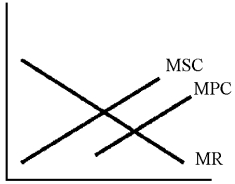 -The firm illustrated in Figure 15-2 is producing
 (Multiple Choice)
4.8/5 (59)
(59) Low interest rates will persuade corporations to invest more right now.
(True/False)
4.8/5 (77)
(77) If both a buyer and a seller have the same information, it is said to be symmetric.
(True/False)
4.8/5 (76)
(76) If, after careful analysis, an economist concludes that there has been a market failure, which of the following possible corrective actions might the economist favor? Why?
a.prohibiting the activity
b.charging fees for continuing the activity
c.requiring that the public be informed of the activity
d.government purchase of the item for the public
(Essay)
4.8/5 (81)
(81) Many cities have summer pops series in which the local orchestra performs light classical music in a public park.These performances are free in some areas.Apply the concept of a public good to pops performances and explain whether an admission charge is efficient.
(Essay)
4.8/5 (67)
(67) AZT is a drug that inhibits the reproduction of the AIDS virus, thus preventing the full development of the disease.The drug, which is sold in an unregulated market, is very expensive and many AIDS patients who can't afford it die from the disease.This case provides ammunition to critics of the market system on the basis of its
(Multiple Choice)
4.8/5 (72)
(72) When a motorist speeds down the road at well above the posted limit, economists believe that the principle of ____ may be directing his actions.
(Multiple Choice)
4.9/5 (81)
(81) When consumers or businessmen stop collecting information to make decisions at the point where marginal cost of data collection equals the marginal utility of the data, economists would call the decisions based on existing data
(Multiple Choice)
4.9/5 (92)
(92) Which of the following is not generally considered a failing of market economies?
(Multiple Choice)
4.8/5 (75)
(75) Symmetric information generally leads to efficient allocations of resources.
(True/False)
4.8/5 (82)
(82) 
Filters
- Essay(0)
- Multiple Choice(0)
- Short Answer(0)
- True False(0)
- Matching(0)