



 Chat with AI
Exam 15: The Shortcomings of Free Markets

Exam 1: What Is Economics?227 Questions
Exam 2: The Economy: Myth and Reality150 Questions
Exam 3: The Fundamental Economic Problem: Scarcity and Choice250 Questions
Exam 4: Supply and Demand: An Initial Look308 Questions
Exam 5: Consumer Choice: Individual and Market Demand202 Questions
Exam 6: Demand and Elasticity209 Questions
Exam 7: Production, Inputs, and Cost: Building Blocks for Supply Analysis216 Questions
Exam 8: Output, Price, and Profit: The Importance of Marginal Analysis189 Questions
Exam 9: Securities: Business Finance, and the Economy: The Tail that Wags the Dog?198 Questions
Exam 10: The Firm and the Industry under Perfect Competition208 Questions
Exam 11: Monopoly203 Questions
Exam 12: Between Competition and Monopoly225 Questions
Exam 13: Limiting Market Power: Regulation and Antitrust152 Questions
Exam 14: The Case for Free Markets I: The Price System220 Questions
Exam 15: The Shortcomings of Free Markets212 Questions
Exam 16: The Market's Prime Achievement: Innovation and Growth110 Questions
Exam 17: Externalities, the Environment, and Natural Resources217 Questions
Exam 18: Taxation and Resource Allocation219 Questions
Exam 19: Pricing the Factors of Production228 Questions
Exam 20: Labor and Entrepreneurship: The Human Inputs223 Questions
Exam 21: Poverty, Inequality, and Discrimination167 Questions
Exam 22: An Introduction to Macroeconomics211 Questions
Exam 23: The Goals of Macroeconomic Policy207 Questions
Exam 24: Economic Growth: Theory and Policy223 Questions
Exam 25: Aggregate Demand and the Powerful Consumer214 Questions
Exam 26: Demand-Side Equilibrium: Unemployment or Inflation?210 Questions
Exam 27: Bringing in the Supply Side: Unemployment and Inflation?223 Questions
Exam 28: Managing Aggregate Demand: Fiscal Policy205 Questions
Exam 29: Money and the Banking System219 Questions
Exam 30: Monetary Policy: Conventional and Unconventional205 Questions
Exam 31: The Financial Crisis and the Great Recession61 Questions
Exam 32: The Debate over Monetary and Fiscal Policy214 Questions
Exam 33: Budget Deficits in the Short and Long Run210 Questions
Exam 34: The Trade-Off between Inflation and Unemployment214 Questions
Exam 35: International Trade and Comparative Advantage226 Questions
Exam 36: The International Monetary System: Order or Disorder?213 Questions
Exam 37: Exchange Rates and the Macroeconomy214 Questions
Select questions type


Markets will always create more efficient outcomes without government intervention.
(True/False)
4.9/5  (93)
(93) Explain why government, rather than private firms, is required for efficient mosquito eradication programs.
(Essay)
4.8/5 (78)
(78) The market's contribution to the general welfare has been its
(Multiple Choice)
4.8/5 (78)
(78) The former communist countries of eastern Europe and the Soviet Union
(Multiple Choice)
5.0/5 (89)
(89) Conscious manipulation of the interest rate causes it to become a less effective tool in allocating resources among time periods.
(True/False)
4.9/5 (70)
(70) As productivity in the manufacturing sector increases, the service sector must keep pace or it will become more expensive in the long run.
(True/False)
4.9/5 (85)
(85) As long as the market sets prices above marginal costs, production will be efficient.
(True/False)
4.7/5 (89)
(89) If interest rates fall, the opportunity cost of spending money today rather than tomorrow
(Multiple Choice)
4.9/5 (78)
(78) Because smoking causes illness and disability to smokers, society must maintain more health-service capacity than it would need in the absence of smoking.Since the cost of maintaining this capacity is covered to a substantial degree by health insurance, even nonsmokers must pay higher premiums.Also, smokers hurt nonsmokers as a result of "passive smoke." The Rand Corporation estimates these costs to be 29 cents per pack of cigarettes.Cigarette taxes average 37 cents per pack.Based on the economist's definition of efficiency, it follows that
(Multiple Choice)
4.8/5 (81)
(81) On balance, markets do some things very well, and some things poorly.
(True/False)
4.9/5 (73)
(73) Government gives subsidies to encourage production of products with beneficial externalities.
(True/False)
4.8/5 (79)
(79) As wages for manufacturing workers rise, wages for service workers will stay the same.
(True/False)
4.8/5 (76)
(76) Often when consumers enter the used car market to make a purchase,
(Multiple Choice)
4.8/5 (77)
(77) Most Americans would voluntarily support defense without required taxation.
(True/False)
4.9/5 (64)
(64) An efficient allocation of resources requires each product's price to equal its marginal cost.
(True/False)
4.9/5 (73)
(73) Markets are primarily responsible for the rapid rise in productivity during the twentieth century.
(True/False)
4.9/5 (87)
(87) Figure 15-1
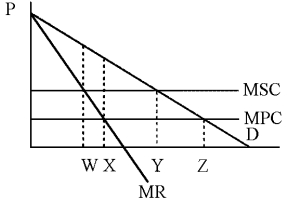 -Figure 15-1 describes conditions in the monopolized weezil industry.In the absence of government intervention, the monopolist will produce an output equal to
 (Multiple Choice)
4.9/5 (72)
(72) 
Filters
- Essay(0)
- Multiple Choice(0)
- Short Answer(0)
- True False(0)
- Matching(0)