



 Chat with AI
Exam 15: The Shortcomings of Free Markets

Exam 1: What Is Economics?227 Questions
Exam 2: The Economy: Myth and Reality150 Questions
Exam 3: The Fundamental Economic Problem: Scarcity and Choice250 Questions
Exam 4: Supply and Demand: An Initial Look308 Questions
Exam 5: Consumer Choice: Individual and Market Demand202 Questions
Exam 6: Demand and Elasticity209 Questions
Exam 7: Production, Inputs, and Cost: Building Blocks for Supply Analysis216 Questions
Exam 8: Output, Price, and Profit: The Importance of Marginal Analysis189 Questions
Exam 9: Securities: Business Finance, and the Economy: The Tail that Wags the Dog?198 Questions
Exam 10: The Firm and the Industry under Perfect Competition208 Questions
Exam 11: Monopoly203 Questions
Exam 12: Between Competition and Monopoly225 Questions
Exam 13: Limiting Market Power: Regulation and Antitrust152 Questions
Exam 14: The Case for Free Markets I: The Price System220 Questions
Exam 15: The Shortcomings of Free Markets212 Questions
Exam 16: The Market's Prime Achievement: Innovation and Growth110 Questions
Exam 17: Externalities, the Environment, and Natural Resources217 Questions
Exam 18: Taxation and Resource Allocation219 Questions
Exam 19: Pricing the Factors of Production228 Questions
Exam 20: Labor and Entrepreneurship: The Human Inputs223 Questions
Exam 21: Poverty, Inequality, and Discrimination167 Questions
Exam 22: An Introduction to Macroeconomics211 Questions
Exam 23: The Goals of Macroeconomic Policy207 Questions
Exam 24: Economic Growth: Theory and Policy223 Questions
Exam 25: Aggregate Demand and the Powerful Consumer214 Questions
Exam 26: Demand-Side Equilibrium: Unemployment or Inflation?210 Questions
Exam 27: Bringing in the Supply Side: Unemployment and Inflation?223 Questions
Exam 28: Managing Aggregate Demand: Fiscal Policy205 Questions
Exam 29: Money and the Banking System219 Questions
Exam 30: Monetary Policy: Conventional and Unconventional205 Questions
Exam 31: The Financial Crisis and the Great Recession61 Questions
Exam 32: The Debate over Monetary and Fiscal Policy214 Questions
Exam 33: Budget Deficits in the Short and Long Run210 Questions
Exam 34: The Trade-Off between Inflation and Unemployment214 Questions
Exam 35: International Trade and Comparative Advantage226 Questions
Exam 36: The International Monetary System: Order or Disorder?213 Questions
Exam 37: Exchange Rates and the Macroeconomy214 Questions
Select questions type


The opportunity cost of postponing income to some future time depends on the interest rate.
(True/False)
4.7/5  (67)
(67) Private ownership of rivers and lakes will halt all water pollution.
(True/False)
4.7/5 (76)
(76) The cost disease of services explains the problems surrounding the health care crisis.
(True/False)
4.8/5 (81)
(81) Producers of computer software are plagued with the problem of "pirating", that is, many people copy software legally purchased by others.The industry estimates that for each legal copy of a program, there are two pirated copies in use.The industry wants strict laws for the enforcement of its "intellectual property rights," but enforcement is obviously very difficult.Economists call this problem
(Multiple Choice)
4.9/5 (82)
(82) If a commodity's price is above its marginal cost, the market will tend to produce too much of the good.
(True/False)
4.9/5 (68)
(68) Which of the following would be classified as an externality?
(Multiple Choice)
4.8/5 (99)
(99) Figure 15-1
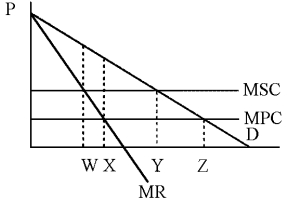 -Figure 15-1 describes conditions in the monopolized weezil industry.If the government replaces the monopolist with perfectly competitive firms and forces these firms to take account of all the costs and benefits they impose on society, the industry will produce an output equal to
 (Multiple Choice)
4.8/5 (74)
(74) Hostile takeovers of corporations have been in the business news for some time now.Several states have passed laws making it harder for out-of-state corporations to acquire firms headquartered in their states.Several corporations have established "golden parachutes" to give executives high payoffs in case of hostile takeover.What market imperfection is likely to be worsened by these actions? Explain.
(Essay)
4.7/5 (74)
(74) A free rider is one who enjoys the benefits of a public good without paying for it.
(True/False)
4.8/5 (89)
(89) Briefly and concisely define the following concepts and terms.
a.marginal social cost
b.detrimental externalities
c.free-rider problem
d.cost disease
e."defective telescopic faculty"
(Essay)
4.9/5 (90)
(90) If a detrimental externality is being produced in the course of producing a good, then
(Multiple Choice)
4.8/5 (100)
(100) Markets can efficiently handle irreversible decisions without involvement of government.
(True/False)
4.9/5 (68)
(68) Motorcycle helmet laws have been controversial in some states.Riders prefer the feel of the wind on their faces.Others, however, point out that riders without helmets are more likely to suffer severe injury and run up hospital bills at public expense.Which of the following would most likely reduce the incidence of high bills for helmetless riders?
(Multiple Choice)
4.8/5 (69)
(69) Private goods are characterized by two important attributes.What are they?
(Multiple Choice)
4.8/5 (79)
(79) Activities that indiscriminately impose costs on others are externalities.
(True/False)
4.9/5 (83)
(83) 
Filters
- Essay(0)
- Multiple Choice(0)
- Short Answer(0)
- True False(0)
- Matching(0)