



 Chat with AI
Exam 55: Ecosystems and Restoration Ecology

Exam 1: Evolution, the Themes of Biology, and Scientific Inquiry51 Questions
Exam 2: The Chemical Context of Life61 Questions
Exam 3: Water and Life55 Questions
Exam 4: Carbon and the Molecular Diversity of Life58 Questions
Exam 5: The Structure and Function of Large Biological Molecules70 Questions
Exam 6: A Tour of the Cell66 Questions
Exam 7: Membrane Structure and Function68 Questions
Exam 8: An Introduction to Metabolism67 Questions
Exam 9: Cellular Respiration and Fermentation68 Questions
Exam 10: Photosynthesis65 Questions
Exam 11: Cell Communication65 Questions
Exam 12: The Cell Cycle66 Questions
Exam 13: Meiosis and Sexual Life Cycles64 Questions
Exam 14: Mendel and the Gene Idea62 Questions
Exam 15: The Chromosomal Basis of Inheritance58 Questions
Exam 16: The Molecular Basis of Inheritance65 Questions
Exam 17: Gene Expression: From Gene to Protein67 Questions
Exam 18: Regulation of Gene Expression66 Questions
Exam 19: Viruses54 Questions
Exam 20: DNA Tools and Biotechnology57 Questions
Exam 21: Genomes and Their Evolution44 Questions
Exam 22: Descent with Modification: A Darwinian View of Life60 Questions
Exam 23: The Evolution of Populations64 Questions
Exam 24: The Origin of Species67 Questions
Exam 25: The History of Life on Earth59 Questions
Exam 26: Phylogeny and the Tree of Life75 Questions
Exam 27: Bacteria and Archaea75 Questions
Exam 28: Protists79 Questions
Exam 29: Plant Diversity I: How Plants Colonized Land82 Questions
Exam 30: Plant Diversity II: The Evolution of Seed Plants80 Questions
Exam 31: Fungi75 Questions
Exam 32: An Overview of Animal Diversity67 Questions
Exam 33: An Introduction to Invertebrates83 Questions
Exam 34: The Origin and Evolution of Vertebrates82 Questions
Exam 35: Vascular Plant Structure, Growth, and Development65 Questions
Exam 36: Resource Acquisition and Transport in Vascular Plants74 Questions
Exam 37: Soil and Plant Nutrition52 Questions
Exam 38: Angiosperm Reproduction and Biotechnology60 Questions
Exam 39: Plant Responses to Internal and External Signals61 Questions
Exam 40: Basic Principles of Animal Form and Function68 Questions
Exam 41: Animal Nutrition64 Questions
Exam 42: Circulation and Gas Exchange67 Questions
Exam 43: The Immune System69 Questions
Exam 44: Osmoregulation and Excretion64 Questions
Exam 45: Hormones and the Endocrine System66 Questions
Exam 46: Animal Reproduction68 Questions
Exam 47: Animal Development70 Questions
Exam 48: Neurons, Synapses, and Signaling68 Questions
Exam 49: Nervous Systems65 Questions
Exam 50: Sensory and Motor Mechanisms67 Questions
Exam 51: Animal Behavior69 Questions
Exam 52: An Introduction to Ecology and the Biosphere68 Questions
Exam 53: Population Ecology69 Questions
Exam 54: Community Ecology71 Questions
Exam 55: Ecosystems and Restoration Ecology68 Questions
Exam 56: Conservation Biology and Global Change69 Questions
Select questions type


Which of the following organisms is incorrectly paired with its trophic level?
(Multiple Choice)
4.9/5  (81)
(81) Use the following figure to answer the question.
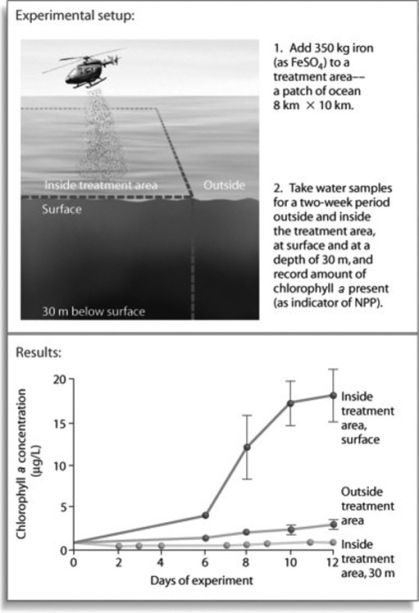 After looking at the experiment in the figure, what can be concluded about productivity in marine ecosystems?
 (Multiple Choice)
4.8/5 (76)
(76) Use the following figure to answer the question.
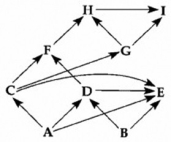 Diagram of a food web (arrows represent energy flow and letters represent species)
If the figure represents a marine food web, zooplankton are most likely ________.
Diagram of a food web (arrows represent energy flow and letters represent species)
If the figure represents a marine food web, zooplankton are most likely ________. (Multiple Choice)
5.0/5 (82)
(82) Use the following figure to answer the question.
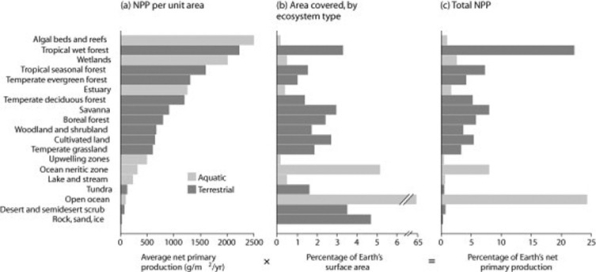 Which habitat types in the figure cover the largest area?
 (Multiple Choice)
4.7/5 (87)
(87) Use the following figure to answer the question.
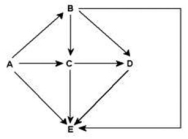 Food web for a particular terrestrial ecosystem (arrows represent energy flow and letters represent species)
Examine this food web for a particular terrestrial ecosystem. Species C is toxic to predators. Which species is most likely to benefit from being a mimic of C?
Food web for a particular terrestrial ecosystem (arrows represent energy flow and letters represent species)
Examine this food web for a particular terrestrial ecosystem. Species C is toxic to predators. Which species is most likely to benefit from being a mimic of C? (Multiple Choice)
5.0/5 (96)
(96) How is net ecosystem production (NEP)typically estimated in ecosystems?
(Multiple Choice)
4.9/5 (74)
(74) How can biodiversity affect the way we decontaminate industrial sites?
I.Bacteria have been found to be able to detoxify certain chemicals; perhaps there are more.
II.Trees produce sawdust, which can be used to soak up chemicals.
III.Species evolving in contaminated areas could adapt and detoxify the area.
(Multiple Choice)
4.9/5 (78)
(78) Use the following figure to answer the question.
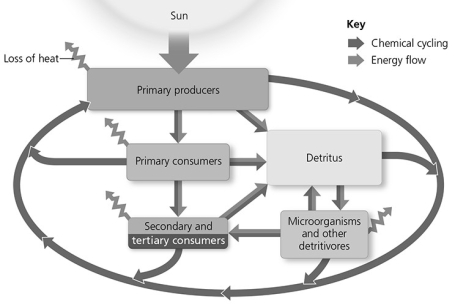 In the ecosystem figure, which unit of the food web has the potential to lose the most energy as heat?
 (Multiple Choice)
4.8/5 (84)
(84) Use the following figure to answer the question.
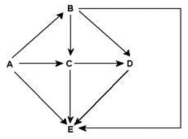 Food web for a particular terrestrial ecosystem (arrows represent energy flow and letters represent species)
Examine this food web for a particular terrestrial ecosystem. Which species is most likely a decomposer on this food web?
Food web for a particular terrestrial ecosystem (arrows represent energy flow and letters represent species)
Examine this food web for a particular terrestrial ecosystem. Which species is most likely a decomposer on this food web? (Multiple Choice)
4.8/5 (72)
(72) Use the following figure to answer the question.
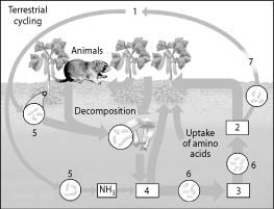 On the diagram of the nitrogen cycle, which number represents nitrite (NO₂)?
 (Multiple Choice)
4.9/5 (96)
(96) Which of the following statements is correct about biogeochemical cycling?
(Multiple Choice)
5.0/5 (86)
(86) Use the following figure to answer the question.
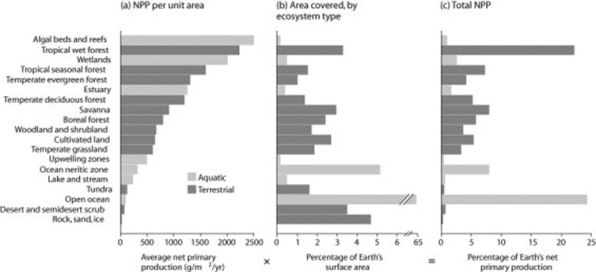 Considering its total area covered, which ecosystem type represented in the figure has a very low level of economic impact on Earth's ecosystem?
 (Multiple Choice)
4.8/5 (89)
(89) Which of the following would be considered an example of bioremediation?
(Multiple Choice)
4.8/5 (75)
(75) Use the following figure to answer the question.
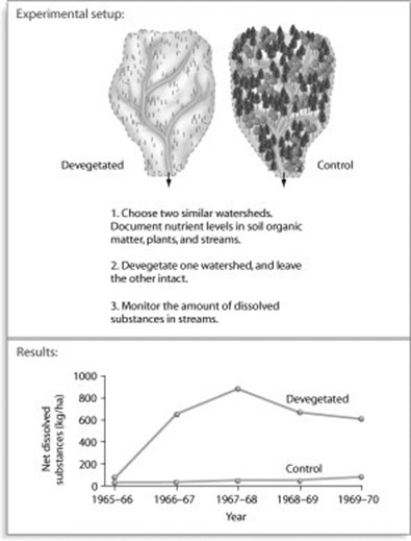 Based on the figure, which of the following are plausible reasons for the results?
I.Nutrients in the control watershed are being lost due to evapotranspiration from leaves.
II.Nutrients dissolve in the water running through the watershed.
III.Nutrients are attached to small particles of sand or clay that leave the watershed.
IV.Intact vegetation includes plant roots that held soil particles and prevented nutrient loss.
Based on the figure, which of the following are plausible reasons for the results?
I.Nutrients in the control watershed are being lost due to evapotranspiration from leaves.
II.Nutrients dissolve in the water running through the watershed.
III.Nutrients are attached to small particles of sand or clay that leave the watershed.
IV.Intact vegetation includes plant roots that held soil particles and prevented nutrient loss. (Multiple Choice)
4.9/5 (80)
(80) If the flow of energy in an arctic ecosystem goes through a simple food chain, perhaps involving humans, starting from phytoplankton to zooplankton to fish to seals to polar bears, then which of the following could be accurate?
(Multiple Choice)
5.0/5 (75)
(75) What advantage would there be for an ecosystem ecologist to measure net ecosystem production (NEP)instead of net primary production (NPP)?
(Multiple Choice)
4.9/5 (81)
(81) Consider the food chain of grass → grasshopper → mouse → snake → hawk. About how much of the chemical energy fixed by photosynthesis of the grass (100 percent)is available to the hawk?
(Multiple Choice)
4.8/5 (90)
(90) Use the following figure to answer the question.
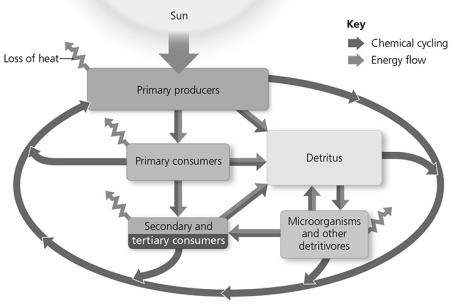 In the figure, what could the jagged arrow leaving microorganisms and other detritivores represent?
 (Multiple Choice)
4.8/5 (79)
(79) Use the following figure to answer the question.
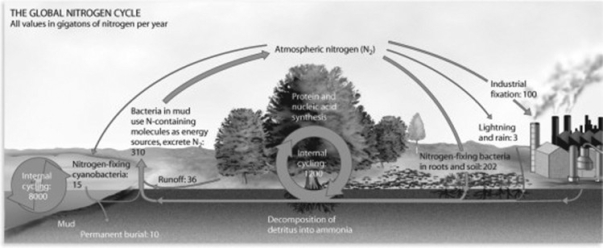 Consider the global nitrogen cycle depicted in the figure. How are humans altering this cycle?
 (Multiple Choice)
4.8/5 (75)
(75) 
Filters
- Essay(0)
- Multiple Choice(0)
- Short Answer(0)
- True False(0)
- Matching(0)