



 Chat with AI
Exam 49: Nervous Systems

Exam 1: Evolution, the Themes of Biology, and Scientific Inquiry51 Questions
Exam 2: The Chemical Context of Life61 Questions
Exam 3: Water and Life55 Questions
Exam 4: Carbon and the Molecular Diversity of Life58 Questions
Exam 5: The Structure and Function of Large Biological Molecules70 Questions
Exam 6: A Tour of the Cell66 Questions
Exam 7: Membrane Structure and Function68 Questions
Exam 8: An Introduction to Metabolism67 Questions
Exam 9: Cellular Respiration and Fermentation68 Questions
Exam 10: Photosynthesis65 Questions
Exam 11: Cell Communication65 Questions
Exam 12: The Cell Cycle66 Questions
Exam 13: Meiosis and Sexual Life Cycles64 Questions
Exam 14: Mendel and the Gene Idea62 Questions
Exam 15: The Chromosomal Basis of Inheritance58 Questions
Exam 16: The Molecular Basis of Inheritance65 Questions
Exam 17: Gene Expression: From Gene to Protein67 Questions
Exam 18: Regulation of Gene Expression66 Questions
Exam 19: Viruses54 Questions
Exam 20: DNA Tools and Biotechnology57 Questions
Exam 21: Genomes and Their Evolution44 Questions
Exam 22: Descent with Modification: A Darwinian View of Life60 Questions
Exam 23: The Evolution of Populations64 Questions
Exam 24: The Origin of Species67 Questions
Exam 25: The History of Life on Earth59 Questions
Exam 26: Phylogeny and the Tree of Life75 Questions
Exam 27: Bacteria and Archaea75 Questions
Exam 28: Protists79 Questions
Exam 29: Plant Diversity I: How Plants Colonized Land82 Questions
Exam 30: Plant Diversity II: The Evolution of Seed Plants80 Questions
Exam 31: Fungi75 Questions
Exam 32: An Overview of Animal Diversity67 Questions
Exam 33: An Introduction to Invertebrates83 Questions
Exam 34: The Origin and Evolution of Vertebrates82 Questions
Exam 35: Vascular Plant Structure, Growth, and Development65 Questions
Exam 36: Resource Acquisition and Transport in Vascular Plants74 Questions
Exam 37: Soil and Plant Nutrition52 Questions
Exam 38: Angiosperm Reproduction and Biotechnology60 Questions
Exam 39: Plant Responses to Internal and External Signals61 Questions
Exam 40: Basic Principles of Animal Form and Function68 Questions
Exam 41: Animal Nutrition64 Questions
Exam 42: Circulation and Gas Exchange67 Questions
Exam 43: The Immune System69 Questions
Exam 44: Osmoregulation and Excretion64 Questions
Exam 45: Hormones and the Endocrine System66 Questions
Exam 46: Animal Reproduction68 Questions
Exam 47: Animal Development70 Questions
Exam 48: Neurons, Synapses, and Signaling68 Questions
Exam 49: Nervous Systems65 Questions
Exam 50: Sensory and Motor Mechanisms67 Questions
Exam 51: Animal Behavior69 Questions
Exam 52: An Introduction to Ecology and the Biosphere68 Questions
Exam 53: Population Ecology69 Questions
Exam 54: Community Ecology71 Questions
Exam 55: Ecosystems and Restoration Ecology68 Questions
Exam 56: Conservation Biology and Global Change69 Questions
Select questions type


Stem cell transplants may someday be used to treat Parkinson's disease. Researchers are hopeful that these cells would alleviate the symptoms of Parkinson's disease by ________.
(Multiple Choice)
4.9/5  (72)
(72) The central nervous system is lacking in animals that have ________.
(Multiple Choice)
4.8/5 (79)
(79) In humans, control of balance and coordinated movements are associated with increased activity in the ________.
(Multiple Choice)
4.9/5 (88)
(88) If you were writing an essay, the part(s)of your brain that would be actively involved in this task is/are the ________.
(Multiple Choice)
4.8/5 (79)
(79) The regulation of body temperature derives from the activity of the ________.
(Multiple Choice)
4.9/5 (80)
(80) Injury localized to the hypothalamus would most likely disrupt
(Multiple Choice)
4.9/5 (96)
(96) Use the figure to answer the following question.
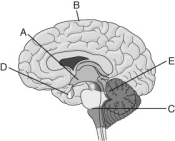 Control of respiration and circulation are associated with the ________.
 (Multiple Choice)
4.8/5 (76)
(76) Exercise and reactions to exciting stimuli include ________.
(Multiple Choice)
4.8/5 (90)
(90) Increased activity in the sympathetic nervous system leads to ________.
(Multiple Choice)
4.9/5 (84)
(84) In mammals, advanced cognition is usually correlated with a large and very convoluted cerebral cortex, but birds are capable of sophisticated cognition because they have ________.
(Multiple Choice)
4.8/5 (78)
(78) Use the figure to answer the following question.
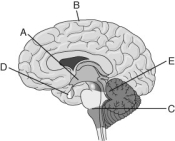 If a person suffered a stroke which damaged brain region B, what might be the expected outcome?
 (Multiple Choice)
4.9/5 (70)
(70) If a patient has an injury in the brainstem, which of the following would be observed?
(Multiple Choice)
4.8/5 (86)
(86) Which of the following structures or regions is incorrectly paired with its function?
(Multiple Choice)
4.8/5 (78)
(78) Forming new long-term memories is strikingly disrupted after damage to the ________.
(Multiple Choice)
4.9/5 (90)
(90) An injury to the temporal lobe will likely impair the function of the ________.
(Multiple Choice)
4.9/5 (74)
(74) The divisions of the nervous system that have antagonistic, or opposing, actions are ________.
(Multiple Choice)
4.8/5 (88)
(88) In the human knee-jerk reflex of a seated individual, as the calf is raised from a vertical position to a horizontal position, the muscles of the quadriceps (on the front of the thighs)and the muscles of the hamstring (on the back side of the thighs)are ________.
(Multiple Choice)
4.7/5 (89)
(89) Short-term and long-term memory are related but have important differences. Short-term memory ________.
(Multiple Choice)
4.7/5 (76)
(76) Food and water appetites are under the regulatory influence of the ________.
(Multiple Choice)
4.9/5 (70)
(70) 
Filters
- Essay(0)
- Multiple Choice(0)
- Short Answer(0)
- True False(0)
- Matching(0)