



 Chat with AI
Exam 46: Animal Reproduction

Exam 1: Evolution, the Themes of Biology, and Scientific Inquiry51 Questions
Exam 2: The Chemical Context of Life61 Questions
Exam 3: Water and Life55 Questions
Exam 4: Carbon and the Molecular Diversity of Life58 Questions
Exam 5: The Structure and Function of Large Biological Molecules70 Questions
Exam 6: A Tour of the Cell66 Questions
Exam 7: Membrane Structure and Function68 Questions
Exam 8: An Introduction to Metabolism67 Questions
Exam 9: Cellular Respiration and Fermentation68 Questions
Exam 10: Photosynthesis65 Questions
Exam 11: Cell Communication65 Questions
Exam 12: The Cell Cycle66 Questions
Exam 13: Meiosis and Sexual Life Cycles64 Questions
Exam 14: Mendel and the Gene Idea62 Questions
Exam 15: The Chromosomal Basis of Inheritance58 Questions
Exam 16: The Molecular Basis of Inheritance65 Questions
Exam 17: Gene Expression: From Gene to Protein67 Questions
Exam 18: Regulation of Gene Expression66 Questions
Exam 19: Viruses54 Questions
Exam 20: DNA Tools and Biotechnology57 Questions
Exam 21: Genomes and Their Evolution44 Questions
Exam 22: Descent with Modification: A Darwinian View of Life60 Questions
Exam 23: The Evolution of Populations64 Questions
Exam 24: The Origin of Species67 Questions
Exam 25: The History of Life on Earth59 Questions
Exam 26: Phylogeny and the Tree of Life75 Questions
Exam 27: Bacteria and Archaea75 Questions
Exam 28: Protists79 Questions
Exam 29: Plant Diversity I: How Plants Colonized Land82 Questions
Exam 30: Plant Diversity II: The Evolution of Seed Plants80 Questions
Exam 31: Fungi75 Questions
Exam 32: An Overview of Animal Diversity67 Questions
Exam 33: An Introduction to Invertebrates83 Questions
Exam 34: The Origin and Evolution of Vertebrates82 Questions
Exam 35: Vascular Plant Structure, Growth, and Development65 Questions
Exam 36: Resource Acquisition and Transport in Vascular Plants74 Questions
Exam 37: Soil and Plant Nutrition52 Questions
Exam 38: Angiosperm Reproduction and Biotechnology60 Questions
Exam 39: Plant Responses to Internal and External Signals61 Questions
Exam 40: Basic Principles of Animal Form and Function68 Questions
Exam 41: Animal Nutrition64 Questions
Exam 42: Circulation and Gas Exchange67 Questions
Exam 43: The Immune System69 Questions
Exam 44: Osmoregulation and Excretion64 Questions
Exam 45: Hormones and the Endocrine System66 Questions
Exam 46: Animal Reproduction68 Questions
Exam 47: Animal Development70 Questions
Exam 48: Neurons, Synapses, and Signaling68 Questions
Exam 49: Nervous Systems65 Questions
Exam 50: Sensory and Motor Mechanisms67 Questions
Exam 51: Animal Behavior69 Questions
Exam 52: An Introduction to Ecology and the Biosphere68 Questions
Exam 53: Population Ecology69 Questions
Exam 54: Community Ecology71 Questions
Exam 55: Ecosystems and Restoration Ecology68 Questions
Exam 56: Conservation Biology and Global Change69 Questions
Select questions type


A primary response by the Leydig cells in the testes to the presence of luteinizing hormone is an increase in the synthesis and secretion of ________.
(Multiple Choice)
4.7/5  (75)
(75) Among nonmammalian vertebrates, the cloaca is an anatomical structure that functions as ________.
(Multiple Choice)
4.8/5 (87)
(87) An ectopic pregnancy occurs when a fertilized egg implants somewhere other than in the lining of the uterus. Usually it implants in the oviduct. Which of the following would be the most likely explanation for such a pregnancy being unsuccessful?
(Multiple Choice)
4.9/5 (92)
(92) Which of the following is the most likely explanation for the absence of a protective filter blocking the passage of alcohol between the maternal and fetal circulations in humans?
(Multiple Choice)
4.8/5 (84)
(84) For which of the following is the number the same in spermatogenesis and oogenesis?
(Multiple Choice)
5.0/5 (77)
(77) Asexual reproduction results in offspring that are genetically identical to their parent. What type of cell process occurs to generate this type of offspring?
(Multiple Choice)
4.8/5 (81)
(81) You decide to study two species of birds, both of which form monogamous pairs (one male and one female). In species 1, you find that the eggs in a pair's nest are in fact almost always the offspring of that pair. In species 2, you are surprised to find that many of the eggs in a nest were actually fathered by males of neighboring pairs. Apparently, mating outside of monogamous pairings is widespread in species 2. Given this information, what would be the logical prediction to make before comparing testes size of males of the two species?
(Multiple Choice)
4.7/5 (94)
(94) Use the following information to answer the question.
Estrogens found in the environment have raised concerns about effects on reproductive health of animals. Researchers studied the effects that estrogens in the water have on sexual differentiation in zebrafish. They exposed embryo-larval (0-21 days post-hatching), juvenile (21-42 days post-hatching), and adult (over 200 days post-hatching)fish to three concentrations of 17β-estradiol (5, 25, and 100 nanograms/liter)that are within the range of concentrations found in water leaving sewage treatment plants in different countries. They then examined the proportion of males and females when the fish exposed at embryo-larval and juvenile stages reached adulthood. Embryo-larval stage fish that had been exposed to 100 ng/l 17β-estradiol resulted in adult populations that had substantially more females than males compared to control groups. Embryo-larval fish that had been exposed to 5 and 25 ng/l of 17β-estradiol did not show a statistically significant shift in the proportion of females. (Brion, F., C. R. Tyler, X. Palazzi, B. Laillet, J. M. Porcher, J. Garric, and P. Flammarion. 2004. Impacts of 17β-estradiol, including environmentally relevant concentrations, on reproduction after exposure during embryo-larval-, juvenile-, and adult-life stages in zebrafish (Danio rerio). Aquatic Toxicology 68:193-217.)
What is the significance of using the concentrations of 5, 25, and 100 ng/l of 17β-estradiol in this experiment?
(Multiple Choice)
4.9/5 (83)
(83) Refer to the following figure, which diagrams the reproductive anatomy of the human female, to answer the question.
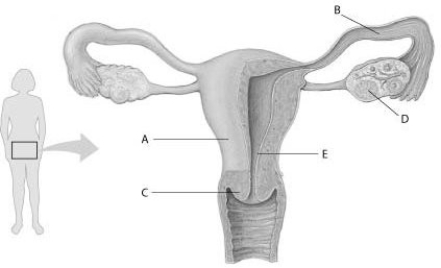 In the figure, which structure is the site of embryo implantation?
 (Multiple Choice)
4.8/5 (76)
(76) For which of the following is the number the same in human males and females?
(Multiple Choice)
4.9/5 (78)
(78) Asexual reproduction results in greater reproductive success than does sexual reproduction when ________.
(Multiple Choice)
4.9/5 (76)
(76) Mature human sperm and ova are similar in that they ________.
(Multiple Choice)
4.9/5 (87)
(87) Which hormone is released from the Sertoli cells that inhibits the release of follicle stimulating hormone?
(Multiple Choice)
4.9/5 (72)
(72) For water fleas of the genus Daphnia, switching from a pattern of asexual reproduction to sexual reproduction coincides with ________.
(Multiple Choice)
4.8/5 (86)
(86) Refer to the following figure, which diagrams the reproductive anatomy of the human male, to answer the question.
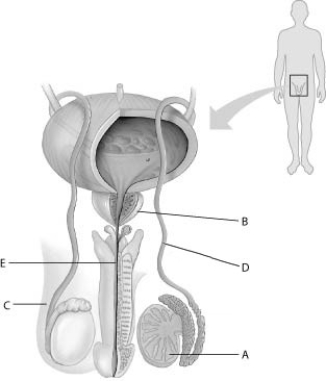 In the figure, which letter points to the prostate gland?
 (Multiple Choice)
4.8/5 (79)
(79) 
Filters
- Essay(0)
- Multiple Choice(0)
- Short Answer(0)
- True False(0)
- Matching(0)