



 Chat with AI
Exam 40: Basic Principles of Animal Form and Function

Exam 1: Evolution, the Themes of Biology, and Scientific Inquiry51 Questions
Exam 2: The Chemical Context of Life61 Questions
Exam 3: Water and Life55 Questions
Exam 4: Carbon and the Molecular Diversity of Life58 Questions
Exam 5: The Structure and Function of Large Biological Molecules70 Questions
Exam 6: A Tour of the Cell66 Questions
Exam 7: Membrane Structure and Function68 Questions
Exam 8: An Introduction to Metabolism67 Questions
Exam 9: Cellular Respiration and Fermentation68 Questions
Exam 10: Photosynthesis65 Questions
Exam 11: Cell Communication65 Questions
Exam 12: The Cell Cycle66 Questions
Exam 13: Meiosis and Sexual Life Cycles64 Questions
Exam 14: Mendel and the Gene Idea62 Questions
Exam 15: The Chromosomal Basis of Inheritance58 Questions
Exam 16: The Molecular Basis of Inheritance65 Questions
Exam 17: Gene Expression: From Gene to Protein67 Questions
Exam 18: Regulation of Gene Expression66 Questions
Exam 19: Viruses54 Questions
Exam 20: DNA Tools and Biotechnology57 Questions
Exam 21: Genomes and Their Evolution44 Questions
Exam 22: Descent with Modification: A Darwinian View of Life60 Questions
Exam 23: The Evolution of Populations64 Questions
Exam 24: The Origin of Species67 Questions
Exam 25: The History of Life on Earth59 Questions
Exam 26: Phylogeny and the Tree of Life75 Questions
Exam 27: Bacteria and Archaea75 Questions
Exam 28: Protists79 Questions
Exam 29: Plant Diversity I: How Plants Colonized Land82 Questions
Exam 30: Plant Diversity II: The Evolution of Seed Plants80 Questions
Exam 31: Fungi75 Questions
Exam 32: An Overview of Animal Diversity67 Questions
Exam 33: An Introduction to Invertebrates83 Questions
Exam 34: The Origin and Evolution of Vertebrates82 Questions
Exam 35: Vascular Plant Structure, Growth, and Development65 Questions
Exam 36: Resource Acquisition and Transport in Vascular Plants74 Questions
Exam 37: Soil and Plant Nutrition52 Questions
Exam 38: Angiosperm Reproduction and Biotechnology60 Questions
Exam 39: Plant Responses to Internal and External Signals61 Questions
Exam 40: Basic Principles of Animal Form and Function68 Questions
Exam 41: Animal Nutrition64 Questions
Exam 42: Circulation and Gas Exchange67 Questions
Exam 43: The Immune System69 Questions
Exam 44: Osmoregulation and Excretion64 Questions
Exam 45: Hormones and the Endocrine System66 Questions
Exam 46: Animal Reproduction68 Questions
Exam 47: Animal Development70 Questions
Exam 48: Neurons, Synapses, and Signaling68 Questions
Exam 49: Nervous Systems65 Questions
Exam 50: Sensory and Motor Mechanisms67 Questions
Exam 51: Animal Behavior69 Questions
Exam 52: An Introduction to Ecology and the Biosphere68 Questions
Exam 53: Population Ecology69 Questions
Exam 54: Community Ecology71 Questions
Exam 55: Ecosystems and Restoration Ecology68 Questions
Exam 56: Conservation Biology and Global Change69 Questions
Select questions type


Blood is best classified as connective tissue because ________.
(Multiple Choice)
5.0/5  (72)
(72) As animals have evolved large body size, they have also evolved adaptations to improve exchange of energy and materials with the environment. For example, in many larger organisms, evolution has favored lungs and a digestive tract with ________.
(Multiple Choice)
4.9/5 (82)
(82) Use the graph to answer the following question.
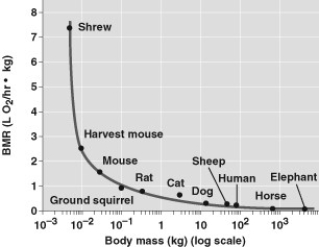 What can you determine from the graph?
 (Multiple Choice)
4.9/5 (76)
(76) Consider the energy budgets for a human, an elephant, a penguin, a mouse, and a snake. The ________ would have the highest total annual energy expenditure, and the ________ would have the highest energy expenditure per unit mass.
(Multiple Choice)
4.9/5 (83)
(83) Consider the energy budgets for a human, an elephant, a penguin, a mouse, and a snake. The ________ would have the highest total annual energy expenditure, and the ________ would have the highest energy expenditure per unit mass.
(Multiple Choice)
4.8/5 (86)
(86) The panting responses observed in overheated birds and mammals dissipate excess heat by ________.
(Multiple Choice)
4.9/5 (72)
(72) Which of the following would increase the rate of heat exchange between an animal and its environment?
(Multiple Choice)
4.8/5 (87)
(87) What is the name of the epithelial cell surface that faces the outside of an organ?
(Multiple Choice)
4.8/5 (84)
(84) An elephant and a mouse are running in full sunlight, and both overheat by the same amount above their normal body temperatures. When they move into the shade and rest, which animal will cool down faster?
(Multiple Choice)
4.9/5 (79)
(79) You are studying a large tropical reptile that has a high and relatively stable body temperature. How would you determine whether this animal is an endotherm or an ectotherm?
(Multiple Choice)
4.8/5 (76)
(76) Which organ system is responsible for protection against injury, infection, and dehydration?
(Multiple Choice)
4.7/5 (76)
(76) Standard metabolic rate (SMR)and basal metabolic rate (BMR)are ________.
(Multiple Choice)
4.8/5 (75)
(75) Generally, epithelial cell layers are responsible for separating two fluids. For example, the epithelium of blood vessels in animals separates the blood from the interstitial fluid. What characteristic would you expect to see in an epithelium that was specialized for passive diffusion of materials from one fluid to another?
(Multiple Choice)
4.8/5 (82)
(82) Organisms maintain dynamic homeostasis through behavioral and physiological mechanisms. Which of the following statements is an accurate explanation of a negative feedback mechanism used by animals to regulate body temperature?
(Multiple Choice)
4.8/5 (85)
(85) Penguins, seals, and tuna have body forms that permit rapid swimming, because ________.
(Multiple Choice)
4.9/5 (63)
(63) Use the figure to answer the following question.
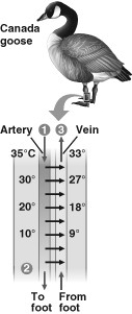 The thin horizontal arrows in the figure above show that the ________.
 (Multiple Choice)
4.9/5 (80)
(80) Compared with a smaller cell, a larger cell of the same shape has
(Multiple Choice)
4.7/5 (77)
(77) Which of the following is a true statement about body size and physiology?
(Multiple Choice)
4.8/5 (85)
(85) 
Filters
- Essay(0)
- Multiple Choice(0)
- Short Answer(0)
- True False(0)
- Matching(0)