



 Chat with AI
Exam 34: The Origin and Evolution of Vertebrates

Exam 1: Evolution, the Themes of Biology, and Scientific Inquiry51 Questions
Exam 2: The Chemical Context of Life61 Questions
Exam 3: Water and Life55 Questions
Exam 4: Carbon and the Molecular Diversity of Life58 Questions
Exam 5: The Structure and Function of Large Biological Molecules70 Questions
Exam 6: A Tour of the Cell66 Questions
Exam 7: Membrane Structure and Function68 Questions
Exam 8: An Introduction to Metabolism67 Questions
Exam 9: Cellular Respiration and Fermentation68 Questions
Exam 10: Photosynthesis65 Questions
Exam 11: Cell Communication65 Questions
Exam 12: The Cell Cycle66 Questions
Exam 13: Meiosis and Sexual Life Cycles64 Questions
Exam 14: Mendel and the Gene Idea62 Questions
Exam 15: The Chromosomal Basis of Inheritance58 Questions
Exam 16: The Molecular Basis of Inheritance65 Questions
Exam 17: Gene Expression: From Gene to Protein67 Questions
Exam 18: Regulation of Gene Expression66 Questions
Exam 19: Viruses54 Questions
Exam 20: DNA Tools and Biotechnology57 Questions
Exam 21: Genomes and Their Evolution44 Questions
Exam 22: Descent with Modification: A Darwinian View of Life60 Questions
Exam 23: The Evolution of Populations64 Questions
Exam 24: The Origin of Species67 Questions
Exam 25: The History of Life on Earth59 Questions
Exam 26: Phylogeny and the Tree of Life75 Questions
Exam 27: Bacteria and Archaea75 Questions
Exam 28: Protists79 Questions
Exam 29: Plant Diversity I: How Plants Colonized Land82 Questions
Exam 30: Plant Diversity II: The Evolution of Seed Plants80 Questions
Exam 31: Fungi75 Questions
Exam 32: An Overview of Animal Diversity67 Questions
Exam 33: An Introduction to Invertebrates83 Questions
Exam 34: The Origin and Evolution of Vertebrates82 Questions
Exam 35: Vascular Plant Structure, Growth, and Development65 Questions
Exam 36: Resource Acquisition and Transport in Vascular Plants74 Questions
Exam 37: Soil and Plant Nutrition52 Questions
Exam 38: Angiosperm Reproduction and Biotechnology60 Questions
Exam 39: Plant Responses to Internal and External Signals61 Questions
Exam 40: Basic Principles of Animal Form and Function68 Questions
Exam 41: Animal Nutrition64 Questions
Exam 42: Circulation and Gas Exchange67 Questions
Exam 43: The Immune System69 Questions
Exam 44: Osmoregulation and Excretion64 Questions
Exam 45: Hormones and the Endocrine System66 Questions
Exam 46: Animal Reproduction68 Questions
Exam 47: Animal Development70 Questions
Exam 48: Neurons, Synapses, and Signaling68 Questions
Exam 49: Nervous Systems65 Questions
Exam 50: Sensory and Motor Mechanisms67 Questions
Exam 51: Animal Behavior69 Questions
Exam 52: An Introduction to Ecology and the Biosphere68 Questions
Exam 53: Population Ecology69 Questions
Exam 54: Community Ecology71 Questions
Exam 55: Ecosystems and Restoration Ecology68 Questions
Exam 56: Conservation Biology and Global Change69 Questions
Select questions type


Use the following information to answer the question.
Brown et al. and Morwood et al. reported in 2004 that they had found skeletal remains of a previously unknown type of hominin, now dubbed Homo floresiensis, on the Indonesian island of Flores. These hominins were small (approximately 1 meter tall)with small braincases (approximately 380 cubic centimeters)as compared with other hominins. The remains of H. floresiensis were found alongside handmade stone tools and the remains of dwarf elephants that also inhabited the island, suggesting that H. floresiensis was able both to make tools and to coordinate the hunting of animals much larger than itself. H. floresiensis is estimated to have lived at the site where the remains were found from at least 38,000 years ago to 18,000 years ago.
Species Australopitheaus afarensis A. africanus Paranthropus boisei Homo habilis H. ergaster H. erectus H. heidelbergensis H. neanderthalensis H. floresiensis H. sapiens Location of Fossils Africa Africa Africa Africa Africa Africa, Asia Africa, Europe Middle East, Europe, Asia Asia Middle East, Europe, Asia Estimated Average Body MLass (kg) 450 450 510 550 850 1000 1200 1500 380 1350 Estimated Average Body MLass (kg) 36 36 44 34 58 57 62 76 16-36 53 Associated with Stone Tools? No No No? yes yes yes yes yes yes yes
The table is a comparison of several characteristics of H. floresiensis to those of nine other hominin species (arranged roughly from oldest to most recent). What do these data suggest?
(Multiple Choice)
4.9/5  (73)
(73) The evolution of similar insulating skin coverings such as fur, hair, and feathers in mammals and birds is a result of ________.
(Multiple Choice)
4.7/5 (80)
(80) Which of the following is a characteristic of all chordates at some point during their life cycle?
(Multiple Choice)
4.9/5 (71)
(71) Which structure of the amniotic egg most closely surrounds the embryo?
(Multiple Choice)
4.9/5 (80)
(80) Use the following figure and information to answer the question.
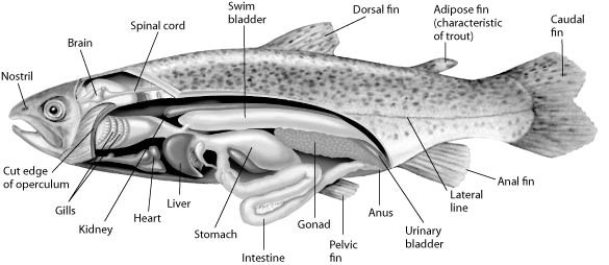 Fishes that have swim bladders can regulate their density and, thus, their buoyancy. There are two types of swim bladder: physostomous and physoclistous. The ancestral version is the physostomous version, in which the swim bladder is connected to the esophagus via a short tube (see the figure). The fish fills this version by swimming to the surface, taking gulps of air, and directing them into the swim bladder. Air is removed from this version by "belching." The physoclistous version is more derived and has lost its connection to the esophagus. Instead, gas enters and leaves the swim bladder via special circulatory mechanisms within the wall of the swim bladder.
If a ray-finned fish is to both hover (remain stationary)in the water column and ventilate its gills effectively, then what other structure besides its swim bladder will it use?
Fishes that have swim bladders can regulate their density and, thus, their buoyancy. There are two types of swim bladder: physostomous and physoclistous. The ancestral version is the physostomous version, in which the swim bladder is connected to the esophagus via a short tube (see the figure). The fish fills this version by swimming to the surface, taking gulps of air, and directing them into the swim bladder. Air is removed from this version by "belching." The physoclistous version is more derived and has lost its connection to the esophagus. Instead, gas enters and leaves the swim bladder via special circulatory mechanisms within the wall of the swim bladder.
If a ray-finned fish is to both hover (remain stationary)in the water column and ventilate its gills effectively, then what other structure besides its swim bladder will it use? (Multiple Choice)
4.7/5 (76)
(76) The earliest known mineralized structures in vertebrates are associated with ________.
(Multiple Choice)
5.0/5 (72)
(72) Chordate pharyngeal slits appear to have functioned first as ________.
(Multiple Choice)
4.8/5 (78)
(78) It is believed that the coelacanths and lungfish represent a crucial link between other fishes and tetrapods. What is the major feature in these fish in support of this hypothesis?
(Multiple Choice)
4.9/5 (78)
(78) Scientific views are based on evidence rather than an appeal to authority. Which of the following statements demonstrates a conclusion based on evidence?
(Multiple Choice)
4.8/5 (67)
(67) Mammals and birds eat more often than reptiles. Which of the following traits shared by mammals and birds best explains this habit?
(Multiple Choice)
4.8/5 (64)
(64) Use the following figure and information to answer the question.
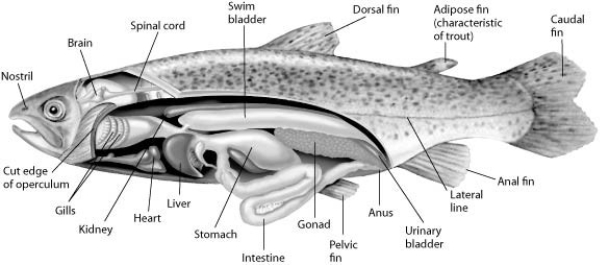 Fishes that have swim bladders can regulate their density and, thus, their buoyancy. There are two types of swim bladder: physostomous and physoclistous. The ancestral version is the physostomous version, in which the swim bladder is connected to the esophagus via a short tube (see the figure). The fish fills this version by swimming to the surface, taking gulps of air, and directing them into the swim bladder. Air is removed from this version by "belching." The physoclistous version is more derived and has lost its connection to the esophagus. Instead, gas enters and leaves the swim bladder via special circulatory mechanisms within the wall of the swim bladder.
Which shark structure is closest in function to a swim bladder full of gas?
Fishes that have swim bladders can regulate their density and, thus, their buoyancy. There are two types of swim bladder: physostomous and physoclistous. The ancestral version is the physostomous version, in which the swim bladder is connected to the esophagus via a short tube (see the figure). The fish fills this version by swimming to the surface, taking gulps of air, and directing them into the swim bladder. Air is removed from this version by "belching." The physoclistous version is more derived and has lost its connection to the esophagus. Instead, gas enters and leaves the swim bladder via special circulatory mechanisms within the wall of the swim bladder.
Which shark structure is closest in function to a swim bladder full of gas? (Multiple Choice)
4.7/5 (72)
(72) Use the following information to answer the question.
Terry catches a ray-finned fish from the ocean and notices that attached to its flank is an equally long, snakelike organism. The attached organism has no external segmentation, no scales, a round mouth surrounded by a sucker, and two small eyes. Terry concludes it is a hagfish.
Terry saved some of the tooth-like objects within the hagfish's round mouth to analyze their composition in his mentor's biochemistry research lab. Terry will find that they are composed of the same protein found in tetrapod ________.
(Multiple Choice)
4.8/5 (68)
(68) Which of the following are the only extant animals that descended directly from dinosaurs?
(Multiple Choice)
4.8/5 (80)
(80) Arrange the following taxonomic terms in order from most inclusive (most general)to least inclusive (most specific).
(Multiple Choice)
4.8/5 (80)
(80) Which of the following represents the strongest evidence that two of the three middle ear bones of mammals are homologous to certain reptilian jawbones?
(Multiple Choice)
4.8/5 (73)
(73) Which of the following is the most inclusive (most general)group in which all of the members have fully opposable thumbs?
(Multiple Choice)
4.8/5 (82)
(82) Use the following figure and information to answer the question.
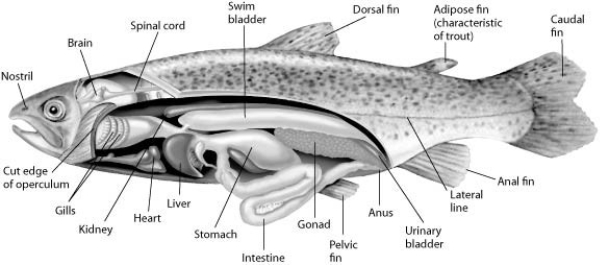 Fishes that have swim bladders can regulate their density and, thus, their buoyancy. There are two types of swim bladder: physostomous and physoclistous. The ancestral version is the physostomous version, in which the swim bladder is connected to the esophagus via a short tube (see the figure). The fish fills this version by swimming to the surface, taking gulps of air, and directing them into the swim bladder. Air is removed from this version by "belching." The physoclistous version is more derived and has lost its connection to the esophagus. Instead, gas enters and leaves the swim bladder via special circulatory mechanisms within the wall of the swim bladder.
The presence of a swim bladder allows the typical ray-finned fish to stop swimming and still ________.
Fishes that have swim bladders can regulate their density and, thus, their buoyancy. There are two types of swim bladder: physostomous and physoclistous. The ancestral version is the physostomous version, in which the swim bladder is connected to the esophagus via a short tube (see the figure). The fish fills this version by swimming to the surface, taking gulps of air, and directing them into the swim bladder. Air is removed from this version by "belching." The physoclistous version is more derived and has lost its connection to the esophagus. Instead, gas enters and leaves the swim bladder via special circulatory mechanisms within the wall of the swim bladder.
The presence of a swim bladder allows the typical ray-finned fish to stop swimming and still ________. (Multiple Choice)
4.9/5 (75)
(75) Which of these might have been observed in the common ancestor of chondrichthyans and osteichthyans?
(Multiple Choice)
4.9/5 (80)
(80) 
Filters
- Essay(0)
- Multiple Choice(0)
- Short Answer(0)
- True False(0)
- Matching(0)