



 Chat with AI
Exam 33: An Introduction to Invertebrates

Exam 1: Evolution, the Themes of Biology, and Scientific Inquiry51 Questions
Exam 2: The Chemical Context of Life61 Questions
Exam 3: Water and Life55 Questions
Exam 4: Carbon and the Molecular Diversity of Life58 Questions
Exam 5: The Structure and Function of Large Biological Molecules70 Questions
Exam 6: A Tour of the Cell66 Questions
Exam 7: Membrane Structure and Function68 Questions
Exam 8: An Introduction to Metabolism67 Questions
Exam 9: Cellular Respiration and Fermentation68 Questions
Exam 10: Photosynthesis65 Questions
Exam 11: Cell Communication65 Questions
Exam 12: The Cell Cycle66 Questions
Exam 13: Meiosis and Sexual Life Cycles64 Questions
Exam 14: Mendel and the Gene Idea62 Questions
Exam 15: The Chromosomal Basis of Inheritance58 Questions
Exam 16: The Molecular Basis of Inheritance65 Questions
Exam 17: Gene Expression: From Gene to Protein67 Questions
Exam 18: Regulation of Gene Expression66 Questions
Exam 19: Viruses54 Questions
Exam 20: DNA Tools and Biotechnology57 Questions
Exam 21: Genomes and Their Evolution44 Questions
Exam 22: Descent with Modification: A Darwinian View of Life60 Questions
Exam 23: The Evolution of Populations64 Questions
Exam 24: The Origin of Species67 Questions
Exam 25: The History of Life on Earth59 Questions
Exam 26: Phylogeny and the Tree of Life75 Questions
Exam 27: Bacteria and Archaea75 Questions
Exam 28: Protists79 Questions
Exam 29: Plant Diversity I: How Plants Colonized Land82 Questions
Exam 30: Plant Diversity II: The Evolution of Seed Plants80 Questions
Exam 31: Fungi75 Questions
Exam 32: An Overview of Animal Diversity67 Questions
Exam 33: An Introduction to Invertebrates83 Questions
Exam 34: The Origin and Evolution of Vertebrates82 Questions
Exam 35: Vascular Plant Structure, Growth, and Development65 Questions
Exam 36: Resource Acquisition and Transport in Vascular Plants74 Questions
Exam 37: Soil and Plant Nutrition52 Questions
Exam 38: Angiosperm Reproduction and Biotechnology60 Questions
Exam 39: Plant Responses to Internal and External Signals61 Questions
Exam 40: Basic Principles of Animal Form and Function68 Questions
Exam 41: Animal Nutrition64 Questions
Exam 42: Circulation and Gas Exchange67 Questions
Exam 43: The Immune System69 Questions
Exam 44: Osmoregulation and Excretion64 Questions
Exam 45: Hormones and the Endocrine System66 Questions
Exam 46: Animal Reproduction68 Questions
Exam 47: Animal Development70 Questions
Exam 48: Neurons, Synapses, and Signaling68 Questions
Exam 49: Nervous Systems65 Questions
Exam 50: Sensory and Motor Mechanisms67 Questions
Exam 51: Animal Behavior69 Questions
Exam 52: An Introduction to Ecology and the Biosphere68 Questions
Exam 53: Population Ecology69 Questions
Exam 54: Community Ecology71 Questions
Exam 55: Ecosystems and Restoration Ecology68 Questions
Exam 56: Conservation Biology and Global Change69 Questions
Select questions type


Use the following information to answer the question.
An elementary school science teacher decided to liven up the classroom with a saltwater aquarium. Knowing that saltwater aquaria can be quite a hassle, the teacher proceeded stepwise. First, the teacher conditioned the water. Next, the teacher decided to stock the tank with various marine invertebrates, including a polychaete, a siliceous sponge, several bivalves, a shrimp, several sea anemones of different types, a colonial hydra, a few coral species, an ectoproct, a sea star, and several herbivorous gastropod varieties. Lastly, she added some vertebrates-a parrot fish and a clown fish. She arranged for daily feedings of copepods and feeder fish.
The bivalves started to die one by one; only the undamaged shells remained. To keep the remaining bivalves alive, the teacher would most likely need to remove the ________.
(Multiple Choice)
5.0/5  (78)
(78) Which of the following organisms would you expect to have the largest surface-area-to-volume ratio? Assume that all of the following are the same total length.
(Multiple Choice)
4.8/5 (77)
(77) While sampling marine plankton in a lab, a student encounters large numbers of fertilized eggs. The student rears some of the eggs in the laboratory for further study and finds that the blastopore becomes the mouth. The embryo develops into a trochophore larva and eventually has a true coelom. These eggs probably belonged to a(n)________.
(Multiple Choice)
4.9/5 (64)
(64) Use the following information to answer the question.
The phylum Cycliophora was discovered in 1995. They are tiny organisms that live in large numbers on the outsides of the mouthparts and appendages of lobsters. The feeding stage permanently attaches to the lobster via an adhesive disk and collects scraps of food from its host's feeding by capturing the scraps in a current created by a ring of cilia. The body is saclike and has a U-shaped intestine that brings the anus close to the mouth. Cycliophorans are coelomates, do not molt (though their host does), and their embryos undergo spiral cleavage.
The feeding stage of cycliophorans ________.
(Multiple Choice)
4.8/5 (83)
(83) Use the following information to answer the question.
Nudibranchs, a type of predatory sea slug, can have various protuberances (that is, extensions)on their dorsal surfaces. Rhinophores are paired structures, located close to the head, which bear many chemoreceptors. Dorsal plumules, usually located posteriorly, perform respiratory gas exchange. Cerata usually cover much of the dorsal surface and contain nematocysts at their tips.
The stingers of honeybees have a function most similar to that of ________.
(Multiple Choice)
5.0/5 (74)
(74) Use the following information to answer the question.
Nudibranchs, a type of predatory sea slug, can have various protuberances (that is, extensions)on their dorsal surfaces. Rhinophores are paired structures, located close to the head, which bear many chemoreceptors. Dorsal plumules, usually located posteriorly, perform respiratory gas exchange. Cerata usually cover much of the dorsal surface and contain nematocysts at their tips.
The antennae of insects have a function most similar to that of ________.
(Multiple Choice)
4.9/5 (91)
(91) Use the following information to answer the question.
The phylum Cycliophora was discovered in 1995. They are tiny organisms that live in large numbers on the outsides of the mouthparts and appendages of lobsters. The feeding stage permanently attaches to the lobster via an adhesive disk and collects scraps of food from its host's feeding by capturing the scraps in a current created by a ring of cilia. The body is saclike and has a U-shaped intestine that brings the anus close to the mouth. Cycliophorans are coelomates, do not molt (though their host does), and their embryos undergo spiral cleavage.
Basing your inferences on information in the paragraph, to which clades should cycliophorans belong?
(Multiple Choice)
4.8/5 (80)
(80) Use the following information to answer the question.
An elementary school science teacher decided to liven up the classroom with a saltwater aquarium. Knowing that saltwater aquaria can be quite a hassle, the teacher proceeded stepwise. First, the teacher conditioned the water. Next, the teacher decided to stock the tank with various marine invertebrates, including a polychaete, a siliceous sponge, several bivalves, a shrimp, several sea anemones of different types, a colonial hydra, a few coral species, an ectoproct, a sea star, and several herbivorous gastropod varieties. Lastly, she added some vertebrates-a parrot fish and a clown fish. She arranged for daily feedings of copepods and feeder fish.
Normally, the clown fish readily swims among the tentacles of the sea anemones; the parrot fish avoids them. One hypothesis for the clown fish's apparent immunity is that they slowly build a tolerance to the sea anemone's toxin. A second hypothesis is that a chemical in the mucus that coats the clown fish prevents the nematocysts from being triggered. Which of the following graphs supports the first, but not the second, of these hypotheses?
(Multiple Choice)
4.8/5 (89)
(89) You find a multi-legged animal in your garden and want to determine if it is a centipede or a millipede. You take the animal to a university where a myriapodologist quickly tells you that you have found a centipede. Which of the following traits may have allowed her to make this distinction?
(Multiple Choice)
5.0/5 (89)
(89) If a lung were to be found in a mollusc, where would it be located?
(Multiple Choice)
5.0/5 (73)
(73) The crown-of-thorns sea star, Acanthaster planci, preys on the flesh of live coral. If coral animals are attacked by these sea stars, then what actually provides nutrition to the sea star, and which chemical (besides the toxin within their nematocysts)do the corals rely on for protection?
(Multiple Choice)
4.9/5 (73)
(73) Imagine that you are a graduate student seeking an idea for a research project that will help us understand the evolution of a parasitic lifestyle from a free-living lifestyle. Which of the following outcomes would you expect if you compare the genes of parasitic species to relatives that are free living?
(Multiple Choice)
4.8/5 (66)
(66) The increase in plant species diversity allowed which of the following events?
(Multiple Choice)
4.8/5 (91)
(91) Use the following information to answer the question.
Nudibranchs, a type of predatory sea slug, can have various protuberances (that is, extensions)on their dorsal surfaces. Rhinophores are paired structures, located close to the head, which bear many chemoreceptors. Dorsal plumules, usually located posteriorly, perform respiratory gas exchange. Cerata usually cover much of the dorsal surface and contain nematocysts at their tips.
The spiracles and tracheae of insects have a function most similar to that of ________.
(Multiple Choice)
4.9/5 (77)
(77) 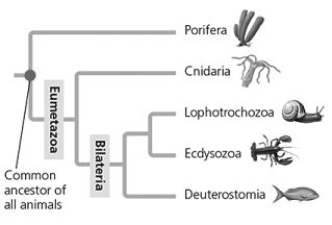 In Figure 33.2, which two main clades branch from the most recent common ancestor of the eumetazoans?
 (Multiple Choice)
5.0/5 (82)
(82) Use the following information to answer the question.
A farm pond, usually dry during winter, has plenty of water and aquatic pond life during the summer. One summer, Sarah returns to the family farm from college. Observing the pond, she is fascinated by some six-legged organisms that can crawl about on submerged surfaces or, when disturbed, seemingly "jet" through the water. Watching further, she is able to conclude that the "mystery organisms" are ambush predators, and their prey includes everything from insects to small fish and tadpoles.
If the pond organisms are larvae, rather than adults, Sarah should expect them to have all of the following structures, except ________.
(Multiple Choice)
4.9/5 (84)
(84) 
Filters
- Essay(0)
- Multiple Choice(0)
- Short Answer(0)
- True False(0)
- Matching(0)