



 Chat with AI
Exam 25: The History of Life on Earth

Exam 1: Evolution, the Themes of Biology, and Scientific Inquiry51 Questions
Exam 2: The Chemical Context of Life61 Questions
Exam 3: Water and Life55 Questions
Exam 4: Carbon and the Molecular Diversity of Life58 Questions
Exam 5: The Structure and Function of Large Biological Molecules70 Questions
Exam 6: A Tour of the Cell66 Questions
Exam 7: Membrane Structure and Function68 Questions
Exam 8: An Introduction to Metabolism67 Questions
Exam 9: Cellular Respiration and Fermentation68 Questions
Exam 10: Photosynthesis65 Questions
Exam 11: Cell Communication65 Questions
Exam 12: The Cell Cycle66 Questions
Exam 13: Meiosis and Sexual Life Cycles64 Questions
Exam 14: Mendel and the Gene Idea62 Questions
Exam 15: The Chromosomal Basis of Inheritance58 Questions
Exam 16: The Molecular Basis of Inheritance65 Questions
Exam 17: Gene Expression: From Gene to Protein67 Questions
Exam 18: Regulation of Gene Expression66 Questions
Exam 19: Viruses54 Questions
Exam 20: DNA Tools and Biotechnology57 Questions
Exam 21: Genomes and Their Evolution44 Questions
Exam 22: Descent with Modification: A Darwinian View of Life60 Questions
Exam 23: The Evolution of Populations64 Questions
Exam 24: The Origin of Species67 Questions
Exam 25: The History of Life on Earth59 Questions
Exam 26: Phylogeny and the Tree of Life75 Questions
Exam 27: Bacteria and Archaea75 Questions
Exam 28: Protists79 Questions
Exam 29: Plant Diversity I: How Plants Colonized Land82 Questions
Exam 30: Plant Diversity II: The Evolution of Seed Plants80 Questions
Exam 31: Fungi75 Questions
Exam 32: An Overview of Animal Diversity67 Questions
Exam 33: An Introduction to Invertebrates83 Questions
Exam 34: The Origin and Evolution of Vertebrates82 Questions
Exam 35: Vascular Plant Structure, Growth, and Development65 Questions
Exam 36: Resource Acquisition and Transport in Vascular Plants74 Questions
Exam 37: Soil and Plant Nutrition52 Questions
Exam 38: Angiosperm Reproduction and Biotechnology60 Questions
Exam 39: Plant Responses to Internal and External Signals61 Questions
Exam 40: Basic Principles of Animal Form and Function68 Questions
Exam 41: Animal Nutrition64 Questions
Exam 42: Circulation and Gas Exchange67 Questions
Exam 43: The Immune System69 Questions
Exam 44: Osmoregulation and Excretion64 Questions
Exam 45: Hormones and the Endocrine System66 Questions
Exam 46: Animal Reproduction68 Questions
Exam 47: Animal Development70 Questions
Exam 48: Neurons, Synapses, and Signaling68 Questions
Exam 49: Nervous Systems65 Questions
Exam 50: Sensory and Motor Mechanisms67 Questions
Exam 51: Animal Behavior69 Questions
Exam 52: An Introduction to Ecology and the Biosphere68 Questions
Exam 53: Population Ecology69 Questions
Exam 54: Community Ecology71 Questions
Exam 55: Ecosystems and Restoration Ecology68 Questions
Exam 56: Conservation Biology and Global Change69 Questions
Select questions type


The Permian period ended and then rapid speciation occurred as new animal and plant forms evolved. The most likely explanation for this is ________.
I adaptive radiation
II ecological opportunity
III lack of competition
IV morphological innovation
(Multiple Choice)
4.9/5  (71)
(71) Which of the following showed their greatest diversity during the Mesozoic era but were a small, less diverse group during the Paleozoic era?
(Multiple Choice)
4.8/5 (81)
(81) You are the lucky student of a wacky professor who develops a time machine. He asks if you will test it with him. You get in, and there is an immediate glitch-the date readout fails so that when you land, you are not sure what era you are in. Your professor begins to panic, but you see something that tells you are in the Cenozoic era. Which of the following could it be?
(Multiple Choice)
4.9/5 (87)
(87) Use the following information to answer the question.
A sediment core is removed from the floor of an inland sea. The sea has been in existence, off and on, throughout the entire time that terrestrial life has existed. Researchers wish to locate and study the terrestrial organisms fossilized in this core. The core is illustrated as a vertical column, with the top of the column representing the most recent strata and the bottom representing the time when land was first colonized by life.
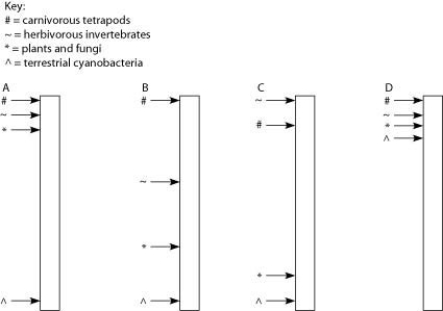 To assign absolute dates to fossils in this sediment core, it would be most helpful if ________.
 (Multiple Choice)
4.8/5 (76)
(76) Use the following information to answer the question.
A sediment core is removed from the floor of an inland sea. The sea has been in existence, off and on, throughout the entire time that terrestrial life has existed. Researchers wish to locate and study the terrestrial organisms fossilized in this core. The core is illustrated as a vertical column, with the top of the column representing the most recent strata and the bottom representing the time when land was first colonized by life.
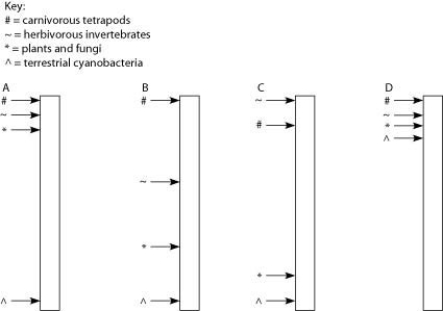 If arrows indicate locations in the column where fossils of a particular type (see key)first appear, then which core in the figure above has the most accurate arrangement of fossils?
 (Multiple Choice)
4.8/5 (76)
(76) Refer to the following information to answer the question.
Fossils of Lystrosaurus, a dicynodont therapsid, are most common in parts of modern-day South America, South Africa, Madagascar, India, South Australia, and Antarctica. The animal apparently lived in arid regions and was mostly herbivorous. It originated during the mid-Permian period, survived the Permian extinction, and dwindled by the late Triassic, though there is evidence of a relict population in Australia during the Cretaceous period. Some dicynodonts had two large tusks, extending down from their upper jaws. The tusks were not used for food gathering, and in some species were limited to males. Food was gathered using an otherwise toothless beak. Judging from the fossil record in sedimentary rocks, these pig-sized organisms were the most common mammal-like reptiles of the Permian.
What is thought to be the correct sequence of these events, from earliest to most recent, in the evolution of life on Earth?
1)origin of mitochondria
2)origin of multicellular eukaryotes
3)origin of chloroplasts
4)origin of cyanobacteria
5)origin of fungal-plant symbioses
(Multiple Choice)
5.0/5 (72)
(72) According to the theory of seafloor spreading, oceanic islands, such as the Hawaiian Islands, form as oceanic crustal plates move over a stationary "hot spot" in the mantle. Currently, the big island of Hawaii is thought to be over a hot spot, which is why it is the only one of the seven large islands that has active volcanoes. What should be true of the island of Hawaii?
I Scientists in search of ongoing speciation events are more likely to find them here than on the other six large islands.
II Its species should be more closely related to those of nearer islands than to those of farther islands.
III It should have a rich fossil record of terrestrial organisms.
IV)It should have species that are not found anywhere else on Earth.
V On average, it should have fewer species per-unit surface area than the other six islands.
(Multiple Choice)
4.9/5 (70)
(70) One hypothesis that has been proposed regarding the origin of life suggests that life evolved from an "RNA world" to today's "DNA world." Considering the properties of RNA and DNA molecules, which questions would direct an investigation of the most insightful test of this hypothesis?
(Multiple Choice)
4.8/5 (72)
(72) Which of the following is the correct sequence of events in the origin of life?
I Formation of protocells
II Synthesis of organic monomers
III Synthesis of organic polymers
IV Formation of DNA-based genetic systems
(Multiple Choice)
4.8/5 (85)
(85) Which factor most likely caused animals and plants in India to differ greatly from species in nearby southeast Asia?
(Multiple Choice)
4.9/5 (80)
(80) The loss of ventral spines by modern freshwater sticklebacks is due to natural selection operating on the phenotypic effects of Pitx1 gene ________.
(Multiple Choice)
4.9/5 (78)
(78) Which of the following characteristics are expected in the first animals to have colonized land?
I They were probably herbivores (ate photosynthesizers).
II Animals had four appendages.
III Animals had the ability to resist dehydration.
IV Animals had lobe-finned fishes as ancestors.
V Invertebrates
(Multiple Choice)
4.8/5 (80)
(80) In 2013, researchers constructed a vesicle with replicated RNA. Why was this significant evidence for abiotic origin of life?
(Multiple Choice)
5.0/5 (82)
(82) Which of the following would be least likely to appear in the fossil record?
(Multiple Choice)
4.8/5 (79)
(79) What is the most accurate method used to measure the age of a fossil?
(Multiple Choice)
4.8/5 (103)
(103) Which of the following steps has not yet been accomplished by scientists studying the origin of life?
(Multiple Choice)
4.9/5 (85)
(85) Which of the following organisms would be most likely to form a fossil?
(Multiple Choice)
4.9/5 (78)
(78) Insect wings may have begun to evolve as lateral extensions of the body that were used as heat dissipaters for thermoregulation. When they had become sufficiently large, these extensions became useful for gliding through the air. Additional selection refined them as flight-producing wings. If this hypothesis is correct, modern insect wings would be an example of ________.
(Multiple Choice)
5.0/5 (85)
(85) 
Filters
- Essay(0)
- Multiple Choice(0)
- Short Answer(0)
- True False(0)
- Matching(0)