



 Chat with AI
Exam 16: The Molecular Basis of Inheritance

Exam 1: Evolution, the Themes of Biology, and Scientific Inquiry51 Questions
Exam 2: The Chemical Context of Life61 Questions
Exam 3: Water and Life55 Questions
Exam 4: Carbon and the Molecular Diversity of Life58 Questions
Exam 5: The Structure and Function of Large Biological Molecules70 Questions
Exam 6: A Tour of the Cell66 Questions
Exam 7: Membrane Structure and Function68 Questions
Exam 8: An Introduction to Metabolism67 Questions
Exam 9: Cellular Respiration and Fermentation68 Questions
Exam 10: Photosynthesis65 Questions
Exam 11: Cell Communication65 Questions
Exam 12: The Cell Cycle66 Questions
Exam 13: Meiosis and Sexual Life Cycles64 Questions
Exam 14: Mendel and the Gene Idea62 Questions
Exam 15: The Chromosomal Basis of Inheritance58 Questions
Exam 16: The Molecular Basis of Inheritance65 Questions
Exam 17: Gene Expression: From Gene to Protein67 Questions
Exam 18: Regulation of Gene Expression66 Questions
Exam 19: Viruses54 Questions
Exam 20: DNA Tools and Biotechnology57 Questions
Exam 21: Genomes and Their Evolution44 Questions
Exam 22: Descent with Modification: A Darwinian View of Life60 Questions
Exam 23: The Evolution of Populations64 Questions
Exam 24: The Origin of Species67 Questions
Exam 25: The History of Life on Earth59 Questions
Exam 26: Phylogeny and the Tree of Life75 Questions
Exam 27: Bacteria and Archaea75 Questions
Exam 28: Protists79 Questions
Exam 29: Plant Diversity I: How Plants Colonized Land82 Questions
Exam 30: Plant Diversity II: The Evolution of Seed Plants80 Questions
Exam 31: Fungi75 Questions
Exam 32: An Overview of Animal Diversity67 Questions
Exam 33: An Introduction to Invertebrates83 Questions
Exam 34: The Origin and Evolution of Vertebrates82 Questions
Exam 35: Vascular Plant Structure, Growth, and Development65 Questions
Exam 36: Resource Acquisition and Transport in Vascular Plants74 Questions
Exam 37: Soil and Plant Nutrition52 Questions
Exam 38: Angiosperm Reproduction and Biotechnology60 Questions
Exam 39: Plant Responses to Internal and External Signals61 Questions
Exam 40: Basic Principles of Animal Form and Function68 Questions
Exam 41: Animal Nutrition64 Questions
Exam 42: Circulation and Gas Exchange67 Questions
Exam 43: The Immune System69 Questions
Exam 44: Osmoregulation and Excretion64 Questions
Exam 45: Hormones and the Endocrine System66 Questions
Exam 46: Animal Reproduction68 Questions
Exam 47: Animal Development70 Questions
Exam 48: Neurons, Synapses, and Signaling68 Questions
Exam 49: Nervous Systems65 Questions
Exam 50: Sensory and Motor Mechanisms67 Questions
Exam 51: Animal Behavior69 Questions
Exam 52: An Introduction to Ecology and the Biosphere68 Questions
Exam 53: Population Ecology69 Questions
Exam 54: Community Ecology71 Questions
Exam 55: Ecosystems and Restoration Ecology68 Questions
Exam 56: Conservation Biology and Global Change69 Questions
Select questions type


How does the enzyme telomerase meet the challenge of replicating the ends of linear chromosomes?
(Multiple Choice)
4.8/5  (83)
(83) Who performed classic experiments that supported the semiconservative model of DNA replication?
(Multiple Choice)
4.9/5 (80)
(80) Which of the following statements accurately describes the differences between DNA replication in prokaryotes and DNA replication in eukaryotes?
(Multiple Choice)
4.8/5 (77)
(77) In DNA replication, the resulting daughter molecules contain one strand of the original parental DNA and one new strand. What is the explanation for this phenomenon?
(Multiple Choice)
4.9/5 (85)
(85) After the first replication was observed in their experiments testing the nature of DNA replication, Meselson and Stahl could be confident of which of the following conclusions?
(Multiple Choice)
4.8/5 (79)
(79) Hershey and Chase set out to determine what molecule served as the unit of inheritance. They completed a series of experiments in which E. coli was infected by a T2 virus. Which molecular component of the T2 virus actually ended up inside the cell?
(Multiple Choice)
4.9/5 (79)
(79) At a specific area of a chromosome, the sequence of nucleotides below is present where the chain opens to form a replication fork:
3' C C T A G G C T G C A A T C C 5'
An RNA primer is formed starting at the underlined T (T)of the template. Which of the following represents the primer sequence?
(Multiple Choice)
4.8/5 (86)
(86) What is meant by the description "antiparallel" regarding the two strands that make up the DNA double helix?
(Multiple Choice)
4.7/5 (83)
(83) What is the role of DNA ligase in the elongation of the lagging strand during DNA replication?
(Multiple Choice)
4.8/5 (88)
(88) Which of the following statements describes the process of transformation in bacteria?
(Multiple Choice)
4.8/5 (84)
(84) A biochemist isolates, purifies, and combines in a test tube a variety of molecules needed for DNA replication. When she adds some DNA to the mixture, replication occurs, but each DNA molecule consists of a normal strand paired with numerous segments of DNA a few hundred nucleotides long. What has she probably left out of the mixture?
(Multiple Choice)
5.0/5 (77)
(77) What is the function of the enzyme topoisomerase in DNA replication?
(Multiple Choice)
4.8/5 (78)
(78) If a cell were unable to produce histone proteins, which of the following results would be a likely effect on the cell?
(Multiple Choice)
4.8/5 (79)
(79) In an analysis of the nucleotide composition of a molecule of DNA, which of the following combinations of base pairs will be found?
(Multiple Choice)
5.0/5 (79)
(79) Use the figure to answer the following question.
Single strand as a template plus end to start DNA synthesis
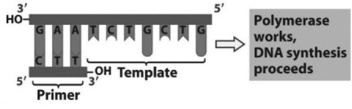 Referring to the figure, what bases will be added to the primer as DNA replication proceeds?
 (Multiple Choice)
4.8/5 (79)
(79) Which of the following facts did Hershey and Chase make use of in trying to determine whether DNA or protein is the genetic material?
(Multiple Choice)
4.8/5 (81)
(81) Suppose you are provided with an actively dividing culture of E. coli bacteria to which radioactive thymine has been added. What would happen if a cell replicates once in the presence of this radioactive base?
(Multiple Choice)
4.8/5 (81)
(81) In analyzing the number of different bases in a DNA sample, which result would be consistent with the base-pairing rules?
(Multiple Choice)
4.8/5 (69)
(69) Individuals with the disorder xeroderma pigmentosum are hypersensitive to sunlight, and mutations to the DNA in their skin cells are left uncorrected. Why are the mutations not corrected in individuals with this disorder?
(Multiple Choice)
4.9/5 (66)
(66) 
Filters
- Essay(0)
- Multiple Choice(0)
- Short Answer(0)
- True False(0)
- Matching(0)