



 Chat with AI
Exam 15: Monopolistic Competition and Product Differentiation

Exam 1: First Principles233 Questions
Exam 2: Economic Models: Trade-Offs and Trade 25382 Questions
Exam 3: Supply and Demand290 Questions
Exam 4: Consumer and Producer Surplus224 Questions
Exam 5: Price Controls and Quotas: Meddling With Markets227 Questions
Exam 6: Elasticity300 Questions
Exam 7: Taxes298 Questions
Exam 8: International Trade272 Questions
Exam 9: Decision Making by Individuals Firms201 Questions
Exam 10: The Rational Consumer372 Questions
Exam 11: Behind the Supply Curve: Inputs and Costs362 Questions
Exam 12: Perfect Competition and the Supply Curve355 Questions
Exam 13: Monopoly350 Questions
Exam 14: Oligopoly294 Questions
Exam 15: Monopolistic Competition and Product Differentiation262 Questions
Exam 16: Externalities199 Questions
Exam 17: Public Goods Common Resources224 Questions
Exam 18: The Economics of the Welfare140 Questions
Exam 19: Factor Markets and the Distribution of Income369 Questions
Exam 20: Uncertainty, Risk, and Private Information202 Questions
Select questions type


Use the following to answer questions:
Figure: Profits in Monopolistic Competition  -(Figure: Profits in Monopolistic Competition) In panel (A) of the figure Profits in Monopolistic Competition, the profit-maximizing quantity of output is determined by the intersection at point:
 (Multiple Choice)
5.0/5  (86)
(86) Use the following to answer questions:
Figure: Profit Maximization in Monopolistic Competition 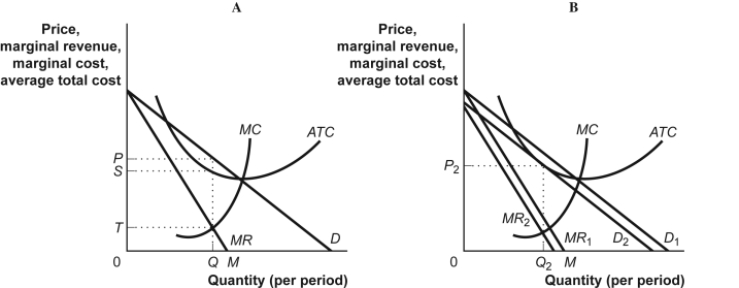 -(Figure: Profit Maximization in Monopolistic Competition) In panel (A) of the figure Profit Maximization in Monopolistic Competition, if the firm raises its price above P, it will:
 (Multiple Choice)
5.0/5 (86)
(86) General Snacks is a typical firm in a market characterized by monopolistic competition. Initially, the market is in long-run equilibrium, and then there is an increase in the market demand for snacks. In the short run the price of snacks will _____ and the output of snacks will _____.
(Multiple Choice)
4.7/5 (71)
(71) Toby operates a small deli downtown. The deli industry is monopolistically competitive. If some delis leave the industry, Toby's _____ curve will shift to the _____.
(Multiple Choice)
4.8/5 (97)
(97) Many customers will walk right past a diner that serves coffee and go to Starbucks, where they pay more for a cup of java. For these customers, coffee is differentiated by:
(Multiple Choice)
4.9/5 (70)
(70) Advertising is an economically productive activity and NOT a waste of resources because:
(Multiple Choice)
4.9/5 (76)
(76) Use the following to answer questions:
Figure: Profit Maximization in Monopolistic Competition
-(Figure: Profit Maximization in Monopolistic Competition) In panel (B) of the figure Profit Maximization in Monopolistic Competition, the long-run equilibrium will result in:
-(Figure: Profit Maximization in Monopolistic Competition) In panel (B) of the figure Profit Maximization in Monopolistic Competition, the long-run equilibrium will result in: (Multiple Choice)
4.9/5 (71)
(71) The _____ demand curve for a firm operating in a monopolistically competitive market _____ facing a perfectly competitive firm.
(Multiple Choice)
4.9/5 (88)
(88) Use the following to answer questions:
Figure: Comparing Long-Run Equilibriums 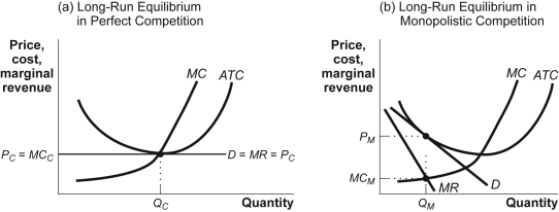 -(Figure: Comparing Long-Run Equilibriums) In the figure Comparing Long-Run Equilibriums, which of the following statements is TRUE?
 (Multiple Choice)
4.8/5 (81)
(81) The main characteristic that distinguishes monopolistic competition from perfect competition is:
(Multiple Choice)
4.8/5 (89)
(89) Monopolistic competitors often hire a celebrity spokesperson to advertise their product. One reason such advertising works is that:
(Multiple Choice)
4.9/5 (79)
(79) A monopolistically competitive firm may have positive or negative profits in the short run but will have zero profits in the long run.
(True/False)
4.7/5 (75)
(75) General Snacks is a typical firm in a market characterized by the model of monopolistic competition. Initially, the market is initially in long-run equilibrium, and then there is an increase in the market demand for snacks. We expect that:
(Multiple Choice)
4.9/5 (83)
(83) A monopolistically competitive firm has excess capacity in the long run. This means that it:
(Multiple Choice)
4.9/5 (74)
(74) Value in diversity means that by providing a variety of differentiated choices, firms in monopolistic competition provide a gain to consumers.
(True/False)
5.0/5 (83)
(83) Use the following to answer questions:
Figure: Profit Maximization for a Firm in Monopolistic Competition  -(Figure: Profit Maximization for a Firm in Monopolistic Competition) Look at the figure Profit Maximization for a Firm in Monopolistic Competition. Suppose that an innovation reduces a firm's costs from ATC to ATC'. Before the innovation reduced the cost, the firm's maximum economic profit was:
 (Multiple Choice)
4.9/5 (84)
(84) If monopolistically competitive firms are earning positive economic profits in the short run, then in the long run:
(Multiple Choice)
4.9/5 (85)
(85) Use the following to answer questions:
Figure: Firms in Monopolistic Competition 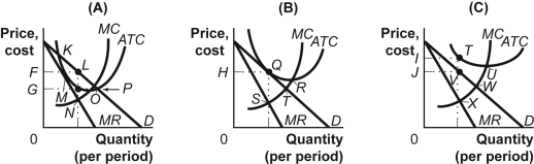 -(Figure: Firms in Monopolistic Competition) In panel (A) of the figure Firms in Monopolistic Competition, the profit-maximizing quantity of output is determined by the intersection at point:
 (Multiple Choice)
4.9/5 (78)
(78) Use the following to answer questions:
Figure: The Restaurant Market  -(Figure: The Restaurant Market) The figure The Restaurant Market shows curves facing a typical restaurant. Assume that many firms, differentiated products, and easy entry and exit characterize the market. In the long run:
 (Multiple Choice)
4.8/5 (78)
(78) In the short run, a monopolistically competitive firm produces at the optimal level of output and is earning positive economic profits. In the long run, the _____ of firms shifts the firm's demand and marginal revenue curves _____ the firm's level of output and _____ the price it can charge until price equals average total cost.
(Multiple Choice)
4.7/5 (75)
(75) 
Filters
- Essay(0)
- Multiple Choice(0)
- Short Answer(0)
- True False(0)
- Matching(0)