



 Chat with AI
Exam 17: Public Goods Common Resources

Exam 1: First Principles233 Questions
Exam 2: Economic Models: Trade-Offs and Trade 25382 Questions
Exam 3: Supply and Demand290 Questions
Exam 4: Consumer and Producer Surplus224 Questions
Exam 5: Price Controls and Quotas: Meddling With Markets227 Questions
Exam 6: Elasticity300 Questions
Exam 7: Taxes298 Questions
Exam 8: International Trade272 Questions
Exam 9: Decision Making by Individuals Firms201 Questions
Exam 10: The Rational Consumer372 Questions
Exam 11: Behind the Supply Curve: Inputs and Costs362 Questions
Exam 12: Perfect Competition and the Supply Curve355 Questions
Exam 13: Monopoly350 Questions
Exam 14: Oligopoly294 Questions
Exam 15: Monopolistic Competition and Product Differentiation262 Questions
Exam 16: Externalities199 Questions
Exam 17: Public Goods Common Resources224 Questions
Exam 18: The Economics of the Welfare140 Questions
Exam 19: Factor Markets and the Distribution of Income369 Questions
Exam 20: Uncertainty, Risk, and Private Information202 Questions
Select questions type


Use the following to answer questions:  -(Table: Total Cost and Total Individual Benefit) Look at the table Total Cost and Total Individual Benefit. If there are 1,000 residents and they all have the same total individual benefit, as shown in the table, what is the total social benefit of three animal control officers?
 (Multiple Choice)
4.9/5  (94)
(94) In a market economy, goods that are nonrival in consumption are subject to inefficiently low production.
(True/False)
4.9/5 (84)
(84) The source of the inefficient use of artificially scarce goods is similar to the source of inefficiencies created by:
(Multiple Choice)
4.8/5 (81)
(81) Use the following to answer questions:
Figure: Market Failure  -(Figure: Market Failure) Look at the figure Market Failure. Suppose the supply curve represents the marginal cost of providing streetlights in a neighborhood that is composed of two people, Ann and Joe. The demand curve represents the marginal benefit that Ann receives from the streetlights. Suppose that Joe's marginal benefit from the streetlights is a constant amount equal to AC. How much is Ann willing to pay for F streetlights?
 (Multiple Choice)
4.8/5 (72)
(72) If the use of a common resource is determined in the private market, the resource will be _____, since the marginal social benefit will be equal to the marginal private cost of production, which is _____ than the marginal social cost.
(Multiple Choice)
4.8/5 (85)
(85) Use the following to answer questions: 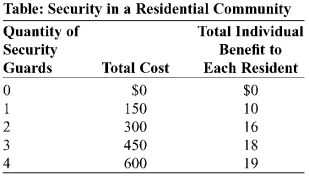 -(Table: Security in a Residential Community) Look at the table Security in a Residential Community. The marginal cost of hiring the second security guard is _____, and the marginal social benefit is _____.
 (Multiple Choice)
4.7/5 (91)
(91) Use the following to answer question:
Figure: Marginal Social Cost and Supply 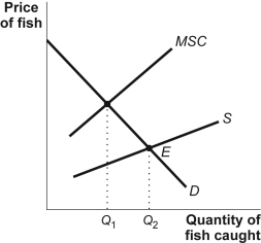 -(Figure: Marginal Social Cost and Supply) Look at the figure Marginal Social Cost and Supply. The marginal social cost curve lies above the supply curve:
 (Multiple Choice)
4.7/5 (83)
(83) If the extent to which common resources (such as fish in the sea) should be used is left to the private market:
(Multiple Choice)
4.8/5 (91)
(91) If a good has a marginal cost of production of zero and an inefficiently low level of consumption, the good must be a(n):
(Multiple Choice)
5.0/5 (94)
(94) Suppose the Alaskan king crab harvest is unregulated and any person with a crab boat and some diesel fuel can go offshore, lower a crab pot, and harvest king crab. As a result, this common resource is overused. Which of the following policy choices might produce the socially optimal king crab harvest?
(Multiple Choice)
4.9/5 (86)
(86) The private market will lead to _____ of clean air because _____.
(Multiple Choice)
4.8/5 (79)
(79) Use the following to answer questions:
Figure: Traffic Lights in Plymouth  -(Figure: Traffic Lights in Plymouth) Look at the figure Traffic Lights in Plymouth. Plymouth has 1,000 residents. Each of the residents has the same individual marginal benefit per traffic light. If the town's population doubles and the new residents share the identical individual marginal benefit of the existing residents, the socially efficient quantity of traffic lights will:
 (Multiple Choice)
4.8/5 (84)
(84) Use the following to answer questions:
Figure: Market Failure
-(Figure: Market Failure) Look at the figure Market Failure. Suppose the supply curve represents the marginal cost of providing streetlights in a neighborhood that is composed of two people, Ann and Joe. The demand curve represents the marginal benefit that Ann receives from the streetlights. Suppose that Joe's marginal benefit from the streetlights is a constant amount equal to AC. The market would provide _____ streetlights. The efficient quantity of streetlights is _____.
-(Figure: Market Failure) Look at the figure Market Failure. Suppose the supply curve represents the marginal cost of providing streetlights in a neighborhood that is composed of two people, Ann and Joe. The demand curve represents the marginal benefit that Ann receives from the streetlights. Suppose that Joe's marginal benefit from the streetlights is a constant amount equal to AC. The market would provide _____ streetlights. The efficient quantity of streetlights is _____. (Multiple Choice)
4.8/5 (75)
(75) Use the following to answer questions:
Figure: An Individual's Marginal Benefit from a Public Good  -(Figure: An Individual's Marginal Benefit from a Public Good) Look at the figure An Individual's Marginal Benefit from a Public Good. Assume that two individuals will share consumption of a public good; each individual has the marginal benefit curve shown in the figure. If the marginal cost of the good is $24, how many units of the public good will be provided by the private market?
 (Multiple Choice)
4.8/5 (79)
(79) On hot summer days, beach parking lots are usually full by early morning even though one must pay to park there. Parking at such lots is _____ in consumption and _____.
(Multiple Choice)
4.9/5 (73)
(73) The marginal cost of producing an artificially scarce good is equal to:
(Multiple Choice)
4.8/5 (70)
(70) A common resource is a good or service for which exclusion is _____ and which is _____ in consumption.
(Multiple Choice)
4.9/5 (75)
(75) Public goods differ from common resources in that both are _____, but public goods are _____, while common resources are _____.
(Multiple Choice)
4.8/5 (74)
(74) If the marginal social benefit received from a good is less than the marginal opportunity cost of production:
(Multiple Choice)
4.9/5 (71)
(71) 
Filters
- Essay(0)
- Multiple Choice(0)
- Short Answer(0)
- True False(0)
- Matching(0)