



 Chat with AI
Exam 20: Uncertainty, Risk, and Private Information

Exam 1: First Principles233 Questions
Exam 2: Economic Models: Trade-Offs and Trade 25382 Questions
Exam 3: Supply and Demand290 Questions
Exam 4: Consumer and Producer Surplus224 Questions
Exam 5: Price Controls and Quotas: Meddling With Markets227 Questions
Exam 6: Elasticity300 Questions
Exam 7: Taxes298 Questions
Exam 8: International Trade272 Questions
Exam 9: Decision Making by Individuals Firms201 Questions
Exam 10: The Rational Consumer372 Questions
Exam 11: Behind the Supply Curve: Inputs and Costs362 Questions
Exam 12: Perfect Competition and the Supply Curve355 Questions
Exam 13: Monopoly350 Questions
Exam 14: Oligopoly294 Questions
Exam 15: Monopolistic Competition and Product Differentiation262 Questions
Exam 16: Externalities199 Questions
Exam 17: Public Goods Common Resources224 Questions
Exam 18: The Economics of the Welfare140 Questions
Exam 19: Factor Markets and the Distribution of Income369 Questions
Exam 20: Uncertainty, Risk, and Private Information202 Questions
Select questions type


The wealthy are generally more risk-averse than the poor, since the wealthy have more to lose.
(True/False)
4.8/5  (91)
(91) Use the following to answer questions:
Scenario: Flood Area
Suppose you own a home that is estimated to be worth $250,000. You live in a flood plain; as a result, the probability that you will lose your home to a flood is 30%.
-(Scenario: Flood Area) Look at the scenario Flood Area. Suppose an insurance company offers you flood insurance. Most likely this insurance would require a premium payment:
(Multiple Choice)
4.9/5 (64)
(64) Use the following to answer questions:
Figure: Differences in Risk Aversion  -(Figure: Differences in Risk Aversion) Look at the figure Differences in Risk Aversion. An important reason Ernest and Salvatore may differ in their aversion to risk is:
 (Multiple Choice)
4.8/5 (74)
(74) Risk-averse individuals will always buy insurance, regardless of the premiums charged.
(True/False)
4.8/5 (89)
(89) If there is a 25% probability that Joseph will earn $10 per hour at his job today and a 75% probability that he will earn $20 per hour today, his expected pay per hour is:
(Multiple Choice)
4.8/5 (83)
(83) In practice, insurance companies faced with adverse selection use _____ to deal with it.
(Multiple Choice)
4.9/5 (76)
(76) Use the following to answer questions: 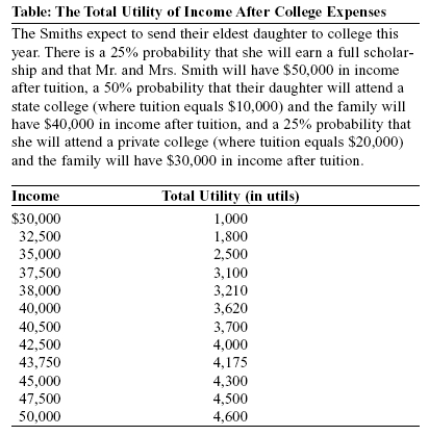 -(Table: Total Utility of Income After College Expenses) The Smith family will choose to purchase insurance:
 (Multiple Choice)
4.9/5 (74)
(74) You are considering the purchase of one ticket for a raffle with a grand prize of $1,000. There are two prizes worth $100 and five prizes worth $20. If you know that only 100 tickets will be sold, what is the most you would pay for one raffle ticket?
(Essay)
4.9/5 (76)
(76) Use the following to answer questions:
Scenario: Choosing Insurance
The Ramirez family owns three cars and is considering buying insurance to cover the cost of repairs. They face two possible states: in state 1 their cars need no repairs and their income available for purchasing other goods and services is $50,000; in state 2 their cars need $10,000 worth of repairs and their income available for purchasing other goods and services is reduced to $40,000. The probability of repairs is 10%, while the probability of no repairs is 90%.
-(Scenario: Choosing Insurance) Refer to the information in the scenario Choosing Insurance. For $2,000 the Ramirez family can buy insurance that will cover the full cost of repairs. If family members are risk-averse and want to maximize their expected utility:
(Multiple Choice)
4.8/5 (72)
(72) A fair insurance policy is one in which the premium equals the expected value of the claim.
(True/False)
4.8/5 (81)
(81) Use the following to answer questions:
Figure: Risk Aversion  -(Figure: Risk Aversion) Look at the figure Risk Aversion. Bob and Nancy have the same income and total utility. Nancy will be willing to pay a ____ insurance premium than Bob because she is _____ risk-averse.
 (Multiple Choice)
4.8/5 (79)
(79) Two individuals make up the auto insurance market. Bonnie drives well, and the probability of her having an accident is 10% this year. Lisa also drives carefully, and her probability of having an accident is 5%. What is the probability that Bonnie and Lisa will both have accidents this year?
(Multiple Choice)
4.8/5 (75)
(75) Use the following to answer questions:
Scenario: Health Costs
Alan is hoping for a healthy year, meaning that he would have zero health costs. Given his habits, there is a 40% chance that Alan will develop a health issue resulting in $50,000 in health costs. Assume these are the only two conditions that could exist for Alan in the coming year.
-(Scenario: Health Costs) Look at the scenario Health Costs. Given the fact that Alan has a 40% chance of developing a health problem, what is the expected value of Alan's health care costs for the coming year?
(Multiple Choice)
4.9/5 (81)
(81) The opportunity to engage in pooling shifts the _____ curve of insurance to the right; insurance companies will take on _____ risk and charge a _____ premium than without pooling.
(Multiple Choice)
4.8/5 (80)
(80) Buying a warranty on a new television is an example of paying to avoid risk.
(True/False)
4.8/5 (84)
(84) Toyotas are known for their quality and durability. As a result, compared to other used car markets, adverse selection in the used Toyota market is:
(Multiple Choice)
4.7/5 (72)
(72) 
Filters
- Essay(0)
- Multiple Choice(0)
- Short Answer(0)
- True False(0)
- Matching(0)