



 Chat with AI
Exam 9: Decision Making by Individuals Firms

Exam 1: First Principles233 Questions
Exam 2: Economic Models: Trade-Offs and Trade 25382 Questions
Exam 3: Supply and Demand290 Questions
Exam 4: Consumer and Producer Surplus224 Questions
Exam 5: Price Controls and Quotas: Meddling With Markets227 Questions
Exam 6: Elasticity300 Questions
Exam 7: Taxes298 Questions
Exam 8: International Trade272 Questions
Exam 9: Decision Making by Individuals Firms201 Questions
Exam 10: The Rational Consumer372 Questions
Exam 11: Behind the Supply Curve: Inputs and Costs362 Questions
Exam 12: Perfect Competition and the Supply Curve355 Questions
Exam 13: Monopoly350 Questions
Exam 14: Oligopoly294 Questions
Exam 15: Monopolistic Competition and Product Differentiation262 Questions
Exam 16: Externalities199 Questions
Exam 17: Public Goods Common Resources224 Questions
Exam 18: The Economics of the Welfare140 Questions
Exam 19: Factor Markets and the Distribution of Income369 Questions
Exam 20: Uncertainty, Risk, and Private Information202 Questions
Select questions type


Use the following to answer questions:
Scenario: Betty's Cookie Shop
Betty runs a cookie shop where she sells cookies for $1 each. She employs five people, each of whom worked a total of 500 hours last year; she paid them $10 per hour. Her costs of equipment and raw materials add up to $75,000. Her business ability is legendary, and other companies have offered to pay Betty $100,000 to come to work for them. She also knows she could sell her cookie shop for $150,000. The bank in town pays an annual interest rate of 3% on all funds deposited with it.
-(Scenario: Betty's Cookie Shop) Betty's explicit costs are equal to:
(Multiple Choice)
4.8/5  (81)
(81) Use the following to answer questions: 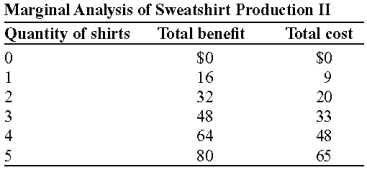 -(Table: Marginal Analysis of Sweatshirt Production II) Look at the table Marginal Analysis of Sweatshirt Production II. The optimal quantity of sweatshirts to produce is:
 (Multiple Choice)
4.9/5 (73)
(73) Which of the following is NOT a common mistake that leads to irrational decisions?
(Multiple Choice)
4.9/5 (77)
(77) Jacquelyn is a student at a major state university. Which of the following is NOT an explicit cost of her attending college?
(Multiple Choice)
5.0/5 (93)
(93) Use the following to answer questions: 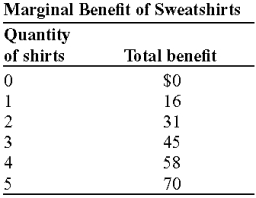 -(Table: Marginal Benefit of Sweatshirts) Look at the table Marginal Benefit of Sweatshirts. The marginal benefit of producing the third sweatshirt is:
 (Multiple Choice)
4.7/5 (72)
(72) If the marginal benefit received from consuming a good is less than the marginal cost of production:
(Multiple Choice)
5.0/5 (87)
(87) Anytime the marginal benefit of an activity is greater than zero, more activity should be undertaken.
(True/False)
4.8/5 (69)
(69) Mary goes ahead and buys a new car because she expects to receive a 10% increase in her salary next year. What type of behavior does this best represent?
(Multiple Choice)
4.9/5 (63)
(63) Which of the following statements about opportunity cost is FALSE?
(Multiple Choice)
4.9/5 (85)
(85) Joan loves sushi. Her first piece of sushi normally gives her a marginal benefit of $5. Each additional piece yields a marginal benefit that declines by $0.25 per piece. If her favorite sushi bar charges $2.75 per piece of sushi, how many pieces should she eat?
(Multiple Choice)
4.7/5 (91)
(91) Use the following to answer questions:
Scenario: Accounting and Economic Profit
Rather than put the $100,000 that his grandmother left him in a mutual fund that earns 5% each year, Tommy Wang quit his job, which paid $60,000 per year, and started Wang's Wicker Furniture Store. He rented a showroom for $20,000 for the year, purchased $60,000 in wicker furniture, and incurred costs of $40,000 for sales help and advertising. Instead of using the capital for his own business, he could rent it to a rival firm and earn $5,000 a year. In his first year, his revenue was $150,000.
-(Scenario: Accounting and Economic Profit) Look at the scenario Accounting and Economic Profit. The accounting profit of Wang's Wicker Furniture Store is:
(Multiple Choice)
4.8/5 (80)
(80) Use the following to answer questions:
Figure: The Optimal Quantity 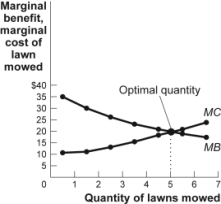 -(Figure: The Optimal Quantity) Look at the figure The Optimal Quantity. If the cost of lawn mowing increased for all quantities of lawns mowed, the _____ curve in the figure would shift to the _____ and the total profit would _____.
 (Multiple Choice)
5.0/5 (85)
(85) After three years at an expensive college, Pierre realizes that he doesn't want to finish school but really wants to be a chef. When Pierre suggests that he leave college for culinary school, his parents insist that he stay for one more year to get his degree. Which of the following is TRUE?
(Multiple Choice)
4.7/5 (82)
(82) Pauli's Pizza offers one slice for $2, two slices for $3.50, three slices for $4.50, and four slices for $5.00. The marginal cost of the third slice is:
(Multiple Choice)
4.8/5 (80)
(80) Use the following to answer questions:
Scenario: Accounting and Economic Profit
Rather than put the $100,000 that his grandmother left him in a mutual fund that earns 5% each year, Tommy Wang quit his job, which paid $60,000 per year, and started Wang's Wicker Furniture Store. He rented a showroom for $20,000 for the year, purchased $60,000 in wicker furniture, and incurred costs of $40,000 for sales help and advertising. Instead of using the capital for his own business, he could rent it to a rival firm and earn $5,000 a year. In his first year, his revenue was $150,000.
-(Scenario: Accounting and Economic Profit) Look at the scenario Accounting and Economic Profit. What is the implicit cost of Wang's Wicker Furniture Store?
(Multiple Choice)
4.7/5 (79)
(79) Tara notices that studying for one hour after class increases her economics grade by 11 points. The second hour yields a 7-point gain, the third hour yields a 4-point gain, and the fourth hour yields only a 1-point gain. This means that the marginal _____ of studying decreases with study hours.
(Multiple Choice)
4.8/5 (71)
(71) 
Filters
- Essay(0)
- Multiple Choice(0)
- Short Answer(0)
- True False(0)
- Matching(0)