



 Chat with AI
Exam 12: The Cell Cycle

Exam 1: Evolution, the Themes of Biology, and Scientific Inquiry51 Questions
Exam 2: The Chemical Context of Life61 Questions
Exam 3: Water and Life55 Questions
Exam 4: Carbon and the Molecular Diversity of Life58 Questions
Exam 5: The Structure and Function of Large Biological Molecules70 Questions
Exam 6: A Tour of the Cell66 Questions
Exam 7: Membrane Structure and Function68 Questions
Exam 8: An Introduction to Metabolism67 Questions
Exam 9: Cellular Respiration and Fermentation68 Questions
Exam 10: Photosynthesis65 Questions
Exam 11: Cell Communication65 Questions
Exam 12: The Cell Cycle66 Questions
Exam 13: Meiosis and Sexual Life Cycles64 Questions
Exam 14: Mendel and the Gene Idea62 Questions
Exam 15: The Chromosomal Basis of Inheritance58 Questions
Exam 16: The Molecular Basis of Inheritance65 Questions
Exam 17: Gene Expression: From Gene to Protein67 Questions
Exam 18: Regulation of Gene Expression66 Questions
Exam 19: Viruses54 Questions
Exam 20: DNA Tools and Biotechnology57 Questions
Exam 21: Genomes and Their Evolution44 Questions
Exam 22: Descent with Modification: A Darwinian View of Life60 Questions
Exam 23: The Evolution of Populations64 Questions
Exam 24: The Origin of Species67 Questions
Exam 25: The History of Life on Earth59 Questions
Exam 26: Phylogeny and the Tree of Life75 Questions
Exam 27: Bacteria and Archaea75 Questions
Exam 28: Protists79 Questions
Exam 29: Plant Diversity I: How Plants Colonized Land82 Questions
Exam 30: Plant Diversity II: The Evolution of Seed Plants80 Questions
Exam 31: Fungi75 Questions
Exam 32: An Overview of Animal Diversity67 Questions
Exam 33: An Introduction to Invertebrates83 Questions
Exam 34: The Origin and Evolution of Vertebrates82 Questions
Exam 35: Vascular Plant Structure, Growth, and Development65 Questions
Exam 36: Resource Acquisition and Transport in Vascular Plants74 Questions
Exam 37: Soil and Plant Nutrition52 Questions
Exam 38: Angiosperm Reproduction and Biotechnology60 Questions
Exam 39: Plant Responses to Internal and External Signals61 Questions
Exam 40: Basic Principles of Animal Form and Function68 Questions
Exam 41: Animal Nutrition64 Questions
Exam 42: Circulation and Gas Exchange67 Questions
Exam 43: The Immune System69 Questions
Exam 44: Osmoregulation and Excretion64 Questions
Exam 45: Hormones and the Endocrine System66 Questions
Exam 46: Animal Reproduction68 Questions
Exam 47: Animal Development70 Questions
Exam 48: Neurons, Synapses, and Signaling68 Questions
Exam 49: Nervous Systems65 Questions
Exam 50: Sensory and Motor Mechanisms67 Questions
Exam 51: Animal Behavior69 Questions
Exam 52: An Introduction to Ecology and the Biosphere68 Questions
Exam 53: Population Ecology69 Questions
Exam 54: Community Ecology71 Questions
Exam 55: Ecosystems and Restoration Ecology68 Questions
Exam 56: Conservation Biology and Global Change69 Questions
Select questions type


Through a microscope, you can see a cell plate beginning to develop across the middle of a cell and nuclei forming on either side of the cell plate. This cell is most likely
(Multiple Choice)
4.8/5  (76)
(76) Which of the following molecules is a protein maintained at steady levels throughout the cell cycle that requires cyclin to become catalytically active?
(Multiple Choice)
4.9/5 (85)
(85) A group of cells is assayed for DNA content immediately following mitosis and is found to have an average of 8 picograms of DNA per nucleus. How many picograms of DNA would be found in a nucleus at prophase of mitosis?
(Multiple Choice)
4.9/5 (76)
(76) Why do neurons and some other specialized cells divide infrequently?
(Multiple Choice)
4.8/5 (65)
(65) Use the data in the accompanying table to answer the question.
Minutes Spent in Cell Cycle Phases
Cell Type Beta 18 24 12 16 Delta 100 1 0 0 Gamma 18 48 14 20
The data in the table were obtained from a study of the length of time spent in each phase of the cell cycle by cells of three eukaryotic organisms designated beta, delta, and gamma. What is the best explanation for the data associated with delta cells?
(Multiple Choice)
4.8/5 (90)
(90) Nucleotides can be radiolabeled before they are incorporated into newly forming DNA and, therefore, can be assayed to track their incorporation. In a set of experiments, a student-faculty research team used labeled T nucleotides to study the incorporation of labeled nucleotides into a culture of lymphocytes. They found that the lymphocytes incorporated the labeled nucleotide at a significantly higher level after a pathogen was introduced into the culture. What might they conclude from this observation?
(Multiple Choice)
4.9/5 (84)
(84) Use the figure to answer the question below.
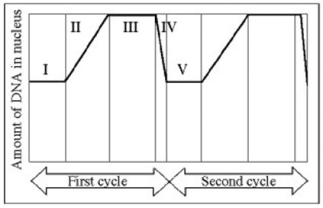 In the figure, which number represents DNA synthesis?
 (Multiple Choice)
4.9/5 (66)
(66) Use the figure to answer the question below.
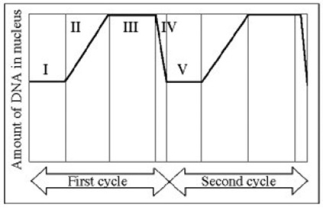 In the figure, MPF reaches its highest concentration during this stage.
 (Multiple Choice)
4.8/5 (75)
(75) The drug cytochalasin B blocks the function of actin. Which of the following aspects of the animal cell cycle would be most disrupted by cytochalasin B?
(Multiple Choice)
4.8/5 (66)
(66) The drug cytochalasin B blocks the function of actin. Which of the following aspects of the animal cell cycle would be most disrupted by cytochalasin B?
(Multiple Choice)
4.7/5 (81)
(81) Several organisms, primarily protists, have what are called intermediate mitotic organization. What is the most probable hypothesis about these intermediate forms of cell division?
(Multiple Choice)
4.8/5 (89)
(89) What is the name of the microtubule-organizing center found in animal cells as an identifiable structure present during all phases of the cell cycle?
(Multiple Choice)
4.7/5 (76)
(76) One difference between cancer cells and normal cells is that cancer cells
(Multiple Choice)
4.8/5 (88)
(88) At what stage of the cell cycle is the cyclin component of MPF destroyed?
(Multiple Choice)
4.8/5 (78)
(78) Use the figure to answer the question below.
The unlettered circle at the top of the figure shows a diploid nucleus with four chromosomes that have not yet replicated. There are two pairs of homologous chromosomes, one long and the other short. One haploid set is black, and the other is gray. The circles labeled A to E show various combinations of these chromosomes.
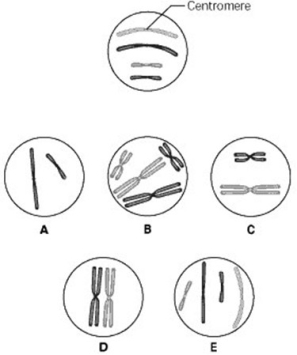 What is the correct chromosomal condition for one daughter nucleus at telophase of mitosis?
 (Multiple Choice)
4.7/5 (73)
(73) Vinblastine is a standard chemotherapeutic drug used to treat cancer. Because it interferes with the assembly of microtubules, its effectiveness must be related to
(Multiple Choice)
4.9/5 (82)
(82) Eukaryotic chromosomes are composed of which of the following macromolecules?
(Multiple Choice)
4.8/5 (83)
(83) Which of the following molecules is released by platelets in the vicinity of an injury?
(Multiple Choice)
4.9/5 (70)
(70) 
Filters
- Essay(0)
- Multiple Choice(0)
- Short Answer(0)
- True False(0)
- Matching(0)