



 Chat with AI
Exam 10: Photosynthesis

Exam 1: Evolution, the Themes of Biology, and Scientific Inquiry51 Questions
Exam 2: The Chemical Context of Life61 Questions
Exam 3: Water and Life55 Questions
Exam 4: Carbon and the Molecular Diversity of Life58 Questions
Exam 5: The Structure and Function of Large Biological Molecules70 Questions
Exam 6: A Tour of the Cell66 Questions
Exam 7: Membrane Structure and Function68 Questions
Exam 8: An Introduction to Metabolism67 Questions
Exam 9: Cellular Respiration and Fermentation68 Questions
Exam 10: Photosynthesis65 Questions
Exam 11: Cell Communication65 Questions
Exam 12: The Cell Cycle66 Questions
Exam 13: Meiosis and Sexual Life Cycles64 Questions
Exam 14: Mendel and the Gene Idea62 Questions
Exam 15: The Chromosomal Basis of Inheritance58 Questions
Exam 16: The Molecular Basis of Inheritance65 Questions
Exam 17: Gene Expression: From Gene to Protein67 Questions
Exam 18: Regulation of Gene Expression66 Questions
Exam 19: Viruses54 Questions
Exam 20: DNA Tools and Biotechnology57 Questions
Exam 21: Genomes and Their Evolution44 Questions
Exam 22: Descent with Modification: A Darwinian View of Life60 Questions
Exam 23: The Evolution of Populations64 Questions
Exam 24: The Origin of Species67 Questions
Exam 25: The History of Life on Earth59 Questions
Exam 26: Phylogeny and the Tree of Life75 Questions
Exam 27: Bacteria and Archaea75 Questions
Exam 28: Protists79 Questions
Exam 29: Plant Diversity I: How Plants Colonized Land82 Questions
Exam 30: Plant Diversity II: The Evolution of Seed Plants80 Questions
Exam 31: Fungi75 Questions
Exam 32: An Overview of Animal Diversity67 Questions
Exam 33: An Introduction to Invertebrates83 Questions
Exam 34: The Origin and Evolution of Vertebrates82 Questions
Exam 35: Vascular Plant Structure, Growth, and Development65 Questions
Exam 36: Resource Acquisition and Transport in Vascular Plants74 Questions
Exam 37: Soil and Plant Nutrition52 Questions
Exam 38: Angiosperm Reproduction and Biotechnology60 Questions
Exam 39: Plant Responses to Internal and External Signals61 Questions
Exam 40: Basic Principles of Animal Form and Function68 Questions
Exam 41: Animal Nutrition64 Questions
Exam 42: Circulation and Gas Exchange67 Questions
Exam 43: The Immune System69 Questions
Exam 44: Osmoregulation and Excretion64 Questions
Exam 45: Hormones and the Endocrine System66 Questions
Exam 46: Animal Reproduction68 Questions
Exam 47: Animal Development70 Questions
Exam 48: Neurons, Synapses, and Signaling68 Questions
Exam 49: Nervous Systems65 Questions
Exam 50: Sensory and Motor Mechanisms67 Questions
Exam 51: Animal Behavior69 Questions
Exam 52: An Introduction to Ecology and the Biosphere68 Questions
Exam 53: Population Ecology69 Questions
Exam 54: Community Ecology71 Questions
Exam 55: Ecosystems and Restoration Ecology68 Questions
Exam 56: Conservation Biology and Global Change69 Questions
Select questions type


Use the following figure to answer the question.
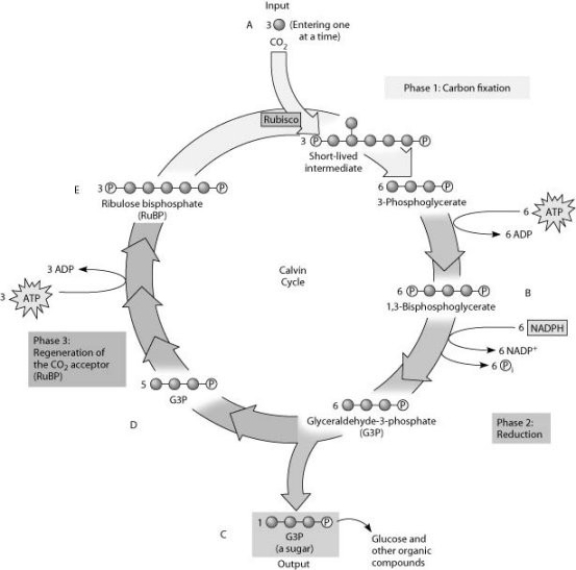 Refer to the accompanying figure and the molecules labeled A, B, C, D, and E. If the carbon atom of each of the incoming CO₂ molecules is labeled with a radioactive isotope of carbon, which organic molecules will be radioactively labeled after one cycle?
 (Multiple Choice)
4.9/5  (82)
(82) In a plant, which of the following reactions produce molecular oxygen (O₂)?
(Multiple Choice)
4.8/5 (90)
(90) Paper chromatography is a technique used to separate molecules based upon their size and solubility in a particular solvent. If pigments from a particular species of plant are extracted and subjected to paper chromatography, which of the following results is most likely?
(Multiple Choice)
4.8/5 (84)
(84) What are the products of linear electron flow during the light reactions of photosynthesis?
(Multiple Choice)
4.8/5 (71)
(71) Why are C₄ plants able to photosynthesize with no apparent photorespiration?
(Multiple Choice)
4.7/5 (69)
(69) Which of the following processes is most directly driven by light energy?
(Multiple Choice)
4.7/5 (66)
(66) In which of the following organisms did the process of photosynthesis most likely originate?
(Multiple Choice)
4.9/5 (76)
(76) Carbon dioxide is split to form oxygen gas and carbon compounds in which of the following metabolic pathways?
(Multiple Choice)
4.9/5 (85)
(85) A spaceship is designed to support animal life for a multiyear voyage to the outer planets of the solar system. Plants will be grown to provide oxygen and to recycle carbon dioxide. Since the spaceship will be too far from the sun for photosynthesis, an artificial light source will be needed. What wavelengths of light should be used to maximize plant growth with a minimum of energy expenditure?
(Multiple Choice)
4.8/5 (89)
(89) Use the following figure to answer the question.
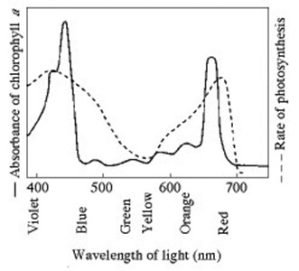 The figure shows the absorption spectrum for chlorophyll a and the action spectrum for photosynthesis. Why are they different?
 (Multiple Choice)
4.9/5 (77)
(77) What would be a likely consequence of a mutation in plants that results in a photorespiration deficiency?
(Multiple Choice)
4.9/5 (79)
(79) What is the relationship between the wavelength of light and the quantity of energy per photon?
(Multiple Choice)
4.9/5 (78)
(78) Which of the following processes occurs during the Calvin cycle?
(Multiple Choice)
4.9/5 (90)
(90) In the initial step in carbon fixation, a molecule of CO₂ is attached to RuBP to produce a six-carbon molecule, which is immediately split to produce two molecules of 3-phosphoglycerate. After phosphorylation and reduction produces glyceraldehyde 3-phosphate (G3P), what more needs to occur to complete the Calvin cycle?
(Multiple Choice)
5.0/5 (81)
(81) Which of the following statements correctly describes a distinction between autotrophs and heterotrophs?
(Multiple Choice)
4.8/5 (77)
(77) CAM plants keep stomata closed in the daytime, thus reducing loss of water. They can do this because they ________.
(Multiple Choice)
4.9/5 (78)
(78) Use the following figure to answer the question.
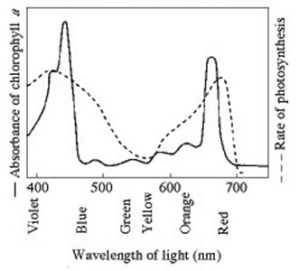 What wavelength of light in the figure is most effective in driving photosynthesis?
 (Multiple Choice)
4.8/5 (77)
(77) Students conducted an experiment to determine the effect of light intensity on the rate of photosynthesis. They punched 40 leaf disks from spinach leaves and used a syringe partially filled with water to pull the gases from the leaf disks so that all leaf disks sunk to the bottom of the syringe. Ten leaf disks from the syringe were placed in each of four cups and covered with 50 ml of the solutions as indicated below. All leaf disks were resting on the bottom of the cups when the experiment began. The volume of liquid in each cup and the temperature of the solutions were held constant. All cups were placed 0.5 meters from the designated light source. A large beaker of water was placed between the light and the cups to act as a heat sink to prevent a change in temperature. At the end of 10 minutes, the number of disks floating in each cup was recorded.
Trial Grams of baking soda source Wattage of light bulb Disks floating at 10 minutes 1 0.5 25 3 2 0.5 50 5 3 0.5 75 9 4 0 75 0
Use your knowledge of the mechanism of photosynthesis and the data presented in the chart to determine which of the statements is a correct explanation for the students' data.
(Multiple Choice)
4.9/5 (79)
(79) 
Filters
- Essay(0)
- Multiple Choice(0)
- Short Answer(0)
- True False(0)
- Matching(0)