



 Chat with AI
Exam 7: Membrane Structure and Function

Exam 1: Evolution, the Themes of Biology, and Scientific Inquiry51 Questions
Exam 2: The Chemical Context of Life61 Questions
Exam 3: Water and Life55 Questions
Exam 4: Carbon and the Molecular Diversity of Life58 Questions
Exam 5: The Structure and Function of Large Biological Molecules70 Questions
Exam 6: A Tour of the Cell66 Questions
Exam 7: Membrane Structure and Function68 Questions
Exam 8: An Introduction to Metabolism67 Questions
Exam 9: Cellular Respiration and Fermentation68 Questions
Exam 10: Photosynthesis65 Questions
Exam 11: Cell Communication65 Questions
Exam 12: The Cell Cycle66 Questions
Exam 13: Meiosis and Sexual Life Cycles64 Questions
Exam 14: Mendel and the Gene Idea62 Questions
Exam 15: The Chromosomal Basis of Inheritance58 Questions
Exam 16: The Molecular Basis of Inheritance65 Questions
Exam 17: Gene Expression: From Gene to Protein67 Questions
Exam 18: Regulation of Gene Expression66 Questions
Exam 19: Viruses54 Questions
Exam 20: DNA Tools and Biotechnology57 Questions
Exam 21: Genomes and Their Evolution44 Questions
Exam 22: Descent with Modification: A Darwinian View of Life60 Questions
Exam 23: The Evolution of Populations64 Questions
Exam 24: The Origin of Species67 Questions
Exam 25: The History of Life on Earth59 Questions
Exam 26: Phylogeny and the Tree of Life75 Questions
Exam 27: Bacteria and Archaea75 Questions
Exam 28: Protists79 Questions
Exam 29: Plant Diversity I: How Plants Colonized Land82 Questions
Exam 30: Plant Diversity II: The Evolution of Seed Plants80 Questions
Exam 31: Fungi75 Questions
Exam 32: An Overview of Animal Diversity67 Questions
Exam 33: An Introduction to Invertebrates83 Questions
Exam 34: The Origin and Evolution of Vertebrates82 Questions
Exam 35: Vascular Plant Structure, Growth, and Development65 Questions
Exam 36: Resource Acquisition and Transport in Vascular Plants74 Questions
Exam 37: Soil and Plant Nutrition52 Questions
Exam 38: Angiosperm Reproduction and Biotechnology60 Questions
Exam 39: Plant Responses to Internal and External Signals61 Questions
Exam 40: Basic Principles of Animal Form and Function68 Questions
Exam 41: Animal Nutrition64 Questions
Exam 42: Circulation and Gas Exchange67 Questions
Exam 43: The Immune System69 Questions
Exam 44: Osmoregulation and Excretion64 Questions
Exam 45: Hormones and the Endocrine System66 Questions
Exam 46: Animal Reproduction68 Questions
Exam 47: Animal Development70 Questions
Exam 48: Neurons, Synapses, and Signaling68 Questions
Exam 49: Nervous Systems65 Questions
Exam 50: Sensory and Motor Mechanisms67 Questions
Exam 51: Animal Behavior69 Questions
Exam 52: An Introduction to Ecology and the Biosphere68 Questions
Exam 53: Population Ecology69 Questions
Exam 54: Community Ecology71 Questions
Exam 55: Ecosystems and Restoration Ecology68 Questions
Exam 56: Conservation Biology and Global Change69 Questions
Select questions type


The sodium-potassium pump is called an electrogenic pump because it ________.
(Multiple Choice)
4.7/5  (87)
(87) In some cells, there are many ion electrochemical gradients across the plasma membrane even though there are usually only one or two proton pumps present in the membrane. The gradients of the other ions are most likely accounted for by ________.
(Multiple Choice)
4.8/5 (82)
(82) Which of the following molecules dramatically increases the rate of diffusion of water across cell membranes?
(Multiple Choice)
4.9/5 (80)
(80) For the following questions, match the labeled component of the cell membrane in the figure with its description.
-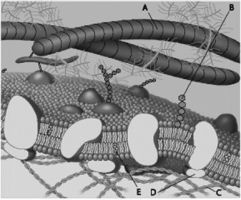 Which component in the accompanying figure is a microfilament (actin filament)of the cytoskeleton?
 (Multiple Choice)
4.7/5 (77)
(77) Three lab groups carried out an experiment to identify the concentration of sucrose in six solutions. Each unknown contained one of the following sucrose concentrations: 0.0 M, 0.2 M, 0.4 M, 0.6 M, 0.8 M, and -1.0 M. Cubes of sweet potato (1 cm³)were soaked for 24 hours in each solution and weighed to determine the change in mass. Each data entry represents the average of three sample replicates expressed as percent change in mass following a 24-hour soak in the unknown solutions. From the data given, which statement most accurately describes what is occurring in response to a particular unknown solution?
Unknown Percent change in Percent change in Percent change in Graup 1 Guss mass A 6.6 7.8 Group 3 B 3.1 3.7 7.5 E -2.7 -3.5 2.9 D 0.7 0.5 -2.5 E -11.6 -12.3 1.1 -5.2 6.2 -12.6
(Multiple Choice)
4.9/5 (88)
(88) Which of the following types of molecules are hydrophilic and therefore excluded from the hydrophobic portion of the phospholipid bilayer?
(Multiple Choice)
4.7/5 (72)
(72) According to the fluid mosaic model of membrane structure, proteins of the membrane are mostly
(Multiple Choice)
4.7/5 (75)
(75) 
Filters
- Essay(0)
- Multiple Choice(0)
- Short Answer(0)
- True False(0)
- Matching(0)