



 Chat with AI
Exam 1: The Environmental Challenges We Face

Exam 1: The Environmental Challenges We Face76 Questions
Exam 2: Sustainability and Human Values70 Questions
Exam 3: Environmental History, Politics, and Economics81 Questions
Exam 4: Risk Analysis and Environmental Health Hazards78 Questions
Exam 5: How Ecosystems Work91 Questions
Exam 6: Ecosystems and Evolution94 Questions
Exam 7: Human Population Change and the Environment89 Questions
Exam 8: Air and Air Pollution80 Questions
Exam 9: Global Atmospheric Changes68 Questions
Exam 10: Freshwater Resources and Water Pollution96 Questions
Exam 11: The Ocean and Fisheries74 Questions
Exam 12: Mineral and Soil Resources98 Questions
Exam 13: Land Resources78 Questions
Exam 14: Agriculture and Food Resources69 Questions
Exam 15: Biodiversity and Conservation73 Questions
Exam 16: Solid and Hazardous Waste69 Questions
Exam 17: Nonrenewable Energy Resources68 Questions
Exam 18: Renewable Energy Resources70 Questions
Select questions type


A _______ is a well substantiated explanation that is acquired through the scientific method and repeatedly tested and confirmed through observation and experimentation.
(Short Answer)
5.0/5  (76)
(76) A state agency has contacted you to do a scientific assessment of kudzu in a nature preserve in southern Georgia. They are concerned about the effects of the non-native invasive vine on a small rare plant that grows on the forest floor in the preserve, but which is found nowhere else in the state. Kudzu is only growing in the east side of the preserve because it hasn't yet had time to invade further. In order to assess the effects of kudzu on the rare plant, you set up the following experiment: Site 1. On the east side of the park with the kudzu, you set up ten 1m x 1m plots on the forest floor. In each plot you count the number of individuals of the rare plant.
Site 2. On the west side of the park without the kudzu, you set up ten 1m x 1m plots of the forest floor. In each plot you count the number of individuals of the rare plant.
In this experiment, Site 2 is your:
(Multiple Choice)
4.7/5 (64)
(64) Which of the following factors is as important as population in determining the environmental impact of humans?
(Multiple Choice)
4.8/5 (78)
(78) Outline how the scientific method is applied in order to solve environmental problems. Use a real-life example and correct terminology in your explanation.
(Essay)
4.8/5 (81)
(81) Which of the following statements associated with poverty is CORRECT? 1. Poverty is associated with a short life expectancy, illiteracy, and inadequate access to health services, safe water, and balanced nutrition
2. The number of people living in poverty has been steadily declining and today less than one billion people live in poverty worldwide.
3. Poverty is a condition in which people are unable to meet their basic needs for food, clothing, shelter, education, or health.
(Multiple Choice)
4.8/5 (85)
(85) Define environmental sustainability. Discuss three reasons why experts in environmental science think that the human population is not operating sustainability.
(Essay)
4.8/5 (64)
(64) Which of the following stages comes LAST in addressing environmental problems?
(Multiple Choice)
4.8/5 (80)
(80) Which of the following describes a highly developed country?
(Multiple Choice)
4.8/5 (73)
(73) What does this graph suggests about our current use of fossil fuels? 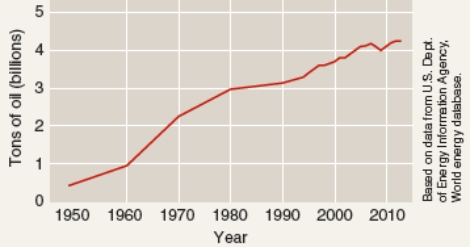
(Multiple Choice)
5.0/5 (93)
(93) 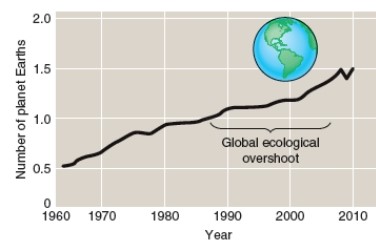
When you complained to a friend from India about India's high population she responded by suggesting you consider that the United States is also overpopulated. What do you think she meant?
(Multiple Choice)
4.8/5 (88)
(88) The scientific analysis and the study of interactions among organisms and their environment is called ________
(Short Answer)
4.8/5 (75)
(75) In order to estimate human impact on the environment we can
(Multiple Choice)
4.8/5 (82)
(82) 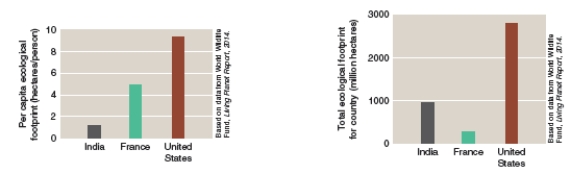
Which of the following represents an idea associated with environmental sustainability?
(Multiple Choice)
5.0/5 (72)
(72) 
Filters
- Essay(0)
- Multiple Choice(0)
- Short Answer(0)
- True False(0)
- Matching(0)