



 Chat with AI
Exam 1: Evolution, the Themes of Biology, and Scientific Inquiry

Exam 1: Evolution, the Themes of Biology, and Scientific Inquiry51 Questions
Exam 2: The Chemical Context of Life61 Questions
Exam 3: Water and Life55 Questions
Exam 4: Carbon and the Molecular Diversity of Life58 Questions
Exam 5: The Structure and Function of Large Biological Molecules70 Questions
Exam 6: A Tour of the Cell66 Questions
Exam 7: Membrane Structure and Function68 Questions
Exam 8: An Introduction to Metabolism67 Questions
Exam 9: Cellular Respiration and Fermentation68 Questions
Exam 10: Photosynthesis65 Questions
Exam 11: Cell Communication65 Questions
Exam 12: The Cell Cycle66 Questions
Exam 13: Meiosis and Sexual Life Cycles64 Questions
Exam 14: Mendel and the Gene Idea62 Questions
Exam 15: The Chromosomal Basis of Inheritance58 Questions
Exam 16: The Molecular Basis of Inheritance65 Questions
Exam 17: Gene Expression: From Gene to Protein67 Questions
Exam 18: Regulation of Gene Expression66 Questions
Exam 19: Viruses54 Questions
Exam 20: DNA Tools and Biotechnology57 Questions
Exam 21: Genomes and Their Evolution44 Questions
Exam 22: Descent with Modification: A Darwinian View of Life60 Questions
Exam 23: The Evolution of Populations64 Questions
Exam 24: The Origin of Species67 Questions
Exam 25: The History of Life on Earth59 Questions
Exam 26: Phylogeny and the Tree of Life75 Questions
Exam 27: Bacteria and Archaea75 Questions
Exam 28: Protists79 Questions
Exam 29: Plant Diversity I: How Plants Colonized Land82 Questions
Exam 30: Plant Diversity II: The Evolution of Seed Plants80 Questions
Exam 31: Fungi75 Questions
Exam 32: An Overview of Animal Diversity67 Questions
Exam 33: An Introduction to Invertebrates83 Questions
Exam 34: The Origin and Evolution of Vertebrates82 Questions
Exam 35: Vascular Plant Structure, Growth, and Development65 Questions
Exam 36: Resource Acquisition and Transport in Vascular Plants74 Questions
Exam 37: Soil and Plant Nutrition52 Questions
Exam 38: Angiosperm Reproduction and Biotechnology60 Questions
Exam 39: Plant Responses to Internal and External Signals61 Questions
Exam 40: Basic Principles of Animal Form and Function68 Questions
Exam 41: Animal Nutrition64 Questions
Exam 42: Circulation and Gas Exchange67 Questions
Exam 43: The Immune System69 Questions
Exam 44: Osmoregulation and Excretion64 Questions
Exam 45: Hormones and the Endocrine System66 Questions
Exam 46: Animal Reproduction68 Questions
Exam 47: Animal Development70 Questions
Exam 48: Neurons, Synapses, and Signaling68 Questions
Exam 49: Nervous Systems65 Questions
Exam 50: Sensory and Motor Mechanisms67 Questions
Exam 51: Animal Behavior69 Questions
Exam 52: An Introduction to Ecology and the Biosphere68 Questions
Exam 53: Population Ecology69 Questions
Exam 54: Community Ecology71 Questions
Exam 55: Ecosystems and Restoration Ecology68 Questions
Exam 56: Conservation Biology and Global Change69 Questions
Select questions type


The following experiment is used for the following question.
A researcher discovered a species of moth that lays its eggs on oak trees. Eggs are laid at two distinct times of the year: early in spring when the oak trees are flowering and in midsummer when flowering is past. Caterpillars from eggs that hatch in spring feed on oak flowers and look like oak flowers, but caterpillars that hatch in summer feed on oak leaves and look like oak twigs.
How does the same population of moths produce such different-looking caterpillars on the same trees? To answer this question, the biologist caught many female moths from the same population and collected their eggs. He put at least one egg from each female into eight identical cups. The eggs hatched, and at least two larvae from each female were maintained in one of the four temperature and light conditions listed below.
Temperature Day Length Springlike Springlike Springlike Summerlike Summerlike springlike Summerlike summerlike
In each of the four environments, one of the caterpillars was fed oak flowers, the other oak leaves. Thus, there were a total of eight treatment groups (4 environments × 2 diets).
Recall that in the experiment, caterpillars born in the spring looked like flowers, and caterpillars born in the summer looked like twigs. What is the most likely selective advantage for this difference in body shape?
(Multiple Choice)
4.8/5  (87)
(87) Cotton-topped tamarins are small primates with tufts of long white hair on their heads. While studying these creatures, you notice that males with longer hair get more opportunities to mate and father more offspring. To test the hypothesis that having longer hair is adaptive in these males, you should ________.
(Multiple Choice)
4.9/5 (86)
(86) Which of the following statements best distinguishes hypotheses from theories in science?
(Multiple Choice)
4.9/5 (93)
(93) A friend of yours calls to say that his car would not start this morning. He asks for your help. You say that you think the battery must be dead. If so, then jump-starting the car from a good battery will solve the problem. In doing so, you are ________.
(Multiple Choice)
5.0/5 (77)
(77) The process by which the information in a gene directs the synthesis of a protein is called ________.
(Multiple Choice)
4.8/5 (76)
(76) Use the following figure to answer the question.
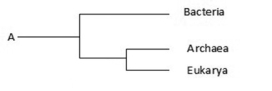 The phylogenetic tree ________.
 (Multiple Choice)
4.9/5 (77)
(77) Why is a scientific topic best discussed by people of varying points of view, from different subdisciplines, and representing diverse cultures?
(Multiple Choice)
4.9/5 (70)
(70) The following experiment is used for the following question.
A researcher discovered a species of moth that lays its eggs on oak trees. Eggs are laid at two distinct times of the year: early in spring when the oak trees are flowering and in midsummer when flowering is past. Caterpillars from eggs that hatch in spring feed on oak flowers and look like oak flowers, but caterpillars that hatch in summer feed on oak leaves and look like oak twigs.
How does the same population of moths produce such different-looking caterpillars on the same trees? To answer this question, the biologist caught many female moths from the same population and collected their eggs. He put at least one egg from each female into eight identical cups. The eggs hatched, and at least two larvae from each female were maintained in one of the four temperature and light conditions listed below.
Temperature Day Length Springlike Springlike Springlike Summerlike Summerlike springlike Summerlike summerlike
In each of the four environments, one of the caterpillars was fed oak flowers, the other oak leaves. Thus, there were a total of eight treatment groups (4 environments × 2 diets).
In every case, caterpillars that feed on oak flowers look like oak flowers. In every case, caterpillars that were raised on oak leaves looked like twigs. These results support which of the following hypotheses?
(Multiple Choice)
4.8/5 (77)
(77) Use the following information when answering the following question.
In 1668, Francesco Redi performed a series of experiments on spontaneous generation. He began by putting similar pieces of meat into eight identical jars. Four jars were left open to the air, and four were sealed. He then did the same experiment with one variation: Instead of sealing four of the jars completely, he covered them with gauze (the gauze excluded the flies while allowing the meat to be exposed to air). In both experiments, he monitored the jars and recorded whether or not maggots (young flies)appeared in the meat.
What hypothesis was being tested in the initial experiment with open versus sealed jars?
(Multiple Choice)
4.8/5 (78)
(78) Which of these provides evidence of the common ancestry of all life?
(Multiple Choice)
4.8/5 (74)
(74) 
Filters
- Essay(0)
- Multiple Choice(0)
- Short Answer(0)
- True False(0)
- Matching(0)