



 Chat with AI
Exam 8: Air and Air Pollution

Exam 1: The Environmental Challenges We Face76 Questions
Exam 2: Sustainability and Human Values70 Questions
Exam 3: Environmental History, Politics, and Economics81 Questions
Exam 4: Risk Analysis and Environmental Health Hazards78 Questions
Exam 5: How Ecosystems Work91 Questions
Exam 6: Ecosystems and Evolution94 Questions
Exam 7: Human Population Change and the Environment89 Questions
Exam 8: Air and Air Pollution80 Questions
Exam 9: Global Atmospheric Changes68 Questions
Exam 10: Freshwater Resources and Water Pollution96 Questions
Exam 11: The Ocean and Fisheries74 Questions
Exam 12: Mineral and Soil Resources98 Questions
Exam 13: Land Resources78 Questions
Exam 14: Agriculture and Food Resources69 Questions
Exam 15: Biodiversity and Conservation73 Questions
Exam 16: Solid and Hazardous Waste69 Questions
Exam 17: Nonrenewable Energy Resources68 Questions
Exam 18: Renewable Energy Resources70 Questions
Select questions type


How do primary air pollutants differ from secondary air pollutants?
(Multiple Choice)
4.9/5  (87)
(87) Which other indoor air pollutant increases the risk of radon-related cancers?
(Multiple Choice)
4.9/5 (73)
(73) Ecosystem services performed by the atmosphere include protecting the Earth's surface from ultraviolet radiation, x-rays, and cosmic rays.
(True/False)
4.8/5 (81)
(81) Radon is a colorless, odorless, tasteless radioactive gas that is produced as a by-product of manufacturing.
(True/False)
4.9/5 (81)
(81) Why did lead pollution decrease significantly after the creation of the Clean Air Act?
(Multiple Choice)
4.9/5 (75)
(75) Photochemical smog is a brownish orange haze formed by chemical reactions involving sunlight, nitrogen oxides, and hydrocarbons.
(True/False)
4.9/5 (77)
(77) Sulfur dioxide is a colorless, nonflammable primary air pollutant gas.
(True/False)
4.8/5 (73)
(73) Smaller cars, removal of sulfur from coal, and cooler combustion temperatures are examples of ways to:
(Multiple Choice)
4.8/5 (90)
(90) The National Academy of Sciences estimate 12% of all lung cancers are related to radioactivity caused by which of the following?
(Multiple Choice)
4.8/5 (84)
(84) Why is radon more of a problem today than in the past? What specific health concerns are related to exposure to radon? Be sure to include a discussion of the source of this gas in your answer.
(Essay)
4.9/5 (76)
(76) Identify the difference between primary and secondary sources of air pollution and give two examples of each type of pollution.
(Essay)
4.8/5 (89)
(89) Sources of air pollution includes all of the following EXCEPT:
(Multiple Choice)
4.9/5 (76)
(76) _______ are domes of heated air that surrounds urban areas and contain high concentrations of air pollution.
(Short Answer)
4.7/5 (92)
(92) What is the largest contributor to urban air pollution in Latin America?
(Multiple Choice)
4.8/5 (77)
(77) Comparing the two images below -- the difference in emissions between the two plants below is MOST LIKELY due to: 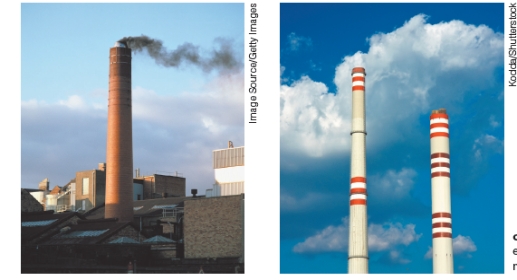
(Multiple Choice)
4.8/5 (75)
(75) How are nitrogen oxides, sulfur oxides, and carbon oxides related?
(Multiple Choice)
4.8/5 (71)
(71) Carbon oxides, nitrogen oxides, sulfur dioxide, and particular matter are known as ________.
(Short Answer)
4.8/5 (79)
(79) 
Filters
- Essay(0)
- Multiple Choice(0)
- Short Answer(0)
- True False(0)
- Matching(0)