



 Chat with AI
Exam 26: Bioenergetics: How the Body Converts Food to Energy

Exam 1: Matter, Energy, and Measurement143 Questions
Exam 2: Atoms134 Questions
Exam 3: Chemical Bonds142 Questions
Exam 4: Chemical Reactions138 Questions
Exam 5: Gases, Liquids, and Solids104 Questions
Exam 6: Solutions and Colloids157 Questions
Exam 7: Reaction Rates and Chemical Equilibrium104 Questions
Exam 8: Acids and Bases198 Questions
Exam 9: Nuclear Chemistry152 Questions
Exam 10: Organic Chemistry71 Questions
Exam 11: Alkanes142 Questions
Exam 12: Alkenes, Alkynes, and Aromatic Compounds184 Questions
Exam 13: Alcohols, Ethers, and Thiols118 Questions
Exam 14: Chirality: the Handedness of Molecules92 Questions
Exam 15: Amines89 Questions
Exam 16: Aldehydes and Ketones102 Questions
Exam 17: Carboxylic Acids115 Questions
Exam 18: Carboxylic Anhydrides, Esters, and Amides117 Questions
Exam 19: Carbohydrates103 Questions
Exam 20: Lipids132 Questions
Exam 21: Proteins128 Questions
Exam 22: Enzymes62 Questions
Exam 23: Chemical Communications: Neurotransmitters and Hormones89 Questions
Exam 24: Nucleotides, Nucleic Acids, and Heredity121 Questions
Exam 25: Gene Expression and Protein Synthesis129 Questions
Exam 26: Bioenergetics: How the Body Converts Food to Energy133 Questions
Exam 27: Specific Catabolic Pathways: Carbohydrate, Lipid, and Protein Metabolism104 Questions
Exam 28: Biosynthetic Pathways67 Questions
Exam 29: Nutrition73 Questions
Exam 30: Immunochemistry132 Questions
Exam 31: Body Fluids72 Questions
Select questions type


Which part of the mitochondrion consists of baffle-like structures?
(Multiple Choice)
4.8/5  (80)
(80) How is a phosphate group linked to the ribose sugar in an ATP molecule?
(Multiple Choice)
4.7/5 (75)
(75) How many molecules of FADH2 are obtained for each acetyl CoA molecule that enters the common catabolic pathway?
(Multiple Choice)
4.7/5 (85)
(85) What is the function of CoQ in complex I of the electron and H+ transport chain?
(Multiple Choice)
4.8/5 (82)
(82) During step 1 of the citric acid cycle, which of the following substrates react to form a citrate ion?
(Multiple Choice)
4.9/5 (72)
(72) Examine the structures of the following compounds. Each structure shows the biologically operative part of a biomolecule. Which of the following statements is not a common characteristic of both compounds? 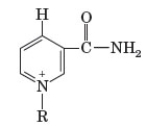

(Multiple Choice)
4.9/5 (67)
(67) Identify a possible outcome of proton movement from the intermembrane space to the matrix.
(Multiple Choice)
4.7/5 (87)
(87) Which of the following coenzymes helps oxidize succinate to fumarate?
(Multiple Choice)
4.8/5 (75)
(75) Which of the following statements is true of acetyl coenzyme A?
(Multiple Choice)
4.8/5 (76)
(76) Which components of NAD+ are linked to each other by a diphosphate bond?
(Multiple Choice)
4.8/5 (73)
(73) Which of the following is the correct composition of an FAD coenzyme?
(Multiple Choice)
4.8/5 (72)
(72) Which of the following is a possible outcome of proton overaccumulation in the matrix of a mitochondrion?
(Multiple Choice)
4.8/5 (80)
(80) Examine the given diagram of a cell organelle. Which numbered structure in the given diagram has the enzymes of the electron transport chain? 
(Multiple Choice)
4.9/5 (70)
(70) Where in the proton-translocating ATPase is ATP synthesized?
(Multiple Choice)
4.9/5 (74)
(74) Which of the following uncoupling proteins is found in brown fat?
(Multiple Choice)
4.8/5 (85)
(85) What is the function of CoQ when it is associated with complex II of the electron and H+ transport chain?
(Multiple Choice)
4.9/5 (82)
(82) Which of the following classes of biological compounds can be used by the body as fuel?
(Multiple Choice)
4.9/5 (80)
(80) How many molecules of ATP are obtained for each acetyl CoA molecule that enters the common catabolic pathway?
(Multiple Choice)
4.8/5 (77)
(77) Identify a sugar that is present in the nucleotides AMP, ADP, and ATP.
(Multiple Choice)
4.7/5 (84)
(84) 
Filters
- Essay(0)
- Multiple Choice(0)
- Short Answer(0)
- True False(0)
- Matching(0)