



 Chat with AI
Exam 26: Bioenergetics: How the Body Converts Food to Energy

Exam 1: Matter, Energy, and Measurement143 Questions
Exam 2: Atoms134 Questions
Exam 3: Chemical Bonds142 Questions
Exam 4: Chemical Reactions138 Questions
Exam 5: Gases, Liquids, and Solids104 Questions
Exam 6: Solutions and Colloids157 Questions
Exam 7: Reaction Rates and Chemical Equilibrium104 Questions
Exam 8: Acids and Bases198 Questions
Exam 9: Nuclear Chemistry152 Questions
Exam 10: Organic Chemistry71 Questions
Exam 11: Alkanes142 Questions
Exam 12: Alkenes, Alkynes, and Aromatic Compounds184 Questions
Exam 13: Alcohols, Ethers, and Thiols118 Questions
Exam 14: Chirality: the Handedness of Molecules92 Questions
Exam 15: Amines89 Questions
Exam 16: Aldehydes and Ketones102 Questions
Exam 17: Carboxylic Acids115 Questions
Exam 18: Carboxylic Anhydrides, Esters, and Amides117 Questions
Exam 19: Carbohydrates103 Questions
Exam 20: Lipids132 Questions
Exam 21: Proteins128 Questions
Exam 22: Enzymes62 Questions
Exam 23: Chemical Communications: Neurotransmitters and Hormones89 Questions
Exam 24: Nucleotides, Nucleic Acids, and Heredity121 Questions
Exam 25: Gene Expression and Protein Synthesis129 Questions
Exam 26: Bioenergetics: How the Body Converts Food to Energy133 Questions
Exam 27: Specific Catabolic Pathways: Carbohydrate, Lipid, and Protein Metabolism104 Questions
Exam 28: Biosynthetic Pathways67 Questions
Exam 29: Nutrition73 Questions
Exam 30: Immunochemistry132 Questions
Exam 31: Body Fluids72 Questions
Select questions type


Identify a metabolic pathway associated with the enzymes localized in the mitochondrial matrix.
(Multiple Choice)
4.7/5  (76)
(76) How much energy is released during the hydrolysis of a phosphoric anhydride bond?
(Multiple Choice)
4.8/5 (91)
(91) Which part of a mitochondrion contains the enzymes that catalyze the citric acid cycle?
(Multiple Choice)
4.9/5 (78)
(78) Examine the given diagram of a cell organelle. Which numbered structure in the given diagram represents the cristae? 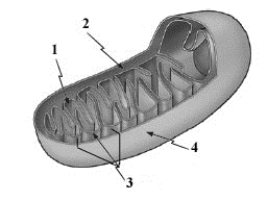
(Multiple Choice)
4.8/5 (84)
(84) Which of the following subunits of the F1 sector stabilizes the proton-translocating ATPase complex?
(Multiple Choice)
4.9/5 (90)
(90) How many molecules of ATP are produced for each molecule of FADH2 utilized in the oxidative phosphorylation pathway?
(Multiple Choice)
4.9/5 (81)
(81) Identify the final principal compound in the common catabolic pathway.
(Multiple Choice)
4.9/5 (75)
(75) Complex I of the electron and H+ transport chain contains a number of clusters that contain a metal and a nonmetal. Which of the following elements are found in these clusters?
(Multiple Choice)
4.7/5 (84)
(84) Which of the following compounds is an intermediate formed during the conversion of citrate to isocitrate?
(Multiple Choice)
4.9/5 (80)
(80) Consider the structural diagram of the operative part of a biologically active molecule. Which of the following coenzymes has the given structure? 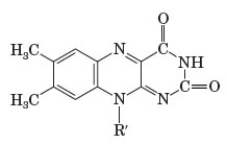
(Multiple Choice)
4.9/5 (75)
(75) Which of the following nucleotides releases the maximum energy on hydrolysis?
(Multiple Choice)
4.9/5 (78)
(78) How many molecules of ATP are produced for each molecule of NADH utilized in the oxidative phosphorylation pathway?
(Multiple Choice)
4.7/5 (88)
(88) Which of the following compounds stimulates the enzyme isocitrate dehydrogenase?
(Multiple Choice)
5.0/5 (69)
(69) When considering both electron and H+ transport and the chemiosmotic pump, which of the following is the correct sequence of energy transformations?
(Multiple Choice)
4.7/5 (81)
(81) Which of the following organelles remove damaged cellular materials and foreign materials from cells?
(Multiple Choice)
4.8/5 (68)
(68) Which of the following sequences of reactions occurs during the conversion of isocitrate to α-ketoglutarate?
(Multiple Choice)
4.8/5 (70)
(70) Which of the following statements is true of a mitochondrion?
(Multiple Choice)
4.9/5 (95)
(95) Which of the following correctly describes the electron flow in complex IV?
(Multiple Choice)
4.9/5 (86)
(86) 
Filters
- Essay(0)
- Multiple Choice(0)
- Short Answer(0)
- True False(0)
- Matching(0)