



 Chat with AI
Exam 31: Body Fluids

Exam 1: Matter, Energy, and Measurement143 Questions
Exam 2: Atoms134 Questions
Exam 3: Chemical Bonds142 Questions
Exam 4: Chemical Reactions138 Questions
Exam 5: Gases, Liquids, and Solids104 Questions
Exam 6: Solutions and Colloids157 Questions
Exam 7: Reaction Rates and Chemical Equilibrium104 Questions
Exam 8: Acids and Bases198 Questions
Exam 9: Nuclear Chemistry152 Questions
Exam 10: Organic Chemistry71 Questions
Exam 11: Alkanes142 Questions
Exam 12: Alkenes, Alkynes, and Aromatic Compounds184 Questions
Exam 13: Alcohols, Ethers, and Thiols118 Questions
Exam 14: Chirality: the Handedness of Molecules92 Questions
Exam 15: Amines89 Questions
Exam 16: Aldehydes and Ketones102 Questions
Exam 17: Carboxylic Acids115 Questions
Exam 18: Carboxylic Anhydrides, Esters, and Amides117 Questions
Exam 19: Carbohydrates103 Questions
Exam 20: Lipids132 Questions
Exam 21: Proteins128 Questions
Exam 22: Enzymes62 Questions
Exam 23: Chemical Communications: Neurotransmitters and Hormones89 Questions
Exam 24: Nucleotides, Nucleic Acids, and Heredity121 Questions
Exam 25: Gene Expression and Protein Synthesis129 Questions
Exam 26: Bioenergetics: How the Body Converts Food to Energy133 Questions
Exam 27: Specific Catabolic Pathways: Carbohydrate, Lipid, and Protein Metabolism104 Questions
Exam 28: Biosynthetic Pathways67 Questions
Exam 29: Nutrition73 Questions
Exam 30: Immunochemistry132 Questions
Exam 31: Body Fluids72 Questions
Select questions type


Which of the following diseases is associated with a low leukocyte count?
(Multiple Choice)
4.7/5  (98)
(98) Which of the following gives the correct order of pressures?
(Multiple Choice)
4.9/5 (91)
(91) Which of the following accounts for most of the dissolved solids in the plasma?
(Multiple Choice)
4.8/5 (76)
(76) Which of the following diseases is associated with a high erythrocyte count?
(Multiple Choice)
4.7/5 (76)
(76) Which of the following blood cells has the largest diameter?
(Multiple Choice)
4.9/5 (71)
(71) Examine the following diagram of a kidney nephron and the surrounding circulatory system. Blood enters the capsule and glomerulus. Which of the following components of the blood when passed to the collecting tubules indicates a disease? 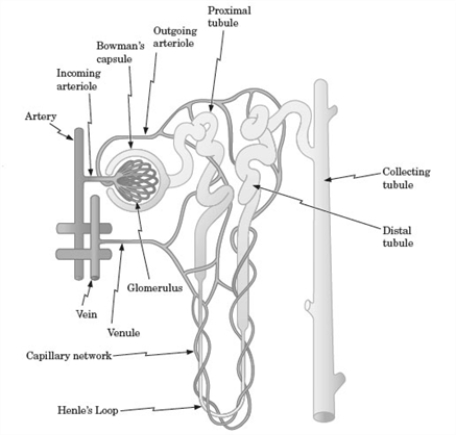
(Multiple Choice)
4.8/5 (84)
(84) Which of the following is the approximate partial pressure of oxygen in the alveoli?
(Multiple Choice)
5.0/5 (82)
(82) Which of the following is synthesized by white blood cells?
(Multiple Choice)
4.8/5 (73)
(73) In addition to the lymph nodes, where are lymphocytes formed?
(Multiple Choice)
4.8/5 (82)
(82) Which of the following fluids that are present in our bodies is a solvent?
(Multiple Choice)
5.0/5 (80)
(80) How many heme units are present in a molecule of hemoglobin?
(Multiple Choice)
4.9/5 (72)
(72) How many different nervous control systems begin to function when a patient hemorrhages?
(Multiple Choice)
4.8/5 (73)
(73) Which of the following diseases is caused by a low platelet count?
(Multiple Choice)
4.9/5 (84)
(84) Which type of blood cells are involved in the formation of a clot?
(Multiple Choice)
4.8/5 (76)
(76) Which of the following hormones is responsible for controlling the Na+ ion concentration in the blood?
(Multiple Choice)
4.9/5 (71)
(71) Which of the following diseases is associated with a low erythrocyte count?
(Multiple Choice)
4.8/5 (94)
(94) Which of the following vitamins is required to produce prothrombin?
(Multiple Choice)
4.8/5 (83)
(83) Which of the following components is not present in the serum?
(Multiple Choice)
4.9/5 (86)
(86) 
Filters
- Essay(0)
- Multiple Choice(0)
- Short Answer(0)
- True False(0)
- Matching(0)