



 Chat with AI
Exam 31: Body Fluids

Exam 1: Matter, Energy, and Measurement143 Questions
Exam 2: Atoms134 Questions
Exam 3: Chemical Bonds142 Questions
Exam 4: Chemical Reactions138 Questions
Exam 5: Gases, Liquids, and Solids104 Questions
Exam 6: Solutions and Colloids157 Questions
Exam 7: Reaction Rates and Chemical Equilibrium104 Questions
Exam 8: Acids and Bases198 Questions
Exam 9: Nuclear Chemistry152 Questions
Exam 10: Organic Chemistry71 Questions
Exam 11: Alkanes142 Questions
Exam 12: Alkenes, Alkynes, and Aromatic Compounds184 Questions
Exam 13: Alcohols, Ethers, and Thiols118 Questions
Exam 14: Chirality: the Handedness of Molecules92 Questions
Exam 15: Amines89 Questions
Exam 16: Aldehydes and Ketones102 Questions
Exam 17: Carboxylic Acids115 Questions
Exam 18: Carboxylic Anhydrides, Esters, and Amides117 Questions
Exam 19: Carbohydrates103 Questions
Exam 20: Lipids132 Questions
Exam 21: Proteins128 Questions
Exam 22: Enzymes62 Questions
Exam 23: Chemical Communications: Neurotransmitters and Hormones89 Questions
Exam 24: Nucleotides, Nucleic Acids, and Heredity121 Questions
Exam 25: Gene Expression and Protein Synthesis129 Questions
Exam 26: Bioenergetics: How the Body Converts Food to Energy133 Questions
Exam 27: Specific Catabolic Pathways: Carbohydrate, Lipid, and Protein Metabolism104 Questions
Exam 28: Biosynthetic Pathways67 Questions
Exam 29: Nutrition73 Questions
Exam 30: Immunochemistry132 Questions
Exam 31: Body Fluids72 Questions
Select questions type


Which of the following is the approximate pressure of oxygen in the muscles?
(Multiple Choice)
4.8/5  (71)
(71) Which of the following is involved in the formation of the fibrin network?
(Multiple Choice)
4.9/5 (75)
(75) Under normal conditions, which of the following hormones is involved in the reabsorption of water?
(Multiple Choice)
4.9/5 (80)
(80) Identify the process associated with the maintenance of body temperature and the appropriate levels of nutrients.
(Multiple Choice)
4.8/5 (82)
(82) Approximately what volume of urine does a normal person excrete each day?
(Multiple Choice)
4.8/5 (86)
(86) Which type of drug is occasionally administered to prevent clot formation?
(Multiple Choice)
4.7/5 (78)
(78) Which of the following can readily cross the blood-brain barrier?
(Multiple Choice)
4.9/5 (82)
(82) Examine the following diagram of a kidney nephron and the surrounding circulatory system. Blood enters the capsule and glomerulus. Which of the following components of the blood will eventually pass to the collecting tubule? 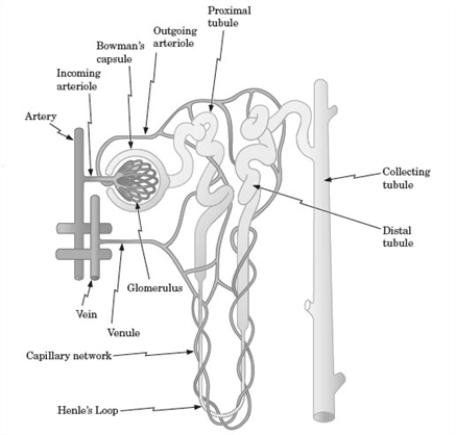
(Multiple Choice)
4.9/5 (78)
(78) Consider the diagram below. Which of the following correctly represents the components transported by the lettered arrows? 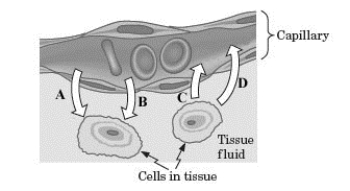
(Multiple Choice)
4.7/5 (85)
(85) Which of the following products is formed when carbon dioxide binds to hemoglobin?
(Multiple Choice)
5.0/5 (73)
(73) Identify the approximate percentage of plasma in whole blood.
(Multiple Choice)
5.0/5 (79)
(79) Which of the following diseases is associated with a high leukocyte count?
(Multiple Choice)
4.9/5 (71)
(71) Whole blood is centrifuged and then separated into a sediment and plasma. Which of the following would most likely be found in the plasma?
(Multiple Choice)
4.9/5 (87)
(87) What is the volume of whole blood in a person's body who weighs 150 lb?
(Multiple Choice)
4.7/5 (75)
(75) How many molecules of CO2 can bind to a molecule of hemoglobin?
(Multiple Choice)
5.0/5 (77)
(77) Which class of drugs that is used to treat hypertension does propranolol belong to?
(Multiple Choice)
4.8/5 (98)
(98) 
Filters
- Essay(0)
- Multiple Choice(0)
- Short Answer(0)
- True False(0)
- Matching(0)