



 Chat with AI
Exam 7: Reaction Rates and Chemical Equilibrium

Exam 1: Matter, Energy, and Measurement143 Questions
Exam 2: Atoms134 Questions
Exam 3: Chemical Bonds142 Questions
Exam 4: Chemical Reactions138 Questions
Exam 5: Gases, Liquids, and Solids104 Questions
Exam 6: Solutions and Colloids157 Questions
Exam 7: Reaction Rates and Chemical Equilibrium104 Questions
Exam 8: Acids and Bases198 Questions
Exam 9: Nuclear Chemistry152 Questions
Exam 10: Organic Chemistry71 Questions
Exam 11: Alkanes142 Questions
Exam 12: Alkenes, Alkynes, and Aromatic Compounds184 Questions
Exam 13: Alcohols, Ethers, and Thiols118 Questions
Exam 14: Chirality: the Handedness of Molecules92 Questions
Exam 15: Amines89 Questions
Exam 16: Aldehydes and Ketones102 Questions
Exam 17: Carboxylic Acids115 Questions
Exam 18: Carboxylic Anhydrides, Esters, and Amides117 Questions
Exam 19: Carbohydrates103 Questions
Exam 20: Lipids132 Questions
Exam 21: Proteins128 Questions
Exam 22: Enzymes62 Questions
Exam 23: Chemical Communications: Neurotransmitters and Hormones89 Questions
Exam 24: Nucleotides, Nucleic Acids, and Heredity121 Questions
Exam 25: Gene Expression and Protein Synthesis129 Questions
Exam 26: Bioenergetics: How the Body Converts Food to Energy133 Questions
Exam 27: Specific Catabolic Pathways: Carbohydrate, Lipid, and Protein Metabolism104 Questions
Exam 28: Biosynthetic Pathways67 Questions
Exam 29: Nutrition73 Questions
Exam 30: Immunochemistry132 Questions
Exam 31: Body Fluids72 Questions
Select questions type


If a particular reactant is involved in the slowest step of a multistep reaction, then what will be the effect of increasing its concentration?
(Multiple Choice)
4.9/5  (71)
(71) For the exothermic reaction  making which of the following changes will ensure that the reaction will not shift either to the left or to the right?
 (Multiple Choice)
4.9/5 (78)
(78) The rate of reaction for the decomposition of hydrogen peroxide to yield water and oxygen is represented by the following equation: Rate = k[H2O2]. Which of the following is indicated by this equation?
(Multiple Choice)
4.7/5 (74)
(74) What is the effect of decreasing the temperature at which a reaction is carried out?
(Multiple Choice)
4.7/5 (85)
(85) In a particular chemical reaction, two bonds are broken and no bonds are formed. Based on this information alone, which of the following is true?
(Multiple Choice)
4.9/5 (82)
(82) Consider the following graph. 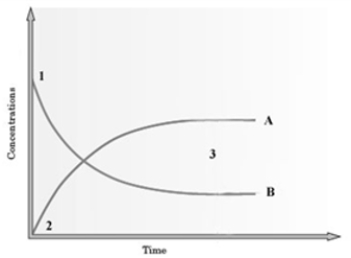 The graph is based on data collected from the following reaction.
 If Curve B presently represents C2H5OH, how would the graph change if this line represented CH3COOH?
The graph is based on data collected from the following reaction. If Curve B presently represents C2H5OH, how would the graph change if this line represented CH3COOH? (Multiple Choice)
4.9/5 (78)
(78) If a reaction occurs very rapidly even at a relatively low temperature, which of the following is true?
(Multiple Choice)
4.9/5 (71)
(71) Given that the reaction 2Na2O (s) → 4Na(s) + 2O2(g) is endothermic, which of the following is true of the reaction 4Na(s) + 2O2(g) → 2Na2O(s)?
(Multiple Choice)
4.9/5 (82)
(82) For the reaction  , which of the following is the equilibrium constant expression?
 (Multiple Choice)
4.7/5 (93)
(93) How does a decrease in temperature affect an endothermic reaction that has not reached equilibrium?
(Multiple Choice)
4.8/5 (78)
(78) Consider a reaction such as A2(g) + B2(g) → 2AB(g). What can we say about the mechanism of the reaction?
(Multiple Choice)
4.8/5 (86)
(86) The temperature effect on reaction rate is the result of which of the following?
(Multiple Choice)
4.9/5 (77)
(77) Which of the following is an example of an equilibrium situation?
(Multiple Choice)
4.7/5 (84)
(84) Which of the following symbols is used to denote a reversible reaction?
(Multiple Choice)
4.8/5 (86)
(86) Acetic acid is the active ingredient in vinegar. In a solution of acetic acid, the following equilibrium is established.  The equilibrium constant for this reaction is 1.5 × 10⁻⁵. What is the equilibrium constant for the following reaction?

The equilibrium constant for this reaction is 1.5 × 10⁻⁵. What is the equilibrium constant for the following reaction? (Multiple Choice)
4.8/5 (65)
(65) For the reaction  equilibrium is established at 472°C when [H2] =0.0400 M, [N2] = 0.0200 M, and [NH3] = 1.074 × 10⁻⁷M. What is the equilibrium constant for this reaction?
 (Multiple Choice)
4.9/5 (87)
(87) Which of the following is the study of the rates of chemical reactions?
(Multiple Choice)
4.8/5 (80)
(80) Which of the following can be the equilibrium constant for a reaction that does not yield a significant concentration of products?
(Multiple Choice)
4.8/5 (62)
(62) For the reaction 2HgO(s) → 2Hg(l) + O2(g), we measure the evolution of gas to determine the rate of reaction. At the beginning of the reaction (at 0 min), 0.070 L of O2 is present. After 15 min, the volume of O2 is 0.40 L. What is the rate of reaction?
(Multiple Choice)
4.8/5 (74)
(74) 
Filters
- Essay(0)
- Multiple Choice(0)
- Short Answer(0)
- True False(0)
- Matching(0)