



 Chat with AI
Exam 7: Reaction Rates and Chemical Equilibrium

Exam 1: Matter, Energy, and Measurement143 Questions
Exam 2: Atoms134 Questions
Exam 3: Chemical Bonds142 Questions
Exam 4: Chemical Reactions138 Questions
Exam 5: Gases, Liquids, and Solids104 Questions
Exam 6: Solutions and Colloids157 Questions
Exam 7: Reaction Rates and Chemical Equilibrium104 Questions
Exam 8: Acids and Bases198 Questions
Exam 9: Nuclear Chemistry152 Questions
Exam 10: Organic Chemistry71 Questions
Exam 11: Alkanes142 Questions
Exam 12: Alkenes, Alkynes, and Aromatic Compounds184 Questions
Exam 13: Alcohols, Ethers, and Thiols118 Questions
Exam 14: Chirality: the Handedness of Molecules92 Questions
Exam 15: Amines89 Questions
Exam 16: Aldehydes and Ketones102 Questions
Exam 17: Carboxylic Acids115 Questions
Exam 18: Carboxylic Anhydrides, Esters, and Amides117 Questions
Exam 19: Carbohydrates103 Questions
Exam 20: Lipids132 Questions
Exam 21: Proteins128 Questions
Exam 22: Enzymes62 Questions
Exam 23: Chemical Communications: Neurotransmitters and Hormones89 Questions
Exam 24: Nucleotides, Nucleic Acids, and Heredity121 Questions
Exam 25: Gene Expression and Protein Synthesis129 Questions
Exam 26: Bioenergetics: How the Body Converts Food to Energy133 Questions
Exam 27: Specific Catabolic Pathways: Carbohydrate, Lipid, and Protein Metabolism104 Questions
Exam 28: Biosynthetic Pathways67 Questions
Exam 29: Nutrition73 Questions
Exam 30: Immunochemistry132 Questions
Exam 31: Body Fluids72 Questions
Select questions type


Which of the following is not true of effective collisions?
(Multiple Choice)
4.8/5  (74)
(74) A particular chemical reaction carried out at 30°C takes 4 hours. Approximately how long will it take to carry out the reaction at 60°C?
(Multiple Choice)
4.7/5 (74)
(74) Which of the following are generally included when writing an equilibrium constant expression?
(Multiple Choice)
4.8/5 (75)
(75) When considering the effect of a catalyst on a system that has not reached equilibrium, which of the following is true?
(Multiple Choice)
5.0/5 (73)
(73) Solid sodium chloride and solid silver nitrate react to form sodium nitrate and silver chloride. The reaction is extremely slow. However, if the sodium chloride and silver nitrate are first dissolved in water and the two solutions are mixed, the reaction occurs very rapidly. Which of the following explains the difference in reaction rates?
(Multiple Choice)
4.9/5 (80)
(80) In writing the equilibrium constant expression, we use square brackets. What does the notation [A] represent?
(Multiple Choice)
4.8/5 (91)
(91) The reaction H2O2(l) + 3I-(aq) + 2 H+(aq) → I3-(aq) + 2H2O(aq) occurs very rapidly. Based on this observation alone, what can we say about this reaction?
(Multiple Choice)
4.9/5 (75)
(75) Which of the following is not true of the catalyst of a reaction?
(Multiple Choice)
4.8/5 (72)
(72) Consider the following graph. 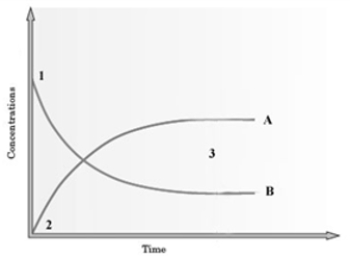 The graph is based on data collected from the following reaction.
 Which curve on the graph represents the change in concentration of CH3COOC2H5 for the forward reaction?
The graph is based on data collected from the following reaction. Which curve on the graph represents the change in concentration of CH3COOC2H5 for the forward reaction? (Multiple Choice)
4.8/5 (83)
(83) The term "heterogeneous catalyst" means which of the following?
(Multiple Choice)
4.8/5 (87)
(87) How does the rate of reaction change as the concentration of the product increases over the course of a reaction?
(Multiple Choice)
4.9/5 (86)
(86) For the reaction  equilibrium is established at 25°C when [NOCl] = 2.6 M, [NO] = 0.34 M, and [Cl2] = 1.4 M. What is the equilibrium constant for this reaction?
 (Multiple Choice)
4.8/5 (86)
(86) Suppose the equilibrium constant for the chemical reaction is 3.3 × 10⁷.  What is the equilibrium constant for the following reaction?
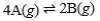
What is the equilibrium constant for the following reaction? (Multiple Choice)
4.8/5 (70)
(70) If the exothermic reaction  has reached equilibrium, what is the effect of reducing the temperature of the reaction vessel?
 (Multiple Choice)
4.9/5 (81)
(81) For the exothermic reaction  making which of the following changes will ensure that the reaction will not shift either to the left or to the right?
 (Multiple Choice)
4.8/5 (71)
(71) Which of the following statements is true of the reaction A + B → 2C?
(Multiple Choice)
4.8/5 (83)
(83) Consider the following graph. 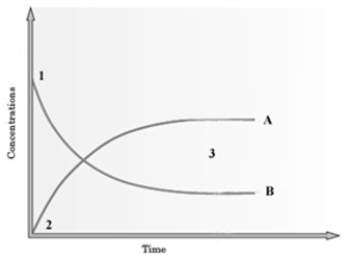 The graph is based on data collected from the following reaction.
 At what point on the graph does the rate of the forward reaction equal the rate of the reverse reaction?
The graph is based on data collected from the following reaction. At what point on the graph does the rate of the forward reaction equal the rate of the reverse reaction? (Multiple Choice)
4.8/5 (77)
(77) A particular reaction has an equilibrium constant of 1 × 10²⁰. Which of the following best describes the relationship between the equilibrium constant and the reaction rate?
(Multiple Choice)
4.9/5 (86)
(86) 
Filters
- Essay(0)
- Multiple Choice(0)
- Short Answer(0)
- True False(0)
- Matching(0)