



 Chat with AI
Exam 4: Forecasting

Exam 1: Operations and Productivity138 Questions
Exam 2: Operations Strategy in a Global Environment134 Questions
Exam 3: Project Management131 Questions
Exam 4: Forecasting148 Questions
Exam 5: Design of Goods and Services126 Questions
Exam 6: Managing Quality226 Questions
Exam 7: Process Strategies259 Questions
Exam 8: Location Strategies233 Questions
Exam 9: Human Resources, Job Design, and Work Measurement321 Questions
Exam 10: Supply Chain Management158 Questions
Exam 11: Inventory Management230 Questions
Exam 12: Aggregate Planning and Sop122 Questions
Exam 13: Material Requirements Planning Mrp and Erp133 Questions
Exam 14: Short-Term Scheduling124 Questions
Exam 15: Lean Operations122 Questions
Exam 16: Maintenance and Reliability119 Questions
Exam 17: Decision-Making Tools101 Questions
Exam 18: Linear Programming102 Questions
Exam 19: Transportation Models92 Questions
Exam 20: Waiting-Line Models126 Questions
Exam 21: Learning Curves114 Questions
Exam 22: Simulation78 Questions
Exam 23: Applying Analytics to Big Data in Operations Management61 Questions
Select questions type


The larger the number of periods in the simple moving average forecasting method, the greater the method's responsiveness to changes in demand.
(True/False)
4.9/5  (73)
(73) Which time-series model below assumes that demand in the next period will be equal to the most recent period's demand?
(Multiple Choice)
4.9/5 (81)
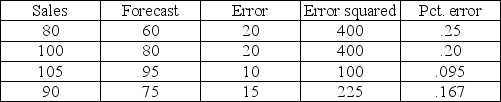
(81) The last four weekly values of sales were 80, 100, 105, and 90 units, respectively. The last four forecasts (for the same four weeks) were 60, 80, 95, and 75 units, respectively. Calculate the MAD, MSE, and MAPE for these four weeks.
(Essay)
4.9/5 (66)
(66) Suppose that the last four months of sales were 8, 10, 15, and 9 units, respectively. Suppose further that the last four forecasts were 5, 6, 11, and 12 units, respectively. What is the Mean Absolute Deviation (MAD) of these forecasts?
(Multiple Choice)
4.8/5 (79)
(79) The three major types of forecasts used by organizations in planning future operations are:
(Multiple Choice)
4.8/5 (84)
(84) Which of the following is TRUE regarding the two smoothing constants of the Forecast Including Trend (FIT) model?
(Multiple Choice)
5.0/5 (84)
(84) Demand forecasts serve as inputs to financial, marketing, and personnel planning.
(True/False)
4.9/5 (73)
(73) Which of the following smoothing constants would make an exponential smoothing forecast equivalent to a naive forecast?
(Multiple Choice)
5.0/5 (81)
(81) Explain, in your own words, the meaning of the coefficient of determination.
(Essay)
4.8/5 (91)
(91) The ________ measures the strength of the relationship between two variables.
(Short Answer)
4.8/5 (86)
(86) An innovative restaurateur owns and operates a dozen "Ultimate Low-Carb" restaurants in northern Arkansas. His signature item is a cheese-encrusted beef medallion wrapped in lettuce. Sales (x, in millions of dollars) are related to Profits (y-hat, in hundreds of thousands of dollars) by the regression equation y-hat = 7.21 + 1.76 x. What is your forecast of profit for a store with sales of $10 million? $30 million?
(Essay)
4.7/5 (77)
(77) When one constant is used to smooth the forecast average and a second constant is used to smooth the trend, the forecasting method is ________.
(Essay)
4.8/5 (71)
(71) In a regression equation where y-hat is demand and x is advertising, a coefficient of determination (R2) of .70 means that 70% of the variance in advertising is explained by demand.
(True/False)
4.9/5 (76)
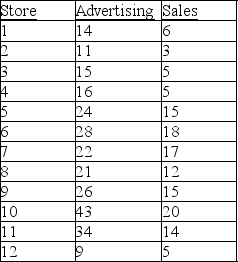
(76) Arnold Tofu owns and operates a chain of 12 vegetable protein "hamburger" restaurants in northern Louisiana. Sales figures and advertising expenses for the stores are provided in the table below. Sales are given in millions of dollars; advertising expenses are in tens of thousands of dollars. Calculate a regression line for the data. What is your forecast of sales for a store with advertising spending of $240,000? $300,000?
(Essay)
4.9/5 (69)
(69) ________ forecasts use a series of past data points to make a forecast.
(Short Answer)
4.8/5 (80)
(80) Give an example, other than a restaurant or other food-service firm, of an organization that experiences an hourly seasonal pattern. (That is, each hour of the day has a pattern that tends to repeat day after day.) Explain.
(Essay)
5.0/5 (90)
(90) 
Filters
- Essay(0)
- Multiple Choice(0)
- Short Answer(0)
- True False(0)
- Matching(0)