



 Chat with AI
Exam 11: Inventory Management

Exam 1: Operations and Productivity138 Questions
Exam 2: Operations Strategy in a Global Environment134 Questions
Exam 3: Project Management131 Questions
Exam 4: Forecasting148 Questions
Exam 5: Design of Goods and Services126 Questions
Exam 6: Managing Quality226 Questions
Exam 7: Process Strategies259 Questions
Exam 8: Location Strategies233 Questions
Exam 9: Human Resources, Job Design, and Work Measurement321 Questions
Exam 10: Supply Chain Management158 Questions
Exam 11: Inventory Management230 Questions
Exam 12: Aggregate Planning and Sop122 Questions
Exam 13: Material Requirements Planning Mrp and Erp133 Questions
Exam 14: Short-Term Scheduling124 Questions
Exam 15: Lean Operations122 Questions
Exam 16: Maintenance and Reliability119 Questions
Exam 17: Decision-Making Tools101 Questions
Exam 18: Linear Programming102 Questions
Exam 19: Transportation Models92 Questions
Exam 20: Waiting-Line Models126 Questions
Exam 21: Learning Curves114 Questions
Exam 22: Simulation78 Questions
Exam 23: Applying Analytics to Big Data in Operations Management61 Questions
Select questions type


In the simple EOQ model, if the carrying cost were to double, the EOQ would also double.
(True/False)
4.9/5  (82)
(82) If the actual order quantity is the economic order quantity in a problem that meets the assumptions of the economic order quantity model shown below, the average amount of inventory on hand: Q* =

(Multiple Choice)
4.8/5 (85)
(85) A disadvantage of the fixed-period inventory system is that:
(Multiple Choice)
4.9/5 (78)
(78) Consider a supply chain where a retailer orders from a wholesaler who orders from a manufacturer who orders from a supplier. The retailer's monthly standard deviation of demand is 20 units. The standard deviation of orders was 30, 60, 70, and 40 units for the retailer, wholesaler, manufacturer, and supplier, respectively. Which of the following is TRUE?
(Multiple Choice)
4.7/5 (70)
(70) Insurance and taxes on inventory are part of the costs known as setup or ordering costs.
(True/False)
4.9/5 (89)
(89) A production order quantity problem has a daily demand rate = 10 and a daily production rate = 50. The production order quantity for this problem is approximately 750 units. What is the average inventory for this problem?
(Multiple Choice)
4.8/5 (65)
(65) The items listed below are stored in a one-dock warehouse. In what order should they be placed in the warehouse (moving from closest to the dock to furthest away from the dock)? 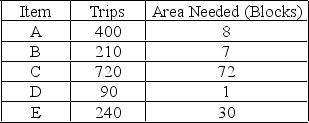
(Multiple Choice)
4.7/5 (89)
(89) Which of the following is NOT an assumption of the economic order quantity model shown below? Q* =

(Multiple Choice)
4.8/5 (67)
(67) Your company has compiled the following data on the small set of products that comprise the specialty repair parts division. Perform ABC analysis on the data. Over which product do you suggest the firm keep the least control? 
(Multiple Choice)
4.9/5 (79)
(79) 
Which of the following statements about quantity discounts is FALSE?
(Multiple Choice)
4.9/5 (77)
(77) The primary trade-off in warehouse storage location analysis involves evaluating the number of trips taken for an item vs. the physical weight of that item.
(True/False)
4.8/5 (82)
(82) In the production order quantity model, inventory does not arrive in a single moment but flows in at a steady rate, resulting in a smaller production/order quantity than in an otherwise identical EOQ problem.
(True/False)
4.8/5 (65)
(65) Describe the difference between a fixed-quantity and a fixed-period inventory system?
(Essay)
4.8/5 (85)
(85) ________ inventory is material that is usually purchased, but has yet to enter the manufacturing process.
(Short Answer)
4.7/5 (84)
(84) ABC analysis divides on-hand inventory into three classes, generally based upon which of the following?
(Multiple Choice)
4.9/5 (86)
(86) A product whose EOQ is 40 units experiences an increase in ordering cost from $10 per order to $90 per order. The revised EOQ is:
(Multiple Choice)
4.8/5 (87)
(87) What is the primary purpose of the basic economic order quantity model shown below? Q* =

(Multiple Choice)
4.9/5 (82)
(82) The primary trade-off in transportation mode analysis involves evaluating ordering cost against the cost of shipping.
(True/False)
4.9/5 (63)
(63) In the quantity discount model, it is possible to have a cost-minimizing solution where annual ordering costs do not equal annual carrying costs.
(True/False)
4.7/5 (75)
(75) 
Filters
- Essay(0)
- Multiple Choice(0)
- Short Answer(0)
- True False(0)
- Matching(0)