



 Chat with AI
Exam 11: Inventory Management

Exam 1: Operations and Productivity138 Questions
Exam 2: Operations Strategy in a Global Environment134 Questions
Exam 3: Project Management131 Questions
Exam 4: Forecasting148 Questions
Exam 5: Design of Goods and Services126 Questions
Exam 6: Managing Quality226 Questions
Exam 7: Process Strategies259 Questions
Exam 8: Location Strategies233 Questions
Exam 9: Human Resources, Job Design, and Work Measurement321 Questions
Exam 10: Supply Chain Management158 Questions
Exam 11: Inventory Management230 Questions
Exam 12: Aggregate Planning and Sop122 Questions
Exam 13: Material Requirements Planning Mrp and Erp133 Questions
Exam 14: Short-Term Scheduling124 Questions
Exam 15: Lean Operations122 Questions
Exam 16: Maintenance and Reliability119 Questions
Exam 17: Decision-Making Tools101 Questions
Exam 18: Linear Programming102 Questions
Exam 19: Transportation Models92 Questions
Exam 20: Waiting-Line Models126 Questions
Exam 21: Learning Curves114 Questions
Exam 22: Simulation78 Questions
Exam 23: Applying Analytics to Big Data in Operations Management61 Questions
Select questions type


If the variance of orders of a manufacturer equals 800, and the variance of orders of its supplier equals 850, what is happening at this part of the supply chain?
(Multiple Choice)
4.9/5  (71)
(71) Which category of inventory holding costs has a much higher percentage than average for rapid-change industries such as tablets and smart phones?
(Multiple Choice)
4.9/5 (72)
(72) ABC analysis classifies inventoried items into three groups, usually based on annual units or quantities used.
(True/False)
4.8/5 (82)
(82) Suppose that in month 1, both the retailer and the wholesaler in a supply chain ordered 20,000 units. Then in month 2, the retailer decreases its order size by 500 units. If the wholesaler then decreases its order size in month 2 by 700 units, which of the following is TRUE?
(Multiple Choice)
4.9/5 (68)
(68) The fixed-period inventory system requires more safety stock than a fixed-quantity system because:
(Multiple Choice)
4.9/5 (83)
(83) If daily demand is constant at 10 units per day, and lead time averages 12 days with a standard deviation of 3 days, 95% service requires how much safety stock?
(Multiple Choice)
4.9/5 (91)
(91) Which of the following is NOT a remedy for the bullwhip effect?
(Multiple Choice)
4.9/5 (91)
(91) Service level is the complement of the probability of a stockout.
(True/False)
5.0/5 (74)
(74) A specific product has demand during lead time of 100 units, with a standard deviation during lead time of 25 units. What safety stock (approximately) provides an 85% service level?
(Multiple Choice)
4.9/5 (74)
(74) Your company has compiled the following data on the small set of products that comprise the specialty repair parts division. Perform ABC analysis on the data. Over which products do you suggest the firm keep the tightest control? Explain.
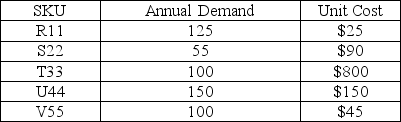
(Essay)
4.8/5 (87)
(87) Suppose that the manager of a company has estimated the probability of a super-event sometime during the next three years that will disrupt all suppliers as 2%. In addition, the firm currently uses four suppliers for its main component, and the manager estimates the probability of a unique-event that would disrupt one of them sometime during the next three years to be 10%. Supplier management costs during this period are $30,000 per supplier. The financial cost incurred if all four suppliers are disrupted at the same time is estimated to be $10,000,000. What is the expected monetary value (cost) of the current supplier diversification arrangement?
(Multiple Choice)
4.8/5 (81)
(81) Work-in-process inventory describes components that have been purchased but not processed.
(True/False)
4.8/5 (91)
(91) In the production order quantity model, the fraction of inventory that is used immediately and not stored is represented by the ratio of ________.
(Short Answer)
5.0/5 (85)
(85) Lead time for one of Montegut Manufacturing's fastest moving products is 4 days. Demand during this period averages 100 units per day. What would be an appropriate reorder point?
(Essay)
4.8/5 (86)
(86) In the production order quantity model, the cost of acquiring goods (product cost) is a factor in determining lot size.
(True/False)
4.8/5 (81)
(81) According to the global company profile, Amazon.com's advantage in inventory management comes from its almost fanatical use of economic order quantity and safety stock calculations.
(True/False)
4.7/5 (75)
(75) Research suggests that shoppers are more likely to make a purchase from displays with many products than the ones with a more limited selection.
(True/False)
4.8/5 (75)
(75) 
Filters
- Essay(0)
- Multiple Choice(0)
- Short Answer(0)
- True False(0)
- Matching(0)