



 Chat with AI
Exam 11: Inventory Management

Exam 1: Operations and Productivity138 Questions
Exam 2: Operations Strategy in a Global Environment134 Questions
Exam 3: Project Management131 Questions
Exam 4: Forecasting148 Questions
Exam 5: Design of Goods and Services126 Questions
Exam 6: Managing Quality226 Questions
Exam 7: Process Strategies259 Questions
Exam 8: Location Strategies233 Questions
Exam 9: Human Resources, Job Design, and Work Measurement321 Questions
Exam 10: Supply Chain Management158 Questions
Exam 11: Inventory Management230 Questions
Exam 12: Aggregate Planning and Sop122 Questions
Exam 13: Material Requirements Planning Mrp and Erp133 Questions
Exam 14: Short-Term Scheduling124 Questions
Exam 15: Lean Operations122 Questions
Exam 16: Maintenance and Reliability119 Questions
Exam 17: Decision-Making Tools101 Questions
Exam 18: Linear Programming102 Questions
Exam 19: Transportation Models92 Questions
Exam 20: Waiting-Line Models126 Questions
Exam 21: Learning Curves114 Questions
Exam 22: Simulation78 Questions
Exam 23: Applying Analytics to Big Data in Operations Management61 Questions
Select questions type


Over the past six months, Wholesale Foods of Fresno has experienced a standard deviation of demand of 200 units. Standard deviation of its orders during that period was 300 units.
(a) What is the bullwhip measure for Wholesale Foods of Fresno?
(b) If Wholesale Foods of Fresno had made a perfect forecast of demand over the past 6 months and had decided to order 1/6 of that demand each month, what would its bullwhip measure have been?
(Essay)
4.9/5  (87)
(87) Explain what "decoupling" means in the context of inventory management.
(Essay)
4.9/5 (72)
(72) ________ is a continuing reconciliation of inventory with inventory records.
(Short Answer)
4.8/5 (78)
(78) The bullwhip effect describes the tendency for larger order size fluctuations in the supply chain as orders move from retailers toward suppliers.
(True/False)
4.9/5 (74)
(74) Identify at least four factors in addition to delivery speed (and its impact on holding cost) that may need to be considered when choosing the best mode of shipment.
(Essay)
4.9/5 (85)
(85) In the quantity discount model, the cost of acquiring goods (product cost) is a factor in determining lot size.
(True/False)
4.9/5 (93)
(93) Demand for gallons of milk (a perishable item) is normally distributed with a weekly mean of 50 and standard deviation of 15. How many additional gallons of milk must be stocked to increase the service level from 50% to 80%?
(Essay)
4.8/5 (90)
(90) Under the disaster risk decision tree model, which of the following conditions would create the HIGHEST incentive to use MORE suppliers?
(Multiple Choice)
4.9/5 (77)
(77) The items listed below are stored in a one-dock warehouse. Which of them should be stored at the very back (furthest away from the dock)? 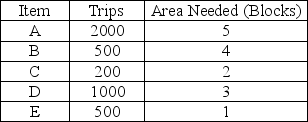
(Multiple Choice)
5.0/5 (75)
(75) The two most basic inventory questions answered by the typical inventory model are:
(Multiple Choice)
4.8/5 (66)
(66) In the simple EOQ model, if annual demand were to increase, the EOQ would increase proportionately.
(True/False)
4.9/5 (72)
(72) Consider the all-units quantity discount schedule below. Which of the following CANNOT be the optimal ordering quantity? 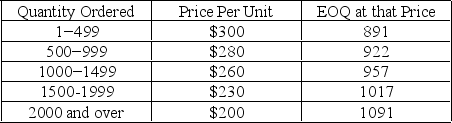
(Multiple Choice)
4.9/5 (80)
(80) The most expensive items in a warehouse should be placed near the dock.
(True/False)
4.7/5 (86)
(86) What is the value of the bullwhip measure for a company with a standard deviation of demand equal to 25, and a variance of orders equal to 450?
(Multiple Choice)
4.9/5 (68)
(68) The items listed below are stored in a one-dock warehouse. Which of them should be stored at the very back (furthest away from the dock)? 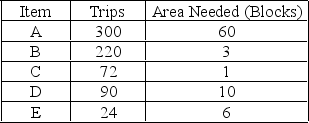
(Multiple Choice)
4.8/5 (64)
(64) 
Filters
- Essay(0)
- Multiple Choice(0)
- Short Answer(0)
- True False(0)
- Matching(0)