



 Chat with AI
Exam 18: Linear Programming

Exam 1: Operations and Productivity138 Questions
Exam 2: Operations Strategy in a Global Environment134 Questions
Exam 3: Project Management131 Questions
Exam 4: Forecasting148 Questions
Exam 5: Design of Goods and Services126 Questions
Exam 6: Managing Quality226 Questions
Exam 7: Process Strategies259 Questions
Exam 8: Location Strategies233 Questions
Exam 9: Human Resources, Job Design, and Work Measurement321 Questions
Exam 10: Supply Chain Management158 Questions
Exam 11: Inventory Management230 Questions
Exam 12: Aggregate Planning and Sop122 Questions
Exam 13: Material Requirements Planning Mrp and Erp133 Questions
Exam 14: Short-Term Scheduling124 Questions
Exam 15: Lean Operations122 Questions
Exam 16: Maintenance and Reliability119 Questions
Exam 17: Decision-Making Tools101 Questions
Exam 18: Linear Programming102 Questions
Exam 19: Transportation Models92 Questions
Exam 20: Waiting-Line Models126 Questions
Exam 21: Learning Curves114 Questions
Exam 22: Simulation78 Questions
Exam 23: Applying Analytics to Big Data in Operations Management61 Questions
Select questions type


Which of the following sets of constraints results in an unbounded maximization problem?
(Multiple Choice)
4.8/5  (80)
(80) The feasible region in the diagram below is consistent with which one of the following constraints? 
(Multiple Choice)
4.9/5 (89)
(89) Solving a linear programming problem with the iso-profit line solution method requires that we move the iso-profit line to each corner of the feasible region until the optimum is identified.
(True/False)
4.8/5 (70)
(70) ________ variables allow us to introduce "yes-or-no" decisions into our linear programs and to introduce special logical conditions.
(Short Answer)
5.0/5 (85)
(85) Sensitivity analysis can be applied to linear programming solutions by either (1) trial and error or (2) the analytic postoptimality method.
(True/False)
4.8/5 (88)
(88) What combination of x and y will yield the optimum for this problem? Minimize $3x + $15y, subject to (1) 2x + 4y ≤ 12 and (2) 5x + 2y ≤ 10 and (3) x, y ≥ 0.
(Multiple Choice)
4.9/5 (87)
(87) A linear programming problem contains a restriction that reads "the quantity of S must be no less than one-fourth as large as T and U combined." Formulate this as a linear programming constraint.
(Multiple Choice)
4.9/5 (85)
(85) Data Corp. is considering which of 4 different projects to undertake in order to maximize its net present value (NPV). Define Xi as a binary variable that equals 1 if project i is undertaken and 0 otherwise, for i = 1, 2, 3, 4. The NPV and required capital (in millions) for each project are listed below. 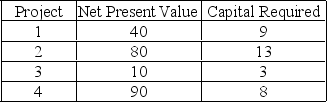 Which of the following represents the constraint stating that project 2 can be undertaken only if project 3 is undertaken?
 (Multiple Choice)
5.0/5 (85)
(85) Which of the following correctly describes all iso-profit lines for an LP maximization problem?
(Multiple Choice)
4.8/5 (88)
(88) If we wish to ensure that decision variable values in a linear program are integers rather than fractions, the generally accepted practice is to round the solutions to the nearest integer values.
(True/False)
4.7/5 (76)
(76) What combination of x and y will yield the optimum for this problem? Maximize $3x + $15y, subject to (1) 2x + 3y ≤ 12 and (2) 5x + 2y ≤ 10 and (3) x, y ≥ 0.
(Multiple Choice)
4.7/5 (77)
(77) A linear programming problem has two constraints 2X + 4Y ≤ 100 and 1X + 8Y ≤ 100, plus nonnegativity constraints on X and Y. Which of the following statements about its feasible region is TRUE?
(Multiple Choice)
4.9/5 (84)
(84) The diet problem is known in agricultural applications as the:
(Multiple Choice)
4.7/5 (82)
(82) A linear programming problem has three constraints, plus nonnegativity constraints on X and Y. The constraints are: 2X + 10Y ≤ 100; 4X + 6Y ≤ 120; 3X + 3Y ≤ 90. What is the largest quantity of X that can be made without violating any of these constraints?
(Multiple Choice)
4.8/5 (81)
(81) Suppose that a constraint is given by X + Y ≤ 10. If another constraint is given to be 3X + 2Y ≥ 15, and if X and Y are restricted to be nonnegative, determine the corners of the feasible solution. If the profit from X is 5 and the profit from Y is 10, determine the combination of X and Y that will yield maximum profit.
(Essay)
4.8/5 (93)
(93) For the constraints given below, which point is in the feasible region of this maximization problem? (1) 14x + 6y ≤ 42 (2) x - y ≤ 3 (3) x, y ≥ 0
(Multiple Choice)
4.8/5 (78)
(78) Identify three examples of resources that are typically constrained in a linear programming problem.
(Essay)
4.8/5 (61)
(61) Suppose that the shadow price for assembly time is $5/hour. The allowable increase for the assembly time constraint is 40 hours, and the allowable decrease is 30 hours. If all assembly hours were used under the initial LP solution and workers normally make $4/hour but can work overtime for $6/hour, what should management do?
(Multiple Choice)
4.8/5 (78)
(78) Consider the following constraints from a two-variable linear program: X ≥ 1; Y ≥ 1; X + Y ≤ 9. If these are the only constraints, which of the following points (X, Y) CANNOT be the optimal solution?
(Multiple Choice)
4.8/5 (84)
(84) 
Filters
- Essay(0)
- Multiple Choice(0)
- Short Answer(0)
- True False(0)
- Matching(0)