



 Chat with AI
Exam 18: Linear Programming

Exam 1: Operations and Productivity138 Questions
Exam 2: Operations Strategy in a Global Environment134 Questions
Exam 3: Project Management131 Questions
Exam 4: Forecasting148 Questions
Exam 5: Design of Goods and Services126 Questions
Exam 6: Managing Quality226 Questions
Exam 7: Process Strategies259 Questions
Exam 8: Location Strategies233 Questions
Exam 9: Human Resources, Job Design, and Work Measurement321 Questions
Exam 10: Supply Chain Management158 Questions
Exam 11: Inventory Management230 Questions
Exam 12: Aggregate Planning and Sop122 Questions
Exam 13: Material Requirements Planning Mrp and Erp133 Questions
Exam 14: Short-Term Scheduling124 Questions
Exam 15: Lean Operations122 Questions
Exam 16: Maintenance and Reliability119 Questions
Exam 17: Decision-Making Tools101 Questions
Exam 18: Linear Programming102 Questions
Exam 19: Transportation Models92 Questions
Exam 20: Waiting-Line Models126 Questions
Exam 21: Learning Curves114 Questions
Exam 22: Simulation78 Questions
Exam 23: Applying Analytics to Big Data in Operations Management61 Questions
Select questions type


A linear programming problem contains a restriction that reads "the quantity of X must be at least twice as large as the quantity of Y." Formulate this as a linear programming constraint.
(Short Answer)
4.8/5  (77)
(77) The main disadvantage of introducing constraints into a linear program that enforce some or all of the decision variables to be either integer or binary is that:
(Multiple Choice)
5.0/5 (88)
(88) For a linear programming problem with the constraints 2X + 4Y ≤ 100 and 1X + 8Y ≤ 100, two of its corner points are (0, 0) and (0, 25).
(True/False)
4.7/5 (79)
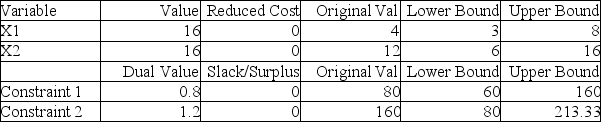
(79) A craftsman builds two kinds of birdhouses, one for wrens (X1), and one for bluebirds (X2). Each wren birdhouse takes two hours of labor and two units of lumber. Each bluebird house requires three hours of labor and eight units of lumber. The craftsman has available 80 hours of labor and 160 units of lumber. Wren houses profit $4 each and bluebird houses profit $12 each.
Use the software output that follows to interpret the problem solution. Include a statement of the solution quantities (how many of which product), a statement of the maximum profit achieved by your product mix, and a statement of "resources unused" and "shadow prices."
(Essay)
4.8/5 (88)
(88) ________ is a mathematical technique designed to help operations managers plan and make decisions necessary to allocate resources.
(Short Answer)
4.9/5 (83)
(83) Very few linear programming problems involve minimizing an objective.
(True/False)
4.9/5 (86)
(86) Which of the following combinations of constraints has no feasible region?
(Multiple Choice)
4.8/5 (88)
(88) A common form of the product-mix linear programming problem seeks to find that combination of products and the quantity of each that maximizes profit in the presence of limited resources.
(True/False)
4.8/5 (88)
(88) Suppose that a constraint for assembly time has a shadow price of $50/hour for 15 hours in either direction and that all available assembly time is currently used (would require overtime to do more). If the salary of workers is $30 and they receive 50% extra pay for overtime what should management do?
(Essay)
4.9/5 (76)
(76) A difference between minimization and maximization problems is that:
(Multiple Choice)
4.8/5 (77)
(77) Using the iso-profit line solution method to solve a maximization problem requires that we:
(Multiple Choice)
4.8/5 (81)
(81) Describe how to incorporate fixed costs into a cost-minimizing linear program, where the fixed cost of using a machine is incurred if any products are produced on that machine.
(Essay)
4.9/5 (71)
(71) Phil Bert's Nuthouse is preparing a new product, a blend of mixed nuts. The product must be at most 40% peanuts, must have more almonds than cashews, and must be at least 15% pecans. The blend will be sold in half-pound bags. Phil's goal is to mix the nuts in such a manner that all conditions are satisfied and the cost per bag is minimized. Peanuts cost $1 per pound. Cashews cost $5 per pound. Almonds cost $3 per pound, and pecans cost $6 per pound. Formulate this problem as a linear program.
(Essay)
4.9/5 (81)
(81) Suppose that the feasible region of a maximization LP problem has corners of (0,0), (10,0), (5,5), and (0,7). If profit is given to be $X + $3Y what is the maximum profit the company can earn?
(Multiple Choice)
4.9/5 (79)
(79) Which of the following represents a valid constraint in linear programming?
(Multiple Choice)
5.0/5 (77)
(77) Suppose that the feasible region of a maximization LP problem has corners of (0,0), (5,0), and (0,5). How many possible combinations of X and Y will yield the maximum profit if profit is given to be 5X + 5Y?
(Multiple Choice)
4.7/5 (94)
(94) Tom is a habitual shopper at garage sales. Last Saturday he stopped at one where there were several types of used building materials for sale. At the low prices being asked, Tom knew that he could resell the items in another town for a substantial gain. Four things stood in his way: he could only make one round trip to resell the goods; his pickup truck bed would hold only 1000 pounds; the pickup truck bed could hold at most 70 cubic feet of merchandise; and he had only $200 cash with him. He wants to load his truck with the mix of materials that will yield the greatest profit when he resells them.
 Formulate this problem as a linear program.
 (Essay)
4.9/5 (72)
(72) 
Filters
- Essay(0)
- Multiple Choice(0)
- Short Answer(0)
- True False(0)
- Matching(0)