



 Chat with AI
Exam 7: Project Management

Exam 1: Using Operations to Create Value115 Questions
Exam 2: Process Strategy and Analysis239 Questions
Exam 3: Quality and Performance198 Questions
Exam 4: Capacity Planning120 Questions
Exam 5: Constraint Management136 Questions
Exam 6: Lean Systems166 Questions
Exam 7: Project Management139 Questions
Exam 8: Forecasting150 Questions
Exam 9: Inventory Management205 Questions
Exam 10: Operations Planning and Scheduling149 Questions
Exam 11: Resource Planning124 Questions
Exam 12: Supply Chain Design77 Questions
Exam 13: Supply Chain Logistic Networks114 Questions
Exam 14: Supply Chain Integration120 Questions
Exam 15: Supply Chain Sustainability78 Questions
Exam 16: Supplement A Decision Making107 Questions
Exam 17: Supplement J Operations Scheduling123 Questions
Exam 18: Supplement K Layout39 Questions
Exam 19: Supplement B Waiting Lines111 Questions
Exam 20: Supplement C Special Inventory Models53 Questions
Exam 21: Supplement D Linear Programming87 Questions
Exam 22: Supplement E Simulation54 Questions
Exam 23: Supplement F Financial Analysis55 Questions
Exam 24: Supplement G Acceptance Sampling Plans87 Questions
Exam 25: Supplement H Measuring Output Rates108 Questions
Exam 26: Supplement I Learning Curve Analysis50 Questions
Select questions type


A plan that identifies key threats to a project and prescribes ways to circumvent them is called a:
(Multiple Choice)
4.9/5  (78)
(78) The earliest start time is never the same as the latest start time.
(True/False)
4.8/5 (77)
(77) Phoebe B. Beebee is constructing a canal for the annual canoe races and has identified eleven activities that are required to complete this important project. She calculated early and late start times and early and late finish times but spilled coffee all over her printout. Use the remaining information to reconstruct the table for Phoebe B. Beebee and her new canoe canal.

(Essay)
4.9/5 (86)
(86) A company could add $10,000 per week in revenues if the project depicted in Table 7.10 could be shortened.
Table 7.10
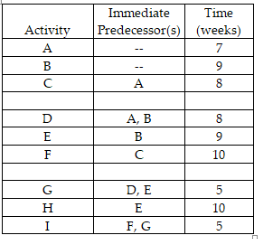 Four possible options exist to crash activities: crash A by one week at a cost of $6,000; crash C by two weeks at a cost of $15,000; crash E by one week at a cost of $2,000; and crash I one week at a cost of $7,000. What is the maximum amount of additional profit that can be made by crashing an option (or options)?
 (Multiple Choice)
4.9/5 (73)
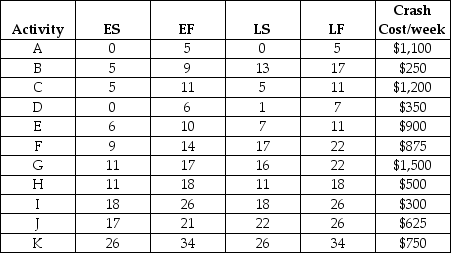
(73) The following table contains a list of activities, with early- and late-start and finish times and crash costs for the network shown in the figure. All start and finish times and crash costs are on a per-week basis. Each activity can be reduced by one week at the most.
a. Determine the uncrashed activity lengths for activities A though K.
b. Determine the minimum completion cost for this project if each week carries a fixed cost of $1,000.

(Essay)
4.9/5 (93)
(93) In addition to finishing the work, the project close out phase should include recording some lessons-learned to carry forward to future projects.
(True/False)
4.9/5 (76)
(76) Table 7.5
 -Using Table 7.5, what is the latest start time for activity E?
 (Multiple Choice)
4.8/5 (81)
(81) Table 7.9
 -Using Table 7.9, if the project's normal earliest completion time is to be reduced by two weeks, what is the minimum additional cost that will be incurred in achieving this two-week reduction?
 (Multiple Choice)
4.9/5 (88)
(88) The ________ is a statement of all work that has to be completed.
(Short Answer)
4.9/5 (70)
(70) ________ is an attempt to reduce the peaks and valleys in resource needs by shifting the schedules of conflicting activities within their earliest and latest start dates.
(Short Answer)
4.9/5 (80)
(80) Which of these steps comes first in the project life cycle?
(Multiple Choice)
4.8/5 (74)
(74) Table 7.8
 -Using Table 7.8, what is the minimum completion time for this project after crashing?
 (Multiple Choice)
4.8/5 (89)
(89) Table 7.6
 -Using Table 7.6, what is the latest start time for activity A?
 (Multiple Choice)
4.9/5 (91)
(91) Figure 7.1
 -For the network shown in Fig. 7.1, what is the project duration?
 (Multiple Choice)
4.7/5 (85)
(85) Table 7.13
All activity times for the project are in weeks.
 -Using Table 7.13, what is the probability that the project will be completed in 65 or fewer weeks?
 (Multiple Choice)
4.8/5 (85)
(85) The ________ is the shortest time in which an activity can be completed if all goes exceptionally well.
(Short Answer)
4.8/5 (68)
(68) A pure project organizational structure houses the project in a specific functional area.
(True/False)
4.9/5 (88)
(88) Table 7.3
 -Using Table 7.3, which activity is on the critical path?
 (Multiple Choice)
4.8/5 (89)
(89) 
Filters
- Essay(0)
- Multiple Choice(0)
- Short Answer(0)
- True False(0)
- Matching(0)