



 Chat with AI
Exam 7: Project Management

Exam 1: Using Operations to Create Value115 Questions
Exam 2: Process Strategy and Analysis239 Questions
Exam 3: Quality and Performance198 Questions
Exam 4: Capacity Planning120 Questions
Exam 5: Constraint Management136 Questions
Exam 6: Lean Systems166 Questions
Exam 7: Project Management139 Questions
Exam 8: Forecasting150 Questions
Exam 9: Inventory Management205 Questions
Exam 10: Operations Planning and Scheduling149 Questions
Exam 11: Resource Planning124 Questions
Exam 12: Supply Chain Design77 Questions
Exam 13: Supply Chain Logistic Networks114 Questions
Exam 14: Supply Chain Integration120 Questions
Exam 15: Supply Chain Sustainability78 Questions
Exam 16: Supplement A Decision Making107 Questions
Exam 17: Supplement J Operations Scheduling123 Questions
Exam 18: Supplement K Layout39 Questions
Exam 19: Supplement B Waiting Lines111 Questions
Exam 20: Supplement C Special Inventory Models53 Questions
Exam 21: Supplement D Linear Programming87 Questions
Exam 22: Supplement E Simulation54 Questions
Exam 23: Supplement F Financial Analysis55 Questions
Exam 24: Supplement G Acceptance Sampling Plans87 Questions
Exam 25: Supplement H Measuring Output Rates108 Questions
Exam 26: Supplement I Learning Curve Analysis50 Questions
Select questions type


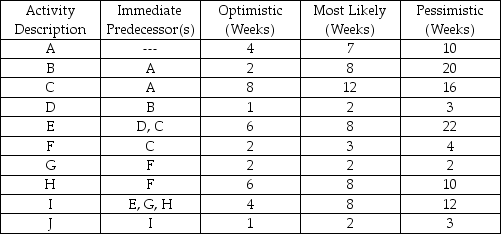
Table 7.14
You are responsible for managing a project with the following activities (times are given in weeks).
 -Using Table 7.14, which activity has the largest standard deviation, and how large is that standard deviation?
 (Multiple Choice)
4.9/5  (64)
(64) Consider the activities, durations, and predecessor relationships in the following network. Draw the network and answer the questions that follow.
 a. What is the expected time for activity B?
b. What is the variance for activity B?
c. Based on the calculation of estimated times, what is the critical path?
d. What is the estimated time of the critical path?
e. What is the activity variance along the critical path?
f. What is the probability of completion of the project before week 42?
a. What is the expected time for activity B?
b. What is the variance for activity B?
c. Based on the calculation of estimated times, what is the critical path?
d. What is the estimated time of the critical path?
e. What is the activity variance along the critical path?
f. What is the probability of completion of the project before week 42? (Essay)
5.0/5 (77)
(77) Figure 7.1
 -For the network shown in Fig. 7.1, which of the following is the critical path?
 (Multiple Choice)
4.7/5 (74)
(74) Figure to accompany Table 7.7
 Table 7.7
 -What is the crashing cost per week for activity A in Table 7.7?
Table 7.7
-What is the crashing cost per week for activity A in Table 7.7? (Multiple Choice)
4.8/5 (71)
(71) A(n) ________ identifies the key threats to a project and prescribes ways to work around them.
(Short Answer)
4.8/5 (86)
(86) A critical path is any sequence of activities between a project's start and finish.
(True/False)
4.7/5 (79)
(79) A project manager hires a few new coders to help speed up the new software project and deliver the package on time to an important client. The manager has engaged in:
(Multiple Choice)
4.8/5 (70)
(70) A risk-management plan contains all identified risks to a project plus the ways that they can be circumvented.
(True/False)
4.9/5 (87)
(87) What are the primary responsibilities of a Project Manager? Briefly describe these responsibilities for a project manager whose team is purchasing a new machine and installing it in a manufacturing process.
(Essay)
4.9/5 (64)
(64) The ________ is the sequence of activities between a project's start and finish that takes the longest time to complete.
(Short Answer)
4.8/5 (72)
(72) Table 7.8
 -Using Table 7.8, what is the activity with the greatest amount of slack?
 (Multiple Choice)
4.9/5 (75)
(75) Activity times for a project are estimated by all except which of the following methods?
(Multiple Choice)
4.9/5 (80)
(80) Table 7.8
-Using Table 7.8, what is the earliest possible completion time for activity E after crashing?
-Using Table 7.8, what is the earliest possible completion time for activity E after crashing? (Multiple Choice)
4.8/5 (68)
(68) Table 7.9
 -Using Table 7.9, if the project completion time has to be reduced by one week, which of the following activities should be crashed to minimize the extra cost of earlier completion?
 (Multiple Choice)
4.9/5 (80)
(80) Table 7.4
 -Using Table 7.4, what is the slack associated with activity B?
 (Multiple Choice)
4.8/5 (83)
(83) A project is currently scheduled to be finished on its normal earliest completion date. The project manager has the opportunity to earn a bonus if the project can be completed three weeks ahead of schedule. The increase in project direct costs related to crashing activities would be $40,000. Also, project indirect costs are $15,000 per week. What is the smallest bonus that the project manager should accept if he or she wants to avoid increasing overall project costs?
(Multiple Choice)
4.8/5 (71)
(71) Figure 7.2
 -Which one of the following statements regarding Figure 7.2 is True?
 (Multiple Choice)
4.9/5 (86)
(86) Table 7.9
-Using Table 7.9, what is the earliest completion time of this project if normal times are used for all activities?
-Using Table 7.9, what is the earliest completion time of this project if normal times are used for all activities? (Multiple Choice)
4.9/5 (84)
(84) 
Filters
- Essay(0)
- Multiple Choice(0)
- Short Answer(0)
- True False(0)
- Matching(0)