



 Chat with AI
Exam 15: Oscillatory Motion

Exam 1: Physics and Measurement25 Questions
Exam 2: Motion in One Dimension66 Questions
Exam 3: Vectors47 Questions
Exam 4: Motion in Two Dimensions79 Questions
Exam 5: The Laws of Motion113 Questions
Exam 6: Circular Motion and Other Applications of Newtons Laws55 Questions
Exam 7: Energy of a System74 Questions
Exam 8: Conservation of Energy84 Questions
Exam 9: Linear Momentum and Collisions89 Questions
Exam 10: Rotation of a Rigid Object About a Fixed Axis82 Questions
Exam 11: Angular Momentum46 Questions
Exam 12: Static Equilibrium and Elasticity34 Questions
Exam 13: Universal Gravitation47 Questions
Exam 14: Fluid Mechanics53 Questions
Exam 15: Oscillatory Motion41 Questions
Exam 16: Wave Motion82 Questions
Exam 18: Superposition and Standing Waves72 Questions
Exam 19: Temperature47 Questions
Exam 20: The First Law of Thermodynamics61 Questions
Exam 21: The Kinetic Theory of Gases38 Questions
Exam 22: Heat Engines, Entropy, and the Second Law of Thermodynamics55 Questions
Exam 23: Electric Fields67 Questions
Exam 24: Gausss Law82 Questions
Exam 25: Electric Potential111 Questions
Exam 26: Capacitance and Dielectrics63 Questions
Exam 27: Current and Resistance34 Questions
Exam 28: Direct-Current Circuits84 Questions
Exam 29: Magnetic Fields80 Questions
Exam 30: Sources of the Magnetic Field95 Questions
Exam 31: Faradays Law62 Questions
Exam 32: Inductance23 Questions
Exam 33: Alternating-Current Circuits65 Questions
Exam 34: Electromagnetic Waves40 Questions
Exam 35: The Nature of Light and the Principles of Ray Optics37 Questions
Exam 36: Image Formation43 Questions
Exam 37: Wave Optics48 Questions
Exam 38: Diffraction Patterns and Polarization47 Questions
Exam 39: Relativity34 Questions
Exam 40: Introduction to Quantum Physics48 Questions
Exam 41: Quantum Mechanics33 Questions
Exam 42: Atomic Physics59 Questions
Exam 43: Molecules and Solids46 Questions
Exam 44: Nuclear Structure89 Questions
Exam 46: Particle Physics and Cosmology34 Questions
Select questions type


John says that the value of the function cos[ω(t + T) + ϕ], obtained one period T after time t, is greater than cos(ωt + ϕ) by 2π. Larry says that it is greater by the addition of 1.00 to cos(ωt + ϕ). Which one, if either, is correct?
(Multiple Choice)
4.8/5  (74)
(74) Ellen says that whenever the acceleration is directly proportional to the displacement of an object from its equilibrium position, the motion of the object is simple harmonic motion. Mary says this is true only if the acceleration is opposite in direction to the displacement. Which one, if either, is correct?
(Multiple Choice)
4.8/5 (78)
(78) A body oscillates with simple harmonic motion along the x axis. Its displacement varies with time according to the equation x = 5 sin (πt + π/3). The phase (in rad) of the motion at t = 2 s is
(Multiple Choice)
4.9/5 (86)
(86) A 2.00 m-long 6.00 kg ladder pivoted at the top hangs down from a platform at the circus. A 42.0 kg trapeze artist climbs to a point where her center of mass is at the center of the ladder and swings at the system's natural frequency. The angular frequency (in s−1) of the system of ladder and woman is
(Multiple Choice)
4.8/5 (90)
(90) The figure shows a uniform rod (length L = 1.0 m, mass = 2.0 kg) suspended from a pivot a distance d = 0.25 m above its center of mass. The angular frequency (in rad/s) for small oscillations is approximately 
(Multiple Choice)
4.8/5 (75)
(75) A uniform rod (mass m = 1.0 kg and length L = 2.0 m) pivoted at one end oscillates in a vertical plane as shown below. The period of oscillation (in s) is approximately 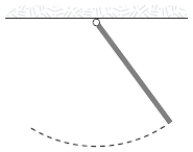
(Multiple Choice)
4.9/5 (70)
(70) An archer pulls her bow string back 0.40 m by exerting a force that increases uniformly from zero to 240 N. What is the equivalent spring constant of the bow, and how much work is done in pulling the bow?
(Short Answer)
4.8/5 (79)
(79) Two circus clowns (each having a mass of 50 kg) swing on two flying trapezes (negligible mass, length 25 m) shown in the figure. At the peak of the swing, one grabs the other, and the two swing back to one platform. The time for the forward and return motion is 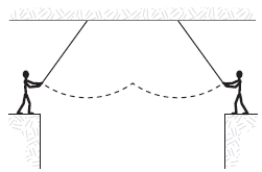
(Multiple Choice)
4.8/5 (77)
(77) Which of the following combinations of variables results in the greatest period for a pendulum?
(Multiple Choice)
5.0/5 (69)
(69) The mat of a trampoline is held by 32 springs, each having a spring constant of 5 000 N/m. A person with a mass of 40.0 kg jumps from a platform 1.93 m high onto the trampoline. Determine the stretch of each of the springs.
(Short Answer)
4.9/5 (83)
(83) The oscillation of the 2.0-kg mass on a spring is described by  where x is in centimeters and t is in seconds. What is the force constant of the spring?
 (Multiple Choice)
5.0/5 (85)
(85) Exhibit 15-1
A graph of position versus time for an object oscillating at the free end of a horizontal spring is shown below. A point or points at which the object has positive velocity and zero acceleration is(are) 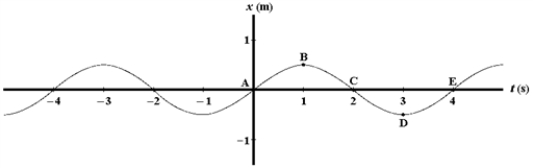 Use this exhibit to answer the following question(s).
-Refer to Exhibit 15-1. The point at which the object has negative velocity and zero acceleration is
Use this exhibit to answer the following question(s).
-Refer to Exhibit 15-1. The point at which the object has negative velocity and zero acceleration is (Multiple Choice)
4.7/5 (75)
(75) In the figure below, a disk (radius R = 1.0 m, mass = 2.0 kg) is suspended from a pivot a distance d = 0.25 m above its center of mass. For a circular disk,  . The angular frequency (in rad/s) for small oscillations is approximately

. The angular frequency (in rad/s) for small oscillations is approximately (Multiple Choice)
4.8/5 (58)
(58) A body oscillates with simple harmonic motion along the x axis. Its displacement varies with time according to the equation x = 5.0 sin (πt + π/3). The velocity (in m/s) of the body at t = 1.0 s is
(Multiple Choice)
4.7/5 (81)
(81) A body of mass 5.0 kg is suspended by a spring which stretches 10 cm when the mass is attached. It is then displaced downward an additional 5.0 cm and released. Its position as a function of time is approximately
(Multiple Choice)
4.8/5 (71)
(71) In an inertia balance, a body supported against gravity executes simple harmonic oscillations in a horizontal plane under the action of a set of springs. If a 1.00 kg body vibrates at 1.00 Hz, a 2.00 kg body will vibrate at
(Multiple Choice)
4.9/5 (72)
(72) In the figure below, a hoop (radius R = 1.0 m, mass = 2.0 kg) having four spokes of negligible mass is suspended from a pivot a distance d = .25 m above its center of mass. The angular frequency (in rad/s) for small oscillations is approximately 
(Multiple Choice)
4.8/5 (90)
(90) A torsional pendulum consists of a solid disk (mass = 2.0 kg, radius = 1.0 m) suspended by a wire attached to a rigid support. The body oscillates about the support wire. If the torsion constant is 16 N⋅m/rad. What is the angular frequency (in rad/s)? 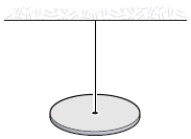
(Multiple Choice)
4.9/5 (79)
(79) The motion of a piston in an auto engine is simple harmonic. If the piston travels back and forth over a distance of 10 cm, and the piston has a mass of 1.5 kg, what is the maximum speed of the piston and the maximum force acting on the piston when the engine is running at 4 200 rpm?
(Short Answer)
4.8/5 (85)
(85) An automobile (m = 1.00 × 10³ kg) is driven into a brick wall in a safety test. The bumper behaves like a spring (k = 5.00 × 10⁶ N/m), and is observed to compress a distance of 3.16 cm as the car is brought to rest. What was the initial speed of the automobile?
(Short Answer)
4.9/5 (77)
(77) 
Filters
- Essay(0)
- Multiple Choice(0)
- Short Answer(0)
- True False(0)
- Matching(0)