



 Chat with AI
Exam 16: Wave Motion

Exam 1: Physics and Measurement25 Questions
Exam 2: Motion in One Dimension66 Questions
Exam 3: Vectors47 Questions
Exam 4: Motion in Two Dimensions79 Questions
Exam 5: The Laws of Motion113 Questions
Exam 6: Circular Motion and Other Applications of Newtons Laws55 Questions
Exam 7: Energy of a System74 Questions
Exam 8: Conservation of Energy84 Questions
Exam 9: Linear Momentum and Collisions89 Questions
Exam 10: Rotation of a Rigid Object About a Fixed Axis82 Questions
Exam 11: Angular Momentum46 Questions
Exam 12: Static Equilibrium and Elasticity34 Questions
Exam 13: Universal Gravitation47 Questions
Exam 14: Fluid Mechanics53 Questions
Exam 15: Oscillatory Motion41 Questions
Exam 16: Wave Motion82 Questions
Exam 18: Superposition and Standing Waves72 Questions
Exam 19: Temperature47 Questions
Exam 20: The First Law of Thermodynamics61 Questions
Exam 21: The Kinetic Theory of Gases38 Questions
Exam 22: Heat Engines, Entropy, and the Second Law of Thermodynamics55 Questions
Exam 23: Electric Fields67 Questions
Exam 24: Gausss Law82 Questions
Exam 25: Electric Potential111 Questions
Exam 26: Capacitance and Dielectrics63 Questions
Exam 27: Current and Resistance34 Questions
Exam 28: Direct-Current Circuits84 Questions
Exam 29: Magnetic Fields80 Questions
Exam 30: Sources of the Magnetic Field95 Questions
Exam 31: Faradays Law62 Questions
Exam 32: Inductance23 Questions
Exam 33: Alternating-Current Circuits65 Questions
Exam 34: Electromagnetic Waves40 Questions
Exam 35: The Nature of Light and the Principles of Ray Optics37 Questions
Exam 36: Image Formation43 Questions
Exam 37: Wave Optics48 Questions
Exam 38: Diffraction Patterns and Polarization47 Questions
Exam 39: Relativity34 Questions
Exam 40: Introduction to Quantum Physics48 Questions
Exam 41: Quantum Mechanics33 Questions
Exam 42: Atomic Physics59 Questions
Exam 43: Molecules and Solids46 Questions
Exam 44: Nuclear Structure89 Questions
Exam 46: Particle Physics and Cosmology34 Questions
Select questions type


A pulse is described by  in SI units. What is the velocity of the pulse?
 (Multiple Choice)
4.9/5  (87)
(87) Determine the intensity (in W/m2) of a harmonic longitudinal wave with a pressure amplitude of 8.0 × 10⁻³ N/m2 propagating down a tube filled with helium. (ρ = 0.179 kg/m3, v = 972 m/s.)
(Multiple Choice)
4.8/5 (74)
(74) A truck moving at 36 m/s passes a police car moving at 45 m/s in the opposite direction. If the frequency of the siren relative to the police car is 500 Hz, what is the frequency heard by an observer in the truck as the police car approaches the truck? (The speed of sound in air is 343 m/s.)
(Multiple Choice)
4.8/5 (80)
(80) If y = 0.02 sin (30x − 400t) (SI units), the frequency of the wave is
(Multiple Choice)
4.7/5 (85)
(85) The variation in the pressure of helium gas, measured from its equilibrium value, is given by ΔP = 2.9 × 10⁻⁵ cos (6.20x − 3 000t) where x and t have units m and s. Determine the speed (in m/s) of the wave.
(Multiple Choice)
4.8/5 (86)
(86) By what factor will an intensity change when the corresponding sound level increases by 3 dB?
(Multiple Choice)
4.7/5 (66)
(66) Bats can detect small objects such as insects that are of a size on the order of a wavelength. If bats emit a chirp at a frequency of 60 kHz and the speed of soundwaves in air is 330 m/s, what is the smallest size insect they can detect?
(Multiple Choice)
4.8/5 (70)
(70) Exhibit 16-1
The figure below shows a sine wave at one point of a string as a function of time. 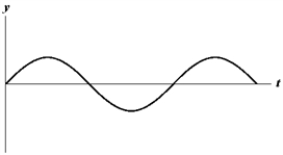 Use the exhibit to answer the following question(s).
-Refer to Exhibit 16-1. Which of the graphs below shows a wave where the amplitude and the frequency are doubled?
Use the exhibit to answer the following question(s).
-Refer to Exhibit 16-1. Which of the graphs below shows a wave where the amplitude and the frequency are doubled? (Multiple Choice)
4.9/5 (75)
(75) A point source emits sound waves with a power output of 100 watts. What is the sound level (in dB) at a distance of 10 m?
(Multiple Choice)
4.8/5 (72)
(72) Calculate the displacement amplitude (in m) of a 20 kHz sound wave in helium if it has a pressure amplitude of 8.0 × 10⁻³ N/m2. (ρ = 0.179 kg/m3, v = 972 m/s.)
(Multiple Choice)
4.9/5 (84)
(84) The variation in the pressure of helium gas, measured from its equilibrium value, is given by ΔP = 2.9 × 10⁻⁵ cos (6.20x − 3 000t) where x and t have units m and s, and ΔP is measured in N/m2. Determine the frequency (in Hz) of the wave.
(Multiple Choice)
4.8/5 (86)
(86) A piano string of density 0.005 0 kg/m is under a tension of 1 350 N. Find the velocity with which a wave travels on the string.
(Multiple Choice)
4.9/5 (83)
(83) Ocean waves with a wavelength of 120 m are coming in at a rate of 8 per minute. What is their speed?
(Multiple Choice)
4.8/5 (80)
(80) Find the period of a wave of 100-m wavelength in deep water where 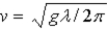 .
. (Multiple Choice)
4.8/5 (85)
(85) A person standing in the street is unaware of a bird dropping that is falling from a point directly above him with increasing velocity. If the dropping were producing sound of a fixed frequency, as it approaches the person would hear the sound
(Multiple Choice)
4.9/5 (89)
(89) If the breakers at a beach are separated by 5.0 m and hit shore with a frequency of 0.20 Hz, with what speed are they traveling?
(Short Answer)
4.7/5 (78)
(78) For the transverse wave described by  , determine the maximum transverse speed of the particles of the medium.
 (Multiple Choice)
4.7/5 (74)
(74) A car approaches a stationary police car at 36 m/s. The frequency of the siren (relative to the police car) is 500 Hz. What is the frequency (in Hz) heard by an observer in the moving car as he approaches the police car? (Assume the velocity of sound in air is 343 m/s.)
(Multiple Choice)
4.8/5 (78)
(78) While you are sounding a tone on a toy whistle, you notice a friend running toward you. If you want her to hear the same frequency that you hear even though she is approaching, you must
(Multiple Choice)
5.0/5 (79)
(79) 
Filters
- Essay(0)
- Multiple Choice(0)
- Short Answer(0)
- True False(0)
- Matching(0)