



 Chat with AI
Exam 19: Temperature

Exam 1: Physics and Measurement25 Questions
Exam 2: Motion in One Dimension66 Questions
Exam 3: Vectors47 Questions
Exam 4: Motion in Two Dimensions79 Questions
Exam 5: The Laws of Motion113 Questions
Exam 6: Circular Motion and Other Applications of Newtons Laws55 Questions
Exam 7: Energy of a System74 Questions
Exam 8: Conservation of Energy84 Questions
Exam 9: Linear Momentum and Collisions89 Questions
Exam 10: Rotation of a Rigid Object About a Fixed Axis82 Questions
Exam 11: Angular Momentum46 Questions
Exam 12: Static Equilibrium and Elasticity34 Questions
Exam 13: Universal Gravitation47 Questions
Exam 14: Fluid Mechanics53 Questions
Exam 15: Oscillatory Motion41 Questions
Exam 16: Wave Motion82 Questions
Exam 18: Superposition and Standing Waves72 Questions
Exam 19: Temperature47 Questions
Exam 20: The First Law of Thermodynamics61 Questions
Exam 21: The Kinetic Theory of Gases38 Questions
Exam 22: Heat Engines, Entropy, and the Second Law of Thermodynamics55 Questions
Exam 23: Electric Fields67 Questions
Exam 24: Gausss Law82 Questions
Exam 25: Electric Potential111 Questions
Exam 26: Capacitance and Dielectrics63 Questions
Exam 27: Current and Resistance34 Questions
Exam 28: Direct-Current Circuits84 Questions
Exam 29: Magnetic Fields80 Questions
Exam 30: Sources of the Magnetic Field95 Questions
Exam 31: Faradays Law62 Questions
Exam 32: Inductance23 Questions
Exam 33: Alternating-Current Circuits65 Questions
Exam 34: Electromagnetic Waves40 Questions
Exam 35: The Nature of Light and the Principles of Ray Optics37 Questions
Exam 36: Image Formation43 Questions
Exam 37: Wave Optics48 Questions
Exam 38: Diffraction Patterns and Polarization47 Questions
Exam 39: Relativity34 Questions
Exam 40: Introduction to Quantum Physics48 Questions
Exam 41: Quantum Mechanics33 Questions
Exam 42: Atomic Physics59 Questions
Exam 43: Molecules and Solids46 Questions
Exam 44: Nuclear Structure89 Questions
Exam 46: Particle Physics and Cosmology34 Questions
Select questions type


A bicycle pump contains air at one atmosphere and 0°C. As the tire is pumped up, the volume of air decreases by 50% with each stroke. What is the new pressure of air (in atm) in the chamber after the first stroke, assuming no temperature change?
(Multiple Choice)
4.7/5  (77)
(77) Two identical containers, A and B, hold equal amounts of the same ideal gas at the same Po, Vo and To. The pressure of A then decreases by a half while its volume doubles; the pressure of B doubles while its volume decreases by a half. Which statement correctly describes the temperatures of the gases after the changes?
(Multiple Choice)
4.8/5 (84)
(84) One mole of an ideal gas is held at a constant pressure of 1 atm. Find the change in volume (in liters) if the temperature changes by 50°C.
(Multiple Choice)
4.8/5 (82)
(82) Two moles of an ideal gas are placed in a container of adjustable volume. When measurements are made
(Multiple Choice)
5.0/5 (71)
(71) A scuba diver has his lungs filled to half capacity (3 liters) when 10 m below the surface. If the diver holds his breath while quietly rising to the surface, what will the volume of the lungs be (in liters) at the surface? Assume the temperature is the same at all depths. (The density of water is 1.0 × 10³ kg/m3.)
(Multiple Choice)
4.9/5 (84)
(84) A helium-filled balloon has a volume of 1 m3. As it rises in the earth's atmosphere, its volume expands. What will its new volume be (in m3) if its original temperature and pressure are 20°C and 1 atm, and its final temperature and pressure are −40°C and 0.1 atm?
(Multiple Choice)
4.9/5 (76)
(76) Two thermometers are calibrated, one in degrees Celsius and the other in degrees Fahrenheit. At what temperature (in kelvins) do their readings measure the same temperature?
(Multiple Choice)
4.8/5 (68)
(68) At what Fahrenheit temperature are the Kelvin and Fahrenheit temperatures numerically equal?
(Short Answer)
5.0/5 (72)
(72) A bowling ball size probe from a spaceship and a pebble size object land on a large asteroid that is far from any star. After a long period of time has passed, it is highly probable that the pebble and the probe
(Multiple Choice)
4.9/5 (75)
(75) A temperature difference of 9.0 Celsius degrees is equal to a Fahrenheit temperature difference of
(Multiple Choice)
4.9/5 (72)
(72) A student has written the equation below to convert a temperature in degrees Fahrenheit into Kelvins. What is wrong with this equation? 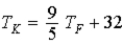
(Multiple Choice)
4.9/5 (86)
(86) Which of the following is not a possible thermometric property of a body?
(Multiple Choice)
4.7/5 (78)
(78) Helium condenses into the liquid phase at approximately 4 K. What temperature, in degrees Fahrenheit, does this correspond to?
(Multiple Choice)
4.7/5 (76)
(76) A gallon container is filled with gasoline. How many gallons are lost if the temperature increases by 25°F? (The volume expansion of gasoline is 9.6 × 10⁻⁴ (°C)−1.) (Neglect the change in volume of the container.)
(Multiple Choice)
4.8/5 (67)
(67) One mole of an ideal gas is held at a constant volume of 1 liter. Find the change in pressure if the temperature increases by 50°C.
(Multiple Choice)
4.8/5 (56)
(56) When the coefficient of linear expansion, α, and the temperature change, Tf − Ti, are large, a length Li of a solid substance expands in length to
(Multiple Choice)
4.9/5 (79)
(79) At which of the following temperatures would one liter of water weigh the most?
(Multiple Choice)
4.8/5 (80)
(80) A bubble having a diameter of 1.00 cm is released from the bottom of a swimming pool where the depth is 5.00 m. What will the diameter of the bubble be when it reaches the surface? The temperature of the water at the surface is 20.0°C, whereas it is 15.0°C at the bottom. (The density of water is 1.00 × 10³ kg/m3.)
(Multiple Choice)
4.8/5 (79)
(79) A square plate has an area of 29.00 cm2 at 20.0°C. It will be used in a low temperature experiment at T = 10.0K where it must have an area of 28.00 cm2. What area must be removed form the plate at 20.0°C for it to have the correct area at 10.0 K? (The coefficient of linear expansion is 10 × 10−6 (°C)−1.)
(Multiple Choice)
4.8/5 (72)
(72) 48 grams of oxygen at room temperature consists of how many moles?
(Multiple Choice)
5.0/5 (84)
(84) 
Filters
- Essay(0)
- Multiple Choice(0)
- Short Answer(0)
- True False(0)
- Matching(0)