



 Chat with AI
Exam 23: Electric Fields

Exam 1: Physics and Measurement25 Questions
Exam 2: Motion in One Dimension66 Questions
Exam 3: Vectors47 Questions
Exam 4: Motion in Two Dimensions79 Questions
Exam 5: The Laws of Motion113 Questions
Exam 6: Circular Motion and Other Applications of Newtons Laws55 Questions
Exam 7: Energy of a System74 Questions
Exam 8: Conservation of Energy84 Questions
Exam 9: Linear Momentum and Collisions89 Questions
Exam 10: Rotation of a Rigid Object About a Fixed Axis82 Questions
Exam 11: Angular Momentum46 Questions
Exam 12: Static Equilibrium and Elasticity34 Questions
Exam 13: Universal Gravitation47 Questions
Exam 14: Fluid Mechanics53 Questions
Exam 15: Oscillatory Motion41 Questions
Exam 16: Wave Motion82 Questions
Exam 18: Superposition and Standing Waves72 Questions
Exam 19: Temperature47 Questions
Exam 20: The First Law of Thermodynamics61 Questions
Exam 21: The Kinetic Theory of Gases38 Questions
Exam 22: Heat Engines, Entropy, and the Second Law of Thermodynamics55 Questions
Exam 23: Electric Fields67 Questions
Exam 24: Gausss Law82 Questions
Exam 25: Electric Potential111 Questions
Exam 26: Capacitance and Dielectrics63 Questions
Exam 27: Current and Resistance34 Questions
Exam 28: Direct-Current Circuits84 Questions
Exam 29: Magnetic Fields80 Questions
Exam 30: Sources of the Magnetic Field95 Questions
Exam 31: Faradays Law62 Questions
Exam 32: Inductance23 Questions
Exam 33: Alternating-Current Circuits65 Questions
Exam 34: Electromagnetic Waves40 Questions
Exam 35: The Nature of Light and the Principles of Ray Optics37 Questions
Exam 36: Image Formation43 Questions
Exam 37: Wave Optics48 Questions
Exam 38: Diffraction Patterns and Polarization47 Questions
Exam 39: Relativity34 Questions
Exam 40: Introduction to Quantum Physics48 Questions
Exam 41: Quantum Mechanics33 Questions
Exam 42: Atomic Physics59 Questions
Exam 43: Molecules and Solids46 Questions
Exam 44: Nuclear Structure89 Questions
Exam 46: Particle Physics and Cosmology34 Questions
Select questions type


A particle (mass = 5.0 g, charge = 40 mC) moves in a region of space where the electric field is uniform and is given by Ex = 2.5 N/C, Ey = Ez = 0. If the velocity of the particle at t = 0 is given by vy = 50 m/s, vx = vz = 0, what is the speed of the particle at t = 2.0 s?
(Multiple Choice)
4.8/5  (89)
(89) A point charge (−5.0 μC) is placed on the x axis at x = 4.0 cm, and a second charge (+5.0 μC) is placed on the x axis at x = −4.0 cm. What is the magnitude of the electric force on a third charge (+2.5 μC) placed on the y axis at y = 3.0 cm?
(Multiple Choice)
4.8/5 (77)
(77) A particle (mass = 4.0 g, charge = 80 mC) moves in a region of space where the electric field is uniform and is given by Ex = −2.5 N/C, Ey = Ez = 0. If the velocity of the particle at t = 0 is given by vx = 80 m/s, vy = vz = 0, what is the speed of the particle at t = 2.0 s?
(Multiple Choice)
4.8/5 (94)
(94) An alpha particle (charge = +2e) is sent at high speed toward a gold nucleus (charge +79e). What is the electrical force acting on the alpha particle when it is at a distance of 2 × 10⁻¹⁴ m away from the gold nucleus? (e = 1.6 × 10⁻¹⁹ C)
(Short Answer)
4.9/5 (76)
(76) If a = 60 cm, b = 80 cm, Q = −6.0 nC, and q = 6.0 nC, what is the magnitude of the electric field at point P in the figure? 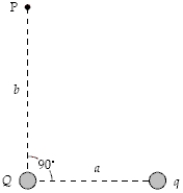
(Multiple Choice)
4.9/5 (81)
(81) A charge Q is placed on the x axis at x = +4.0 m. A second charge q is located at the origin. If Q = +75 nC and q = −8.0 nC, what is the magnitude of the electric field on the y axis at y = +3.0 m?
(Multiple Choice)
4.9/5 (76)
(76) In a diagram of charges and electric field lines charge  has twelve field lines going outward from it and charge
 has three field lines going into it. If one of the charges is 100 nC, what is the other one?
has twelve field lines going outward from it and charge has three field lines going into it. If one of the charges is 100 nC, what is the other one? (Multiple Choice)
4.9/5 (70)
(70) When a positive charge q is placed in the field created by two other charges Q1 and Q2, each a distance r away from q, the acceleration of q is
(Multiple Choice)
4.8/5 (81)
(81) A +20-nC point charge is placed on the x axis at x = 2.0 m, and a −25-nC point charge is placed on the y axis at y = −3.0 m. What is the direction of the electric field at the origin?
(Multiple Choice)
4.7/5 (85)
(85) The symbol  appears in Coulomb's law because we use independently defined units for
 (Multiple Choice)
4.9/5 (76)
(76) Three 2.50 μC charges are placed on tiny conducting spheres at the ends of 1.00 m-long strings that are connected at 120° angles as shown below. The magnitude, in N, of the force on the knot at the center is 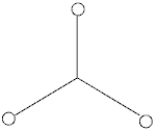
(Multiple Choice)
4.8/5 (74)
(74) A positively charged particle is moving in the +y-direction when it enters a region with a uniform electric field pointing in the +x-direction. Which of the diagrams below shows its path while it is in the region where the electric field exists. The region with the field is the region between the plates bounding each figure. The field lines always point to the right. The x-direction is to the right; the y-direction is up.
(Multiple Choice)
4.8/5 (68)
(68) If a = 60 cm, b = 80 cm, Q = −4.0 nC, and q = 1.5 nC, what is the magnitude of the electric field at point P? 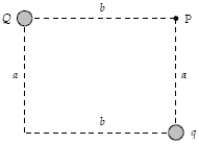
(Multiple Choice)
5.0/5 (93)
(93) The electron gun in a television tube accelerates electrons (mass = 9.11 × 10⁻³¹ kg, charge = 1.60 × 10⁻¹⁹ C) from rest to 3.00 × 10⁷ m/s within a distance of 2.00 cm. What electric field is required?
(Short Answer)
4.9/5 (72)
(72) If Q = 25 μC, q = 10 μC, and L = 40 cm in the figure, what is the magnitude of the electrostatic force on q? 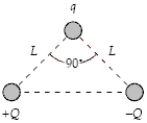
(Multiple Choice)
4.9/5 (70)
(70) A particle (m = 20 mg, q = −5.0 μC) moves in a uniform electric field of 60 N/C in the positive x direction. At t = 0, the particle is moving 30 m/s in the positive x direction and is passing through the origin. Determine the maximum distance beyond x = 0 the particle travels in the positive x direction.
(Multiple Choice)
4.8/5 (93)
(93) A point charge Q is placed at the origin. A second charge, 2Q, is placed on the x axis at x = −3.0 m. If Q = 50 μC, what is the magnitude of the electrostatic force on a third point charge, −Q, placed on the y axis at y = +4.0 m?
(Multiple Choice)
4.8/5 (87)
(87) Enrico says that positive charge is created when you rub a glass rod with silk, and that negative charge is simply the absence of positive charge. Rosetta says that negative charge is created and that positive charge is the absence of positive charge. (She has heard that Ben Franklin should have reversed the signs he associated with the charges.) Which one, if either, is correct?
(Multiple Choice)
5.0/5 (83)
(83) If a = 3.0 mm, b = 4.0 mm, Q1 = 60 nC, Q2 = −80 nC, and q = 36 nC in the figure, what is the magnitude of the electric force on q? 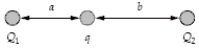
(Multiple Choice)
4.9/5 (77)
(77) Two identical pith balls supported by insulating threads hang side by side and close together, as shown below. 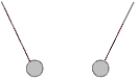 One is positively charged; the other is neutral. We can conclude that
 (Multiple Choice)
4.8/5 (74)
(74) 
Filters
- Essay(0)
- Multiple Choice(0)
- Short Answer(0)
- True False(0)
- Matching(0)