



 Chat with AI
Exam 24: Gausss Law

Exam 1: Physics and Measurement25 Questions
Exam 2: Motion in One Dimension66 Questions
Exam 3: Vectors47 Questions
Exam 4: Motion in Two Dimensions79 Questions
Exam 5: The Laws of Motion113 Questions
Exam 6: Circular Motion and Other Applications of Newtons Laws55 Questions
Exam 7: Energy of a System74 Questions
Exam 8: Conservation of Energy84 Questions
Exam 9: Linear Momentum and Collisions89 Questions
Exam 10: Rotation of a Rigid Object About a Fixed Axis82 Questions
Exam 11: Angular Momentum46 Questions
Exam 12: Static Equilibrium and Elasticity34 Questions
Exam 13: Universal Gravitation47 Questions
Exam 14: Fluid Mechanics53 Questions
Exam 15: Oscillatory Motion41 Questions
Exam 16: Wave Motion82 Questions
Exam 18: Superposition and Standing Waves72 Questions
Exam 19: Temperature47 Questions
Exam 20: The First Law of Thermodynamics61 Questions
Exam 21: The Kinetic Theory of Gases38 Questions
Exam 22: Heat Engines, Entropy, and the Second Law of Thermodynamics55 Questions
Exam 23: Electric Fields67 Questions
Exam 24: Gausss Law82 Questions
Exam 25: Electric Potential111 Questions
Exam 26: Capacitance and Dielectrics63 Questions
Exam 27: Current and Resistance34 Questions
Exam 28: Direct-Current Circuits84 Questions
Exam 29: Magnetic Fields80 Questions
Exam 30: Sources of the Magnetic Field95 Questions
Exam 31: Faradays Law62 Questions
Exam 32: Inductance23 Questions
Exam 33: Alternating-Current Circuits65 Questions
Exam 34: Electromagnetic Waves40 Questions
Exam 35: The Nature of Light and the Principles of Ray Optics37 Questions
Exam 36: Image Formation43 Questions
Exam 37: Wave Optics48 Questions
Exam 38: Diffraction Patterns and Polarization47 Questions
Exam 39: Relativity34 Questions
Exam 40: Introduction to Quantum Physics48 Questions
Exam 41: Quantum Mechanics33 Questions
Exam 42: Atomic Physics59 Questions
Exam 43: Molecules and Solids46 Questions
Exam 44: Nuclear Structure89 Questions
Exam 46: Particle Physics and Cosmology34 Questions
Select questions type


Charge of uniform density (80 nC/m3) is distributed throughout a hollow cylindrical region formed by two coaxial cylindrical surfaces of radii 1.0 mm and 3.0 mm. Determine the magnitude of the electric field at a point which is 2.0 mm from the symmetry axis.
(Multiple Choice)
4.8/5  (78)
(78) Which one of the following is not an expression for electric charge?
(Multiple Choice)
5.0/5 (81)
(81) A uniform linear charge density of 7.0 nC/m is distributed along the y axis from y = 2 m to y = 5 m. Which of the following integrals is correct for the magnitude (in N/C) of the electric field at y = 0 on the y axis?
(Multiple Choice)
4.8/5 (72)
(72) A Geiger counter is like an electroscope that discharges whenever ions formed by a radioactive particle produce a conducting path. A typical Geiger counter consists of a thin conducting wire of radius 0.002 cm stretched along the axis of a conducting cylinder of radius 2.0 cm. The wire and the cylinder carry equal and opposites charges of 8.0 × 10⁻¹⁰ C all along their length of 10.0 cm. What is the magnitude of the electric field at the surface of the wire?
(Short Answer)
4.8/5 (77)
(77) Which one of the following cannot be a statement of Gauss's Law for some physical situation?
(Multiple Choice)
4.7/5 (76)
(76) Charge of uniform density (40 pC/m2) is distributed on a spherical surface (radius = 1.0 cm), and a second concentric spherical surface (radius = 3.0 cm) carries a uniform charge density of 60 pC/m2. What is the magnitude of the electric field at a point 4.0 cm from the center of the two surfaces?
(Multiple Choice)
4.9/5 (91)
(91) Two charges of 15 pC and −40 pC are inside a cube with sides that are of 0.40-m length. Determine the net electric flux through the surface of the cube.
(Multiple Choice)
4.9/5 (87)
(87) A hemispherical surface (half of a spherical surface) of radius R is located in a uniform electric field of magnitude E that is parallel to the axis of the hemisphere. What is the magnitude of the electric flux through the hemisphere surface?
(Multiple Choice)
4.9/5 (73)
(73) A point charge +Q is located on the x axis at x = a, and a second point charge −Q is located on the x axis at x = −a. A Gaussian surface with radius r = 2a is centered at the origin. The flux through this Gaussian surface is
(Multiple Choice)
4.9/5 (82)
(82) A long nonconducting cylinder (radius = 12 cm) has a charge of uniform density (5.0 nC/m3) distributed throughout its column. Determine the magnitude of the electric field 5.0 cm from the axis of the cylinder.
(Multiple Choice)
4.8/5 (69)
(69) At the point of fission, a nucleus of U-238, with 92 protons is divided into two smaller spheres each with 46 protons and a radius of 5.9 × 10⁻¹⁵ m. What is the repulsive force pushing the two spheres apart when they are just touching one another? (The mass of the U-238 nucleus is 3.98 × 10⁻²⁵ kg.)
(Short Answer)
4.8/5 (81)
(81) A uniformly charged rod (length = 2.0 m, charge per unit length = 3.0 nC/m) is bent to form a semicircle. What is the magnitude of the electric field at the center of the circle?
(Multiple Choice)
4.9/5 (79)
(79) A uniform linear charge of 3.0 nC/m is distributed along the y axis from y = −3 m to y = 2m. Which of the following integrals is correct for the magnitude of the electric field at y = 4 m on the y axis?
(Multiple Choice)
4.8/5 (92)
(92) The electric field in the region of space shown is given by  N/C where y is in m. What is the magnitude of the electric flux through the top face of the cube shown?
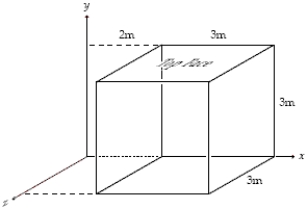
N/C where y is in m. What is the magnitude of the electric flux through the top face of the cube shown? (Multiple Choice)
4.8/5 (75)
(75) Three infinite planes of charge, A, B and C, are vertical and parallel to one another. There is a uniform electric field  to the left of plane A and a uniform electric field
 to the right of plane C. The field
 points to the left and the field
 points to the right. The signs of the charges on plates A, B and C may be
to the left of plane A and a uniform electric field to the right of plane C. The field points to the left and the field points to the right. The signs of the charges on plates A, B and C may be (Multiple Choice)
4.8/5 (84)
(84) A 5.0-nC point charge is embedded at the center of a nonconducting sphere (radius = 2.0 cm) which has a charge of −8.0 nC distributed uniformly throughout its volume. What is the magnitude of the electric field at a point that is 1.0 cm from the center of the sphere?
(Multiple Choice)
4.9/5 (82)
(82) A charge of 5.0 pC is distributed uniformly on a spherical surface (radius = 2.0 cm), and a second charge of −2.0 pC is distributed uniformly on a concentric spherical surface (radius = 4.0 cm). Determine the magnitude of the electric field 3.0 cm from the center of the two surfaces.
(Multiple Choice)
4.9/5 (83)
(83) An uncharged spherical conducting shell surrounds a charge −q at the center of the shell. The charges on the inner and outer surfaces of the shell are respectively
(Multiple Choice)
4.8/5 (77)
(77) A uniform linear charge of 2.0 nC/m is distributed along the x axis from x = 0 to x = 3 m. Which of the following integrals is correct for the y component of the electric field at y = 4 m on the y axis?
(Multiple Choice)
4.9/5 (82)
(82) Whitney says that Gauss's Law can be used to find the electric field of a sufficiently symmetrical distribution of charge as long as  over the whole Gaussian surface. Algie says that the electric field must be a constant vector over the entire Gaussian surface. Which one, if either, is correct?
 (Multiple Choice)
4.8/5 (82)
(82) 
Filters
- Essay(0)
- Multiple Choice(0)
- Short Answer(0)
- True False(0)
- Matching(0)