



 Chat with AI
Exam 31: Faradays Law

Exam 1: Physics and Measurement25 Questions
Exam 2: Motion in One Dimension66 Questions
Exam 3: Vectors47 Questions
Exam 4: Motion in Two Dimensions79 Questions
Exam 5: The Laws of Motion113 Questions
Exam 6: Circular Motion and Other Applications of Newtons Laws55 Questions
Exam 7: Energy of a System74 Questions
Exam 8: Conservation of Energy84 Questions
Exam 9: Linear Momentum and Collisions89 Questions
Exam 10: Rotation of a Rigid Object About a Fixed Axis82 Questions
Exam 11: Angular Momentum46 Questions
Exam 12: Static Equilibrium and Elasticity34 Questions
Exam 13: Universal Gravitation47 Questions
Exam 14: Fluid Mechanics53 Questions
Exam 15: Oscillatory Motion41 Questions
Exam 16: Wave Motion82 Questions
Exam 18: Superposition and Standing Waves72 Questions
Exam 19: Temperature47 Questions
Exam 20: The First Law of Thermodynamics61 Questions
Exam 21: The Kinetic Theory of Gases38 Questions
Exam 22: Heat Engines, Entropy, and the Second Law of Thermodynamics55 Questions
Exam 23: Electric Fields67 Questions
Exam 24: Gausss Law82 Questions
Exam 25: Electric Potential111 Questions
Exam 26: Capacitance and Dielectrics63 Questions
Exam 27: Current and Resistance34 Questions
Exam 28: Direct-Current Circuits84 Questions
Exam 29: Magnetic Fields80 Questions
Exam 30: Sources of the Magnetic Field95 Questions
Exam 31: Faradays Law62 Questions
Exam 32: Inductance23 Questions
Exam 33: Alternating-Current Circuits65 Questions
Exam 34: Electromagnetic Waves40 Questions
Exam 35: The Nature of Light and the Principles of Ray Optics37 Questions
Exam 36: Image Formation43 Questions
Exam 37: Wave Optics48 Questions
Exam 38: Diffraction Patterns and Polarization47 Questions
Exam 39: Relativity34 Questions
Exam 40: Introduction to Quantum Physics48 Questions
Exam 41: Quantum Mechanics33 Questions
Exam 42: Atomic Physics59 Questions
Exam 43: Molecules and Solids46 Questions
Exam 44: Nuclear Structure89 Questions
Exam 46: Particle Physics and Cosmology34 Questions
Select questions type


A small airplane with a wing span of 12 m flies horizontally and due north at a speed of 60 m/s in a region where the magnetic field of the earth is 60 μT directed 60° below the horizontal. What is the magnitude of the induced emf between the ends of the wing?
(Multiple Choice)
4.8/5  (77)
(77) The coil shown in the figure has 2 turns, a cross-sectional area of 0.20 m2, and a field (parallel to the axis of the coil) with a magnitude given by B = (4.0 + 3.0t2) T, where t is in s. What is the potential difference, VA − VC, at t = 3.0 s? 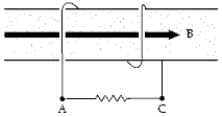
(Multiple Choice)
4.8/5 (79)
(79) In a region of space where the magnetic field of the earth has a magnitude of 80 μT and is directed 30° below the horizontal, a 50-cm length of wire oriented horizontally along an east-west direction is moved horizontally to the south with a speed of 20 m/s. What is the magnitude of the induced potential difference between the ends of this wire?
(Multiple Choice)
4.9/5 (67)
(67) As shown below, a square loop of wire of side a moves through a uniform magnetic field of magnitude B perpendicular to the page at constant velocity  directed to the right. Which statement regarding the electric field induced in the wires is correct for the wires at the left and right sides of the loop?
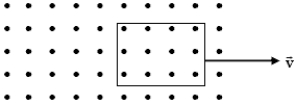
directed to the right. Which statement regarding the electric field induced in the wires is correct for the wires at the left and right sides of the loop? (Multiple Choice)
4.8/5 (76)
(76) The magnetic flux through a loop perpendicular to a uniform magnetic field will change
(Multiple Choice)
4.9/5 (79)
(79) A conducting rectangular loop of mass M, resistance R, and dimensions a × b is allowed to fall from rest through a uniform magnetic field which is perpendicular to the plane of the loop. The loop accelerates until it reaches a terminal speed (before the upper end enters the magnetic field). If a = 2.0 m, B = 6.0 T, R = 40 Ω, and M = 0.60 kg, what is the terminal speed? 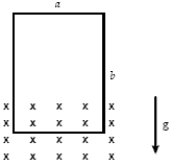
(Multiple Choice)
5.0/5 (86)
(86) A metal blade spins at a constant rate of 5.0 revolutions per second about a pivot through one end of the blade. This rotation occurs in a region where the component of the earth's magnetic field perpendicular to the blade is 30 μT. If the blade is 60 cm in length, what is the magnitude of the potential difference between its ends?
(Multiple Choice)
4.9/5 (72)
(72) A circular loop (area = 0.20 m2) turns in a uniform magnetic field with B = 0.13 T. At an instant when the angle between the magnetic field and the normal to the plane of the loop is (π) rads and is decreasing at the rate of 0.50 rad/s, what is the magnitude of the emf induced in the loop?
(Multiple Choice)
4.8/5 (81)
(81) A coil is wrapped with 300 turns of wire on the perimeter of a square frame (side length = 20 cm). Each turn has the same area as the frame, and the total resistance of the coil is 1.5 Ω. A uniform magnetic field perpendicular to the plane of the coil changes in magnitude at a constant rate from 0.50 T to 0.90 T in 2.0 s. What is the magnitude of the induced emf in the coil while the field is changing?
(Multiple Choice)
4.8/5 (76)
(76) A conducting bar moves as shown near a long wire carrying a constant 80-A current. If a = 1.0 mm, b = 20 mm, and v = 5.0 m/s, what is the potential difference, Va − Vb? 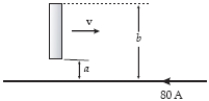
(Multiple Choice)
4.8/5 (68)
(68) A flat coil of wire consisting of 20 turns, each with an area of 50 cm2, is positioned perpendicularly to a uniform magnetic field that increases its magnitude at a constant rate from 2.0 T to 6.0 T in 2.0 s. If the coil has a total resistance of 0.40 Ω, what is the magnitude of the induced current?
(Multiple Choice)
4.8/5 (70)
(70) A conducting bar of length L rotates in a counterclockwise direction with a constant angular speed of +2.0 rad/s about a pivot P at one end, as shown. A uniform magnetic field (magnitude = 0.20 T) is directed into the paper. If L = 0.40 m, what is the potential difference, VA − VB? 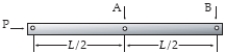
(Multiple Choice)
4.9/5 (70)
(70) A long solenoid (n = 1 500 turns/m) has a cross-sectional area of 0.40 m2 and a current given by I = (4.0 + 3.0t2) A, where t is in seconds. A flat circular coil (N = 300 turns) with a cross-sectional area of 0.15 m2 is inside and coaxial with the solenoid. What is the magnitude of the emf induced in the coil at t = 2.0 s?
(Multiple Choice)
4.8/5 (75)
(75) A rectangular wire loop (length = 60 cm, width = 40 cm) lies completely within a perpendicular and uniform magnetic field of magnitude of 0.5 T. If the length of the loop starts increasing at a rate of 20 mm/s at time t = 0, while the width is decreasing at the same rate, what is the magnitude of the induced emf at time t = 4.0 s?
(Multiple Choice)
4.8/5 (80)
(80) A metal blade (length = 80 cm) spins at a constant rate of 10 radians/s about a pivot at one end. A uniform magnetic field of 2.0 mT is directed at an angle of 30° with the plane of the rotation. What is the magnitude of the potential difference between the two ends of the blade?
(Multiple Choice)
4.9/5 (75)
(75) Starting outside the region with the magnetic field, a single square coil of wire moves across the region with a uniform magnetic field  perpendicular to the page. The loop moves at constant velocity
 . As seen from above, a counterclockwise emf is regarded as positive. Roger claims that the graph shown below represents the induced emf. Martin says he's wrong. In which direction did the loop move over the plane of the page, or is Martin correct?
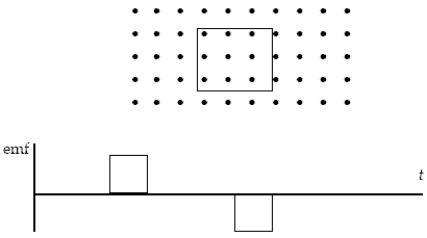
perpendicular to the page. The loop moves at constant velocity . As seen from above, a counterclockwise emf is regarded as positive. Roger claims that the graph shown below represents the induced emf. Martin says he's wrong. In which direction did the loop move over the plane of the page, or is Martin correct? (Multiple Choice)
4.8/5 (75)
(75) A long straight wire is parallel to one edge and is in the plane of a single-turn rectangular loop as shown. If the loop is moving in the plane shown so that the distance x changes at a constant rate of 20 cm/s, what is the magnitude of the emf induced in the loop at the instant x = 5.0 cm? Let I = 50 A, a = 50 cm, b = 6.0 cm. 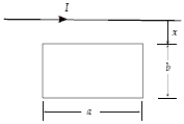
(Multiple Choice)
4.9/5 (67)
(67) 
Filters
- Essay(0)
- Multiple Choice(0)
- Short Answer(0)
- True False(0)
- Matching(0)