



 Chat with AI
Exam 37: Wave Optics

Exam 1: Physics and Measurement25 Questions
Exam 2: Motion in One Dimension66 Questions
Exam 3: Vectors47 Questions
Exam 4: Motion in Two Dimensions79 Questions
Exam 5: The Laws of Motion113 Questions
Exam 6: Circular Motion and Other Applications of Newtons Laws55 Questions
Exam 7: Energy of a System74 Questions
Exam 8: Conservation of Energy84 Questions
Exam 9: Linear Momentum and Collisions89 Questions
Exam 10: Rotation of a Rigid Object About a Fixed Axis82 Questions
Exam 11: Angular Momentum46 Questions
Exam 12: Static Equilibrium and Elasticity34 Questions
Exam 13: Universal Gravitation47 Questions
Exam 14: Fluid Mechanics53 Questions
Exam 15: Oscillatory Motion41 Questions
Exam 16: Wave Motion82 Questions
Exam 18: Superposition and Standing Waves72 Questions
Exam 19: Temperature47 Questions
Exam 20: The First Law of Thermodynamics61 Questions
Exam 21: The Kinetic Theory of Gases38 Questions
Exam 22: Heat Engines, Entropy, and the Second Law of Thermodynamics55 Questions
Exam 23: Electric Fields67 Questions
Exam 24: Gausss Law82 Questions
Exam 25: Electric Potential111 Questions
Exam 26: Capacitance and Dielectrics63 Questions
Exam 27: Current and Resistance34 Questions
Exam 28: Direct-Current Circuits84 Questions
Exam 29: Magnetic Fields80 Questions
Exam 30: Sources of the Magnetic Field95 Questions
Exam 31: Faradays Law62 Questions
Exam 32: Inductance23 Questions
Exam 33: Alternating-Current Circuits65 Questions
Exam 34: Electromagnetic Waves40 Questions
Exam 35: The Nature of Light and the Principles of Ray Optics37 Questions
Exam 36: Image Formation43 Questions
Exam 37: Wave Optics48 Questions
Exam 38: Diffraction Patterns and Polarization47 Questions
Exam 39: Relativity34 Questions
Exam 40: Introduction to Quantum Physics48 Questions
Exam 41: Quantum Mechanics33 Questions
Exam 42: Atomic Physics59 Questions
Exam 43: Molecules and Solids46 Questions
Exam 44: Nuclear Structure89 Questions
Exam 46: Particle Physics and Cosmology34 Questions
Select questions type


In a double-slit experiment using light of wavelength 486 nm, the slit spacing is 0.600 mm and the screen is 2.00 m from the slits. Find the distance along the screen between adjacent bright fringes.
(Short Answer)
5.0/5  (79)
(79) When a central dark fringe is observed in reflection in a circular interference pattern, waves reflected from the upper and lower surfaces of the medium must have a phase difference, in radians, of
(Multiple Choice)
4.9/5 (86)
(86) The superposition of two waves E1 = E0 sin(ωt) and E2 = E0 sin(ωt + φ) arriving at the same point in space at the same time is E =
(Multiple Choice)
4.7/5 (73)
(73) The figures below represent interference fringes. The distances from the screen to the slits is the same for each figure, and the planes of the screen and the slits are parallel. Which figure(s) represent(s) slits with the smallest spacing d between the slits? The white spaces represent the interference maxima. 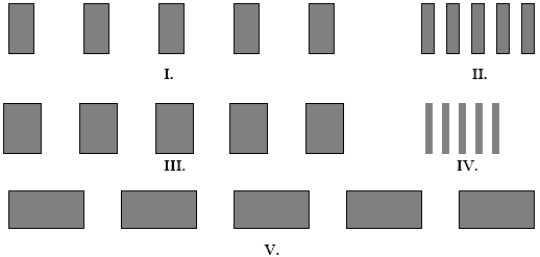
(Multiple Choice)
4.8/5 (84)
(84) Bright and dark fringes are seen on a screen when light from a single source reaches two narrow slits a short distance apart. Each bright fringe will shift to the location of the adjacent bright fringe if a thin film is placed in front of one of the slits. The minimum thickness of this film must be
(Multiple Choice)
4.9/5 (85)
(85) The electric fields arriving at a point P from three coherent sources are described by E1 = E0 sin ωt, E2 = E0 sin (ωt + π/4) and E3 = E0 sin (ωt + π/2). Assume the resultant field is represented by Ep = ER sin (ωt + α). The amplitude of the resultant wave at P is
(Multiple Choice)
4.8/5 (81)
(81) A planar cross section through two spherical waves emanating from the sources S1 and S2 in the plane is shown in the figure. The black circles are one and two wavelengths from their respective sources. The lighter circles are one half and one and a half wavelengths distant from their respective sources. If the phase at S1 and S2 is zero at this instant, and the waves shown arriving at P2 both arrive with amplitude A, the difference in phase angle at point P2 (in radians) is 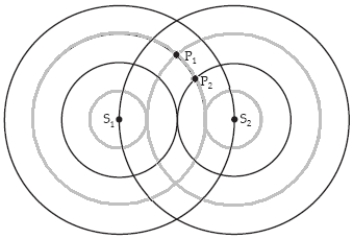
(Multiple Choice)
5.0/5 (80)
(80) A uniform film of oil (n = 1.31) is floating on water. When sunlight in air is incident normally on the film, an observer finds that the reflected light has a brightness maximum at λ = 450 nm and a brightness minimum at λ = 600 nm. What is the thickness of the oil film?
(Short Answer)
4.7/5 (83)
(83) A planar cross section through two spherical waves emanating from the sources S1 and S2 in the plane is shown in the figure. The black circles are one and two wavelengths from their respective sources. The lighter circles are one half and one and a half wavelengths distant from their respective sources. If the phase at S1 and S2 is zero at this instant, and the waves shown arriving at P1 both arrive with amplitude A, the magnitude of the phase angle of each wave at point P1 (in radians) is 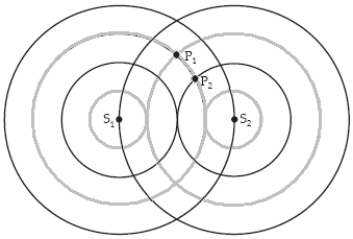
(Multiple Choice)
4.8/5 (89)
(89) A planar cross section through two spherical waves emanating from the sources S1 and S2 in the plane is shown in the figure. S1 and S2 are in phase. The black circles are one and two wavelengths from their respective sources. The lighter circles are one half and one and a half wavelengths distant from their respective sources. If the waves shown arriving at P1 both arrive with amplitude A, the resultant amplitude at point P1 is 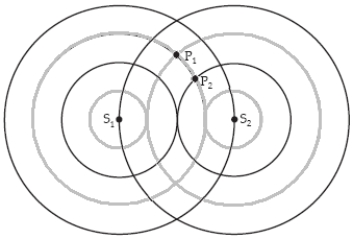
(Multiple Choice)
4.7/5 (97)
(97) A film of index of refraction n1 coats a surface with index of refraction n2. When n1 < n2, the condition for constructive interference for reflected monochromatic light of wavelength λ in air is
(Multiple Choice)
4.8/5 (80)
(80) Monochromatic light (λ = 500 nm) is incident on a soap bubble (n = 1.40). What is the wavelength of the light (in nm) in the bubble film?
(Multiple Choice)
4.8/5 (83)
(83) The figures below represent interference fringes. The distances from the screen to the slits is the same for each figure, and the planes of the screen and the slits are parallel. Which figure(s) represent(s) slits with the greatest spacing d between the slits? The white spaces represent the interference maxima. 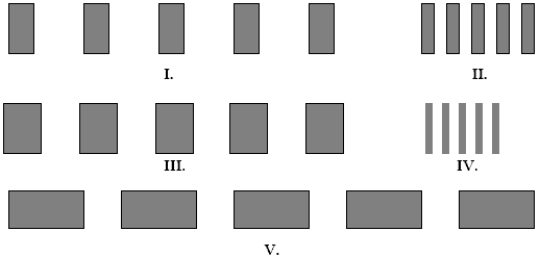
(Multiple Choice)
4.8/5 (80)
(80) The figures below represent interference fringes. The distances from the screen to the slits is the same for each figure, and the planes of the screen and the slits are parallel. In each figure the spacing d between the slits is the same. Which figure(s) represent(s) slits illuminated with light of the shortest wavelength λ? The white spaces represent the interference maxima. 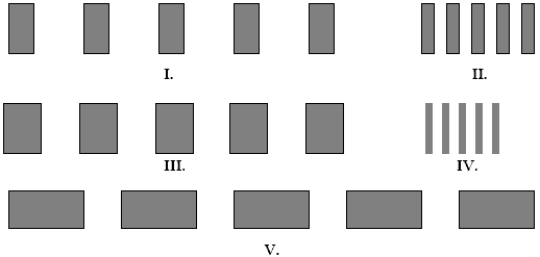
(Multiple Choice)
4.8/5 (71)
(71) Light is incident on a double-slit. The fourth bright band has an angular distance of 7.0° from the central maximum. What is the distance between the slits (in μm)? (Assume the frequency of the light is 5.4 × 10¹⁴ Hz.)
(Multiple Choice)
4.9/5 (72)
(72) Monochromatic light (λ = 500 nm) is incident on a soap bubble (n = 1.4) that is 500-nm thick. Calculate the change of phase of the light that penetrates the front surface, reflects from the second surface, and emerges through the first surface as an angle between 0° and 360°?
(Multiple Choice)
5.0/5 (78)
(78) Estimate the distance (in cm) between the central bright region and the third dark fringe on a screen 5.00 m from two double slits 0.500 mm apart illuminated by 500-nm light.
(Multiple Choice)
4.8/5 (84)
(84) In a double slit experiment, the distance between the slits is 0.2 mm and the distance to the screen is 150 cm. What is the phase difference (in degrees) between the waves from the two slits arriving at a point P when the angular distance of P is 10° relative to the central peak, and the wavelength is 500 nm? (Convert your result so the angle is between 0 and 360°.)
(Multiple Choice)
4.8/5 (77)
(77) The light reflected from a soap bubble (n = 1.40) appears red (λ = 640 nm) at its center. What is the minimum thickness (in nm)?
(Multiple Choice)
4.9/5 (88)
(88) When the adjustable mirror on the Michelson interferometer is moved 20 wavelengths, how many fringe pattern shifts would be counted?
(Multiple Choice)
4.9/5 (70)
(70) 
Filters
- Essay(0)
- Multiple Choice(0)
- Short Answer(0)
- True False(0)
- Matching(0)