



 Chat with AI
Exam 41: Quantum Mechanics

Exam 1: Physics and Measurement25 Questions
Exam 2: Motion in One Dimension66 Questions
Exam 3: Vectors47 Questions
Exam 4: Motion in Two Dimensions79 Questions
Exam 5: The Laws of Motion113 Questions
Exam 6: Circular Motion and Other Applications of Newtons Laws55 Questions
Exam 7: Energy of a System74 Questions
Exam 8: Conservation of Energy84 Questions
Exam 9: Linear Momentum and Collisions89 Questions
Exam 10: Rotation of a Rigid Object About a Fixed Axis82 Questions
Exam 11: Angular Momentum46 Questions
Exam 12: Static Equilibrium and Elasticity34 Questions
Exam 13: Universal Gravitation47 Questions
Exam 14: Fluid Mechanics53 Questions
Exam 15: Oscillatory Motion41 Questions
Exam 16: Wave Motion82 Questions
Exam 18: Superposition and Standing Waves72 Questions
Exam 19: Temperature47 Questions
Exam 20: The First Law of Thermodynamics61 Questions
Exam 21: The Kinetic Theory of Gases38 Questions
Exam 22: Heat Engines, Entropy, and the Second Law of Thermodynamics55 Questions
Exam 23: Electric Fields67 Questions
Exam 24: Gausss Law82 Questions
Exam 25: Electric Potential111 Questions
Exam 26: Capacitance and Dielectrics63 Questions
Exam 27: Current and Resistance34 Questions
Exam 28: Direct-Current Circuits84 Questions
Exam 29: Magnetic Fields80 Questions
Exam 30: Sources of the Magnetic Field95 Questions
Exam 31: Faradays Law62 Questions
Exam 32: Inductance23 Questions
Exam 33: Alternating-Current Circuits65 Questions
Exam 34: Electromagnetic Waves40 Questions
Exam 35: The Nature of Light and the Principles of Ray Optics37 Questions
Exam 36: Image Formation43 Questions
Exam 37: Wave Optics48 Questions
Exam 38: Diffraction Patterns and Polarization47 Questions
Exam 39: Relativity34 Questions
Exam 40: Introduction to Quantum Physics48 Questions
Exam 41: Quantum Mechanics33 Questions
Exam 42: Atomic Physics59 Questions
Exam 43: Molecules and Solids46 Questions
Exam 44: Nuclear Structure89 Questions
Exam 46: Particle Physics and Cosmology34 Questions
Select questions type


A particle is in the first excited state of a one-dimensional box of length 1.0 m. What is the minimum value of its momentum (in kg ⋅ m/s)?
(Multiple Choice)
4.9/5  (71)
(71) If the interaction of a particle with its environment restricts the particle to a finite region of space, the result is the quantization of ____ of the particle.
(Multiple Choice)
4.8/5 (84)
(84) A particle is in the second excited state of a one-dimensional box of length 1.0 m. What is its momentum (in kg ⋅ m/s)?
(Multiple Choice)
5.0/5 (87)
(87) The graph below represents a wave function ψ(x) for a particle confined to −4.00 m ≤ x ≤ +4.00 m. The magnitude of the normalization constant A is 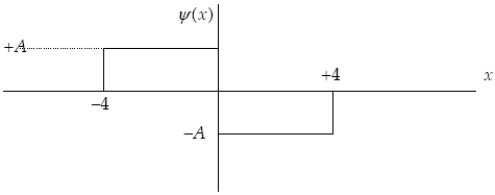
(Multiple Choice)
4.8/5 (72)
(72) What is the quantum number n of a particle of mass m confined to a one-dimensional box of length L when its momentum is 4h/L?
(Multiple Choice)
4.9/5 (80)
(80) A particle in a finite potential well has energy E, as shown below. 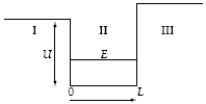 The wave function in region II where x > 0 has the form ψII =
 (Multiple Choice)
4.9/5 (91)
(91) The graph below represents a wave function ψ(x) for a particle confined to −2.00 m ≤ x ≤ +2.00 m. The value of the normalization constant A may be 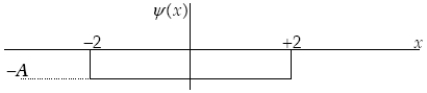
(Multiple Choice)
4.9/5 (75)
(75) The wave function for a particle confined to a one-dimensional box located between x = 0 and x = L is given by Ψ(x) = A sin (nπx/L) + B cos (nπx/L) . The constants A and B are determined to be
(Multiple Choice)
4.7/5 (74)
(74) The wave function for a particle in a box of length L is given by 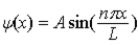 . If the box extends from x = 0 to x = L, What is the probability of finding the particle between x = 0.60 L and x = 0.70 L?
 (Multiple Choice)
4.8/5 (88)
(88) The wave function ψ(x) of a particle confined to 0 ≤ x ≤ L is given by ψ(x) = Ax. ψ(x) = 0 for x < 0 and x > L. When the wave function is normalized, the probability density at coordinate x has the value
(Multiple Choice)
4.7/5 (88)
(88) A particle in a finite potential well has energy E, as shown below. 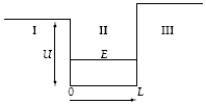 The wave function in region III where x > L has the form ψIII =
 (Multiple Choice)
4.9/5 (72)
(72) Classically, the concept of "tunneling" is impossible. Why?
(Multiple Choice)
4.7/5 (73)
(73) 
Filters
- Essay(0)
- Multiple Choice(0)
- Short Answer(0)
- True False(0)
- Matching(0)