



 Chat with AI
Exam 4: Motion in Two Dimensions

Exam 1: Physics and Measurement25 Questions
Exam 2: Motion in One Dimension66 Questions
Exam 3: Vectors47 Questions
Exam 4: Motion in Two Dimensions79 Questions
Exam 5: The Laws of Motion113 Questions
Exam 6: Circular Motion and Other Applications of Newtons Laws55 Questions
Exam 7: Energy of a System74 Questions
Exam 8: Conservation of Energy84 Questions
Exam 9: Linear Momentum and Collisions89 Questions
Exam 10: Rotation of a Rigid Object About a Fixed Axis82 Questions
Exam 11: Angular Momentum46 Questions
Exam 12: Static Equilibrium and Elasticity34 Questions
Exam 13: Universal Gravitation47 Questions
Exam 14: Fluid Mechanics53 Questions
Exam 15: Oscillatory Motion41 Questions
Exam 16: Wave Motion82 Questions
Exam 18: Superposition and Standing Waves72 Questions
Exam 19: Temperature47 Questions
Exam 20: The First Law of Thermodynamics61 Questions
Exam 21: The Kinetic Theory of Gases38 Questions
Exam 22: Heat Engines, Entropy, and the Second Law of Thermodynamics55 Questions
Exam 23: Electric Fields67 Questions
Exam 24: Gausss Law82 Questions
Exam 25: Electric Potential111 Questions
Exam 26: Capacitance and Dielectrics63 Questions
Exam 27: Current and Resistance34 Questions
Exam 28: Direct-Current Circuits84 Questions
Exam 29: Magnetic Fields80 Questions
Exam 30: Sources of the Magnetic Field95 Questions
Exam 31: Faradays Law62 Questions
Exam 32: Inductance23 Questions
Exam 33: Alternating-Current Circuits65 Questions
Exam 34: Electromagnetic Waves40 Questions
Exam 35: The Nature of Light and the Principles of Ray Optics37 Questions
Exam 36: Image Formation43 Questions
Exam 37: Wave Optics48 Questions
Exam 38: Diffraction Patterns and Polarization47 Questions
Exam 39: Relativity34 Questions
Exam 40: Introduction to Quantum Physics48 Questions
Exam 41: Quantum Mechanics33 Questions
Exam 42: Atomic Physics59 Questions
Exam 43: Molecules and Solids46 Questions
Exam 44: Nuclear Structure89 Questions
Exam 46: Particle Physics and Cosmology34 Questions
Select questions type


At t = 0, a particle leaves the origin with a velocity of 9.0 m/s in the positive y direction and moves in the xy plane with a constant acceleration of (2.0i − 4.0j) m/s2. At the instant the x coordinate of the particle is 15 m, what is the speed of the particle?
(Multiple Choice)
4.8/5  (84)
(84) A hunter wishes to cross a river that is 1.5 km wide and flows with a velocity of 5.0 km/h parallel to its banks. The hunter uses a small powerboat that moves at a maximum speed of 12 km/h with respect to the water. What is the minimum time for crossing?
(Short Answer)
4.8/5 (96)
(96) A student in the front of a school bus tosses a ball to another student in the back of the bus while the bus is moving forward at constant velocity. The speed of the ball as seen by a stationary observer in the street:
(Multiple Choice)
4.9/5 (80)
(80) Jane plans to fly from Binghampton, New York, to Springfield, Massachusetts, about 280 km due east of Binghampton. She heads due east at 280 km/h for one hour but finds herself at Keene, which is 294 km from Binghampton in a direction 17.8 degrees north of due east. What was the wind velocity?
(Multiple Choice)
4.9/5 (79)
(79) At t = 0, a particle leaves the origin with a velocity of 12 m/s in the positive x direction and moves in the xy plane with a constant acceleration of 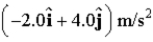 . At the instant the y coordinate of the particle is 18 m, what is the x coordinate of the particle?
 (Multiple Choice)
4.9/5 (72)
(72) A particle starts from the origin at t = 0 with a velocity of (16  − 12
 ) m/s and moves in the xy plane with a constant acceleration of
 = (3.0
 − 6.0
 ) m/s2. What is the speed of the particle at t = 2.0 s?
− 12 ) m/s and moves in the xy plane with a constant acceleration of = (3.0 − 6.0 ) m/s2. What is the speed of the particle at t = 2.0 s? (Multiple Choice)
4.8/5 (83)
(83) A car travels in an oval path as shown below.  = 25 m/s, West, and
 = 20 m/s, North. The ratio of the magnitude of the centripetal acceleration at B to that at A,
 , is:
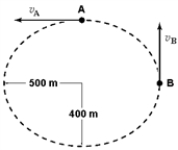
= 25 m/s, West, and = 20 m/s, North. The ratio of the magnitude of the centripetal acceleration at B to that at A, , is: (Multiple Choice)
4.8/5 (79)
(79) Given the equations below, which description best fits the physical situation? 
(Multiple Choice)
4.8/5 (96)
(96) A ball is thrown horizontally from the top of a building 0.10 km high. The ball strikes the ground at a point 65 m horizontally away from and below the point of release. What is the speed of the ball just before it strikes the ground?
(Multiple Choice)
4.8/5 (85)
(85) A rock is thrown from the edge of the top of a 100-ft tall building at some unknown angle above the horizontal. The rock strikes the ground a horizontal distance of 160 ft from the base of the building 5.0 s after being thrown. Assume that the ground is level and that the side of the building is vertical. Determine the speed with which the rock was thrown.
(Multiple Choice)
4.8/5 (75)
(75) A particle moves along a circular path having a radius of 2.0 m. At an instant when the speed of the particle is equal to 3.0 m/s and changing at the rate of 5.0 m/s2, what is the magnitude of the total acceleration of the particle?
(Multiple Choice)
4.7/5 (58)
(58) The initial speed of a cannon ball is 0.20 km/s. If the ball is to strike a target that is at a horizontal distance of 3.0 km from the cannon, what is the minimum time of flight for the ball?
(Multiple Choice)
4.8/5 (66)
(66) At t = 0, a particle leaves the origin with a velocity of 5.0 m/s in the positive y direction. Its acceleration is given by  = (3.0
 − 2.0
 ) m/s2. At the instant the particle reaches its maximum y coordinate how far is the particle from the origin?
= (3.0 − 2.0 ) m/s2. At the instant the particle reaches its maximum y coordinate how far is the particle from the origin? (Multiple Choice)
4.9/5 (72)
(72) Car A leaves point O at t = 0 and travels a quarter circle counterclockwise at 30.0 m/s to point P. Car B will leave point O and travel to point P at the same speed but in a straight line. The radius of the circle is 100 m. At what time should car B leave point O in order to arrive at point P at the same time as car A?
(Multiple Choice)
4.7/5 (80)
(80) A car travels in a flat circle of radius R. At a certain instant the velocity of the car is 20 m/s north, and the total acceleration of the car is 2.5 m/s2 37° south of west. Which of the following is correct?
(Multiple Choice)
4.7/5 (68)
(68) The site from which an airplane takes off is the origin. The x axis points east; the y axis points straight up. The position and velocity vectors of the plane at a later time are given by  and
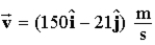 . The magnitude, in meters, of the plane's displacement from the origin is
and . The magnitude, in meters, of the plane's displacement from the origin is (Multiple Choice)
4.9/5 (71)
(71) A track star in the broad jump goes into the jump at 12 m/s and launches himself at 20° above the horizontal. How long is he in the air before returning to Earth?
(Short Answer)
4.7/5 (75)
(75) While the gondola is rising at a speed of 5.0 m/s, a passenger in a balloon-supported gondola throws a small ball up at a speed of 2.0 m/s relative to his body. A person who measures the ball's velocity at the instant of release will find that the ball's velocity relative to the ground at that instant is
(Multiple Choice)
4.9/5 (84)
(84) Which of the following quantities is directly proportional to the time interval after a projectile has left the barrel that shot it out? The x axis is horizontal; the y axis is vertically upward.
(Multiple Choice)
4.7/5 (82)
(82) 
Filters
- Essay(0)
- Multiple Choice(0)
- Short Answer(0)
- True False(0)
- Matching(0)